



 Chat with AI
Exam 15: Monopoly

Exam 1: Ten Lessons From Economics149 Questions
Exam 2: Thinking Like an Economist147 Questions
Exam 3: Interdependence and the Gains From Trade153 Questions
Exam 4: The Market Forces of Supply and Demand222 Questions
Exam 5: Elasticity and Its Application181 Questions
Exam 6: Supply, Demand and Government Policies148 Questions
Exam 7: Consumers, Producers and the Efficiency of Markets177 Questions
Exam 8: Application: The Costs of Taxation141 Questions
Exam 9: Application: International Trade161 Questions
Exam 10: Externalities199 Questions
Exam 11: Public Goods and Common Resources182 Questions
Exam 12: The Design of the Tax System154 Questions
Exam 13: The Costs of Production191 Questions
Exam 14: Firms in Competitive Markets200 Questions
Exam 15: Monopoly214 Questions
Exam 16: Business Strategy184 Questions
Exam 17: Competition Policy104 Questions
Exam 18: Monopolistic Competition214 Questions
Exam 19: The Markets for the Factors of Production215 Questions
Exam 20: Earnings, Unions and Discrimination206 Questions
Exam 21: Income Inequity and Poverty111 Questions
Exam 22: The Theory of Consumer Choice161 Questions
Exam 23: Frontiers of Microeconomics120 Questions
Exam 24: Measuring a Nations Income51 Questions
Exam 25: Measuring the Cost of Living52 Questions
Exam 26: Production and Growth62 Questions
Exam 27: Saving, Investment and the Financial System62 Questions
Exam 28: The Natural Rate of Unemployment59 Questions
Exam 29: The Monetary System66 Questions
Exam 30: Inflation: Its Causes and Costs74 Questions
Exam 31: Open-Economy Macroeconomics: Basic Concepts68 Questions
Exam 32: A Macroeconomic Theory of the Open Economy64 Questions
Exam 33: Aggregate Demand and Aggregate Supply82 Questions
Exam 34: The Influence of Monetary and Fiscal Policy on Aggregate Demand73 Questions
Exam 35: The Short-Run Trade-Off Between Inflation and Unemployment58 Questions
Exam 36: Five Debates Over Macroeconomic Policy38 Questions
Select questions type


Graph 15-6
 This graph depicts the demand, marginal-revenue and marginal-cost curves of a profit-maximising monopolist. Use the graph to answer the following question(s).
-Refer to Graph 15-6. What is the deadweight loss equal to when the monopolist engages in perfect price discrimination?
This graph depicts the demand, marginal-revenue and marginal-cost curves of a profit-maximising monopolist. Use the graph to answer the following question(s).
-Refer to Graph 15-6. What is the deadweight loss equal to when the monopolist engages in perfect price discrimination? (Multiple Choice)
4.8/5  (82)
(82) Khan is a wholesale imported fish distributor. He sells his imported fish to all the restaurants in town and he is the only distributor of a specialty imported fish. Assuming that Khan is maximising his profit, which of the following statements is true?
(Multiple Choice)
4.8/5 (65)
(65) It doesn't make sense to talk about a monopolist's supply curve.
(True/False)
4.9/5 (71)
(71) A monopoly can generate a deadweight loss to society by exploiting monopoly pricing. This means potentially beneficial trades do not occur.
(True/False)
4.8/5 (71)
(71) Price discrimination is a rational strategy for a profit-maximising monopolist when:
(Multiple Choice)
5.0/5 (81)
(81) A monopoly is likely to occur if it is the incumbent firm and there are significant barriers to entry.
(True/False)
5.0/5 (73)
(73) An appropriate way to measure the economic inefficiency of a monopoly is the:
(Multiple Choice)
4.8/5 (78)
(78) When a monopolist increases the number of units it sells, there are two effects on revenue, the:
(Multiple Choice)
4.9/5 (72)
(72) Is a publisher of a hugely popular book able to exercise monopoly power?
(Essay)
4.7/5 (83)
(83) When a local grocery store offers discount coupons in the Sunday paper, it is most likely trying to:
(Multiple Choice)
4.8/5 (81)
(81) Table 15-1
 -Refer to Table 15-1. If the monopolist sells eight units of its product, how much revenue will it receive from the sale?
 (Multiple Choice)
4.9/5 (81)
(81) Firms with substantial monopoly power are quite common, because many goods are truly unique.
(True/False)
4.8/5 (63)
(63) Graph 15-4
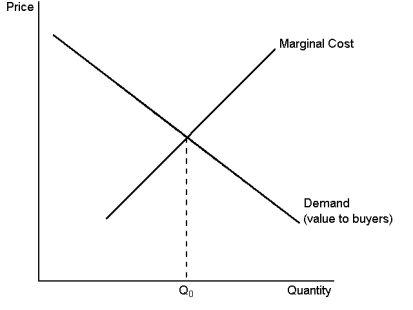 This graph depicts the demand and marginal-cost curves of a profit-maximising monopolist. Use the graph to answer the following question(s).
-Refer to Graph 15-4. If the monopoly operates at an output level below Q0, decreasing output would:
This graph depicts the demand and marginal-cost curves of a profit-maximising monopolist. Use the graph to answer the following question(s).
-Refer to Graph 15-4. If the monopoly operates at an output level below Q0, decreasing output would: (Multiple Choice)
4.9/5 (90)
(90) When deciding what price to charge consumers, the monopolist may choose to charge them different prices based on:
(Multiple Choice)
4.8/5 (89)
(89) For price discrimination to be feasible it is necessary for the firm to:
(Multiple Choice)
4.8/5 (80)
(80) 
Filters
- Essay(0)
- Multiple Choice(0)
- Short Answer(0)
- True False(0)
- Matching(0)