



 Chat with AI
Exam 15: Monopoly

Exam 1: Ten Lessons From Economics149 Questions
Exam 2: Thinking Like an Economist147 Questions
Exam 3: Interdependence and the Gains From Trade153 Questions
Exam 4: The Market Forces of Supply and Demand222 Questions
Exam 5: Elasticity and Its Application181 Questions
Exam 6: Supply, Demand and Government Policies148 Questions
Exam 7: Consumers, Producers and the Efficiency of Markets177 Questions
Exam 8: Application: The Costs of Taxation141 Questions
Exam 9: Application: International Trade161 Questions
Exam 10: Externalities199 Questions
Exam 11: Public Goods and Common Resources182 Questions
Exam 12: The Design of the Tax System154 Questions
Exam 13: The Costs of Production191 Questions
Exam 14: Firms in Competitive Markets200 Questions
Exam 15: Monopoly214 Questions
Exam 16: Business Strategy184 Questions
Exam 17: Competition Policy104 Questions
Exam 18: Monopolistic Competition214 Questions
Exam 19: The Markets for the Factors of Production215 Questions
Exam 20: Earnings, Unions and Discrimination206 Questions
Exam 21: Income Inequity and Poverty111 Questions
Exam 22: The Theory of Consumer Choice161 Questions
Exam 23: Frontiers of Microeconomics120 Questions
Exam 24: Measuring a Nations Income51 Questions
Exam 25: Measuring the Cost of Living52 Questions
Exam 26: Production and Growth62 Questions
Exam 27: Saving, Investment and the Financial System62 Questions
Exam 28: The Natural Rate of Unemployment59 Questions
Exam 29: The Monetary System66 Questions
Exam 30: Inflation: Its Causes and Costs74 Questions
Exam 31: Open-Economy Macroeconomics: Basic Concepts68 Questions
Exam 32: A Macroeconomic Theory of the Open Economy64 Questions
Exam 33: Aggregate Demand and Aggregate Supply82 Questions
Exam 34: The Influence of Monetary and Fiscal Policy on Aggregate Demand73 Questions
Exam 35: The Short-Run Trade-Off Between Inflation and Unemployment58 Questions
Exam 36: Five Debates Over Macroeconomic Policy38 Questions
Select questions type


When the price of a good increases, which of the following happen(s) to the quantity sold for a monopoly firm? (i) customers are forced to buy at the higher price
(ii) quantity sold will stay the same
(iii) revenue will necessarily increase
(iv) quantity sold will fall
(Multiple Choice)
4.8/5  (74)
(74) Selling a good at a price where the demand curve intersects the marginal-cost curve is consistent with which of the following? (i) the market solution with competitive firms
(ii) the market solution with monopoly firms
(iii) the socially optimal level of output
(Multiple Choice)
4.9/5 (79)
(79) The De Beers Diamond company is not worried about differentiating their product from all the other gemstones.
(True/False)
4.8/5 (85)
(85) A natural monopoly can arise when a single firm has equal or greater average total costs than two or more firms.
(True/False)
4.7/5 (74)
(74) Black Box Pay TV is able to purchase an exclusive right to sell a premium movie channel (PMC) in its market area. Black Box pays $150 000 a year for the exclusive marketing rights to PMC. Since Black Box has already installed satellite dishes to all of the homes in its market area, the marginal cost of PMC to subscribers is zero. The manager of Black Box needs to know what price to charge for the PMC service in order to maximise her profit. Before setting the price, she hires an economist to estimate the demand for the PMC service. The economist discovers that there are two types of subscribers who value premium movie channels. First are the 4000 diehard TV viewers who will pay as much as $150 a year for the new PMC premium channel. Second, the PMC channel will appeal to about 20 000 occasional TV viewers who will pay as much as $20 a year for a subscription to PMC.
-According to the information provided, if Black Box Pay TV is able to price discriminate, what will be the maximum amount of profit it can generate?
(Multiple Choice)
4.9/5 (81)
(81) Compared to the output in a competitive market, monopoly pricing has the consequence of the market output being:
(Multiple Choice)
4.8/5 (60)
(60) The profit-maximising level of output for a monopoly firm is where:
(Multiple Choice)
4.9/5 (80)
(80) Discount coupons have the ability to help a supermarket price discriminate.
(True/False)
4.8/5 (77)
(77) Table 15-1
 -Refer to Table 15-1. What is the marginal revenue for the monopolist for the 6th unit sold?
 (Multiple Choice)
4.8/5 (83)
(83) Suppose monopoly firm has exclusive ownership of a key resource, this results in:
(Multiple Choice)
4.9/5 (70)
(70) When a firm operates under conditions of a monopoly, its price is unconstrained.
(True/False)
4.9/5 (66)
(66) Characteristics of a monopoly include which of the following? (i) it is the sole seller of its product
(ii) its product does not have close substitutes
(iii) it generates large economic profits
(iv) it is located in a small geographic market
(Multiple Choice)
5.0/5 (80)
(80) A firm will be unable to price discriminate if its customers are able to:
(Multiple Choice)
4.8/5 (71)
(71) Total economic loss due to monopoly pricing is equal to the loss to producer surplus minus the loss in consumer surplus.
(True/False)
5.0/5 (68)
(68) For a monopoly firm, which of the following equalities is true?
(Multiple Choice)
4.7/5 (93)
(93) The main constraint facing the ability of a natural monopolist to price its product is:
(Multiple Choice)
4.9/5 (69)
(69) When a firm operates under conditions of a monopoly, its price is:
(Multiple Choice)
4.9/5 (69)
(69) Graph 15-3
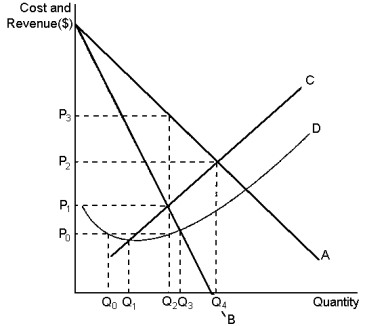 This graph reflects the cost and revenue structure for a monopoly firm. Use the graph to answer the following question(s).
-Refer to Graph 15-3. A profit-maximising monopoly would have a total revenue equal to:
This graph reflects the cost and revenue structure for a monopoly firm. Use the graph to answer the following question(s).
-Refer to Graph 15-3. A profit-maximising monopoly would have a total revenue equal to: (Multiple Choice)
4.7/5 (76)
(76) 
Filters
- Essay(0)
- Multiple Choice(0)
- Short Answer(0)
- True False(0)
- Matching(0)