



 Chat with AI
Exam 15: Monopoly

Exam 1: Ten Lessons From Economics149 Questions
Exam 2: Thinking Like an Economist147 Questions
Exam 3: Interdependence and the Gains From Trade153 Questions
Exam 4: The Market Forces of Supply and Demand222 Questions
Exam 5: Elasticity and Its Application181 Questions
Exam 6: Supply, Demand and Government Policies148 Questions
Exam 7: Consumers, Producers and the Efficiency of Markets177 Questions
Exam 8: Application: The Costs of Taxation141 Questions
Exam 9: Application: International Trade161 Questions
Exam 10: Externalities199 Questions
Exam 11: Public Goods and Common Resources182 Questions
Exam 12: The Design of the Tax System154 Questions
Exam 13: The Costs of Production191 Questions
Exam 14: Firms in Competitive Markets200 Questions
Exam 15: Monopoly214 Questions
Exam 16: Business Strategy184 Questions
Exam 17: Competition Policy104 Questions
Exam 18: Monopolistic Competition214 Questions
Exam 19: The Markets for the Factors of Production215 Questions
Exam 20: Earnings, Unions and Discrimination206 Questions
Exam 21: Income Inequity and Poverty111 Questions
Exam 22: The Theory of Consumer Choice161 Questions
Exam 23: Frontiers of Microeconomics120 Questions
Exam 24: Measuring a Nations Income51 Questions
Exam 25: Measuring the Cost of Living52 Questions
Exam 26: Production and Growth62 Questions
Exam 27: Saving, Investment and the Financial System62 Questions
Exam 28: The Natural Rate of Unemployment59 Questions
Exam 29: The Monetary System66 Questions
Exam 30: Inflation: Its Causes and Costs74 Questions
Exam 31: Open-Economy Macroeconomics: Basic Concepts68 Questions
Exam 32: A Macroeconomic Theory of the Open Economy64 Questions
Exam 33: Aggregate Demand and Aggregate Supply82 Questions
Exam 34: The Influence of Monetary and Fiscal Policy on Aggregate Demand73 Questions
Exam 35: The Short-Run Trade-Off Between Inflation and Unemployment58 Questions
Exam 36: Five Debates Over Macroeconomic Policy38 Questions
Select questions type


If a monopolist sells 500 units at $20 per unit and realises an average total cost of $8 per unit, what is the monopolist's profit?
(Multiple Choice)
4.9/5  (79)
(79) Graph 15-5
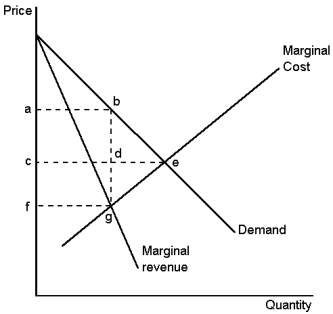 This graph depicts the demand, marginal-revenue and marginal-cost curves of a profit-maximising monopolist. Use the graph to answer the following question(s).
-Refer to Graph 15-5. Total surplus lost due to monopoly pricing is reflected in:
This graph depicts the demand, marginal-revenue and marginal-cost curves of a profit-maximising monopolist. Use the graph to answer the following question(s).
-Refer to Graph 15-5. Total surplus lost due to monopoly pricing is reflected in: (Multiple Choice)
4.8/5 (75)
(75) What is the defining characteristic of a natural monopoly? Give an example of a natural monopoly.
(Essay)
4.9/5 (68)
(68) Monopoly firms can employ their market power to charge a price that is:
(Multiple Choice)
4.9/5 (97)
(97) If the government deems a newly invented drug to be truly original, the pharmaceutical company is given the exclusive right to manufacture and sell the drug for five years.
(True/False)
4.8/5 (72)
(72) Which of the following qualify as barriers to entering a monopoly market? (i) a key resource's ownership is not defined
(ii) the government has given the existing monopoly the exclusive right to produce the good
(iii) the costs of production make a single producer more efficient than a large number of producers
(Multiple Choice)
4.9/5 (83)
(83) When a natural monopoly exists, it is always more cost-effective for two or more private firms to produce the product.
(True/False)
4.9/5 (69)
(69) Table 15-1
 -Refer to Table 15-1. If the monopolist wants to maximise its revenue, how many units of its product should it sell?
 (Multiple Choice)
4.9/5 (86)
(86) Which of the following scenarios best represents a monopoly situation?
(Multiple Choice)
4.9/5 (70)
(70) Where does the marginal-revenue curve for a monopoly firm start? (i) at the same point on the vertical axis as the average-revenue curve
(ii) above the demand curve
(iii) below the demand curve
(Multiple Choice)
4.8/5 (75)
(75) Graph 15-2
 This graph reflects the cost and revenue structure for a monopoly firm. Use the graph to answer the following question(s).
-Refer to Graph 15-2. The demand curve for a monopoly firm is depicted by curve:
This graph reflects the cost and revenue structure for a monopoly firm. Use the graph to answer the following question(s).
-Refer to Graph 15-2. The demand curve for a monopoly firm is depicted by curve: (Multiple Choice)
4.8/5 (81)
(81) Many bus companies allow discount tickets to be sold to students because:
(Multiple Choice)
5.0/5 (81)
(81) Consumers' willingness to pay for a good minus the amount they actually pay for it equals consumer:
(Multiple Choice)
4.8/5 (78)
(78) Which of the following can eliminate the inefficiency inherent in monopoly pricing?
(Multiple Choice)
4.9/5 (68)
(68) Another form of price discrimination is when a monopoly offers lower prices to customers who buy small quantities.
(True/False)
4.9/5 (77)
(77) One example of price discrimination occurs in the publishing industry when a publisher initially releases an expensive hardcover edition of a popular novel, and later releases a cheaper paperback edition. Use this example to demonstrate the benefits and potential pitfalls of a price discrimination pricing strategy.
(Essay)
4.9/5 (96)
(96) Consider the market for water in a small town in Western Australia. Assume that the only source of water is the underground aquifer that lies directly below the town. Wells are used to supply water to the entire town.
-Refer to the information provided. Jack, the sole owner of all the wells in town, decides to move to a more suitable climate, so he sells the wells to a couple of dozen different town residents. Which of the following is likely to occur?
(Multiple Choice)
4.8/5 (81)
(81) Natural monopolies differ from other forms of monopoly because they:
(Multiple Choice)
4.9/5 (79)
(79) 
Filters
- Essay(0)
- Multiple Choice(0)
- Short Answer(0)
- True False(0)
- Matching(0)