



 Chat with AI
Exam 15: Monopoly

Exam 1: Ten Lessons From Economics149 Questions
Exam 2: Thinking Like an Economist147 Questions
Exam 3: Interdependence and the Gains From Trade153 Questions
Exam 4: The Market Forces of Supply and Demand222 Questions
Exam 5: Elasticity and Its Application181 Questions
Exam 6: Supply, Demand and Government Policies148 Questions
Exam 7: Consumers, Producers and the Efficiency of Markets177 Questions
Exam 8: Application: The Costs of Taxation141 Questions
Exam 9: Application: International Trade161 Questions
Exam 10: Externalities199 Questions
Exam 11: Public Goods and Common Resources182 Questions
Exam 12: The Design of the Tax System154 Questions
Exam 13: The Costs of Production191 Questions
Exam 14: Firms in Competitive Markets200 Questions
Exam 15: Monopoly214 Questions
Exam 16: Business Strategy184 Questions
Exam 17: Competition Policy104 Questions
Exam 18: Monopolistic Competition214 Questions
Exam 19: The Markets for the Factors of Production215 Questions
Exam 20: Earnings, Unions and Discrimination206 Questions
Exam 21: Income Inequity and Poverty111 Questions
Exam 22: The Theory of Consumer Choice161 Questions
Exam 23: Frontiers of Microeconomics120 Questions
Exam 24: Measuring a Nations Income51 Questions
Exam 25: Measuring the Cost of Living52 Questions
Exam 26: Production and Growth62 Questions
Exam 27: Saving, Investment and the Financial System62 Questions
Exam 28: The Natural Rate of Unemployment59 Questions
Exam 29: The Monetary System66 Questions
Exam 30: Inflation: Its Causes and Costs74 Questions
Exam 31: Open-Economy Macroeconomics: Basic Concepts68 Questions
Exam 32: A Macroeconomic Theory of the Open Economy64 Questions
Exam 33: Aggregate Demand and Aggregate Supply82 Questions
Exam 34: The Influence of Monetary and Fiscal Policy on Aggregate Demand73 Questions
Exam 35: The Short-Run Trade-Off Between Inflation and Unemployment58 Questions
Exam 36: Five Debates Over Macroeconomic Policy38 Questions
Select questions type


For a monopolist, when does marginal revenue equal demand?
(Multiple Choice)
4.9/5  (72)
(72) Graph 15-1
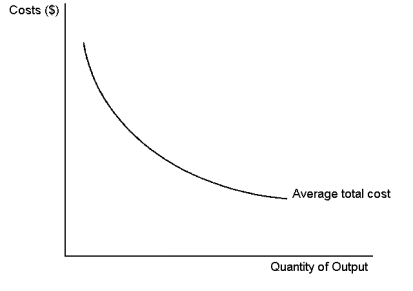 -Refer to Graph 15-1. The shape of the average-total-cost curve in the figure suggests an opportunity for a profit-maximising monopolist to exploit:
 (Multiple Choice)
4.9/5 (95)
(95) Which of the following qualify as a social cost of monopoly power? (i) loss of consumer surplus
(ii) loss of producer surplus
(iii) excessive profit earned by the owner of a monopoly
(Multiple Choice)
4.9/5 (91)
(91) A firm in a competitive market sells a product that has many substitutes. This means the demand curve such a firm faces is:
(Multiple Choice)
4.8/5 (87)
(87) Consider the market for water in a small town in Western Australia. Assume that the only source of water is the underground aquifer that lies directly below the town. Wells are used to supply water to the entire town.
-According to the information provided, suppose only one resident owns all the wells in town. Which of the following statements is most likely going to be true of the market for water?
(Multiple Choice)
4.9/5 (88)
(88) Graph 15-3
 This graph reflects the cost and revenue structure for a monopoly firm. Use the graph to answer the following question(s).
-Refer to Graph 15-3. At the profit-maximising level of output, average revenue is equal to:
This graph reflects the cost and revenue structure for a monopoly firm. Use the graph to answer the following question(s).
-Refer to Graph 15-3. At the profit-maximising level of output, average revenue is equal to: (Multiple Choice)
4.9/5 (95)
(95) Allowing an inventor to have the exclusive rights to market her new invention will lead to which of the following? (i) a product that is priced higher than it would be without the exclusive rights
(ii) desirable behaviour in the sense that inventors are encouraged to invent
(iii) higher profits for the inventor
(Multiple Choice)
5.0/5 (86)
(86) Graph 15-2
 This graph reflects the cost and revenue structure for a monopoly firm. Use the graph to answer the following question(s).
-Refer to Graph 15-2. Profit can always be increased by decreasing the level of output by one unit if the monopolist is currently operating at which of the following output levels? (i) Q0
(ii) Q1
(iii) Q2
(iv) Q3
This graph reflects the cost and revenue structure for a monopoly firm. Use the graph to answer the following question(s).
-Refer to Graph 15-2. Profit can always be increased by decreasing the level of output by one unit if the monopolist is currently operating at which of the following output levels? (i) Q0
(ii) Q1
(iii) Q2
(iv) Q3 (Multiple Choice)
4.8/5 (95)
(95) For a monopoly market, total surplus can be defined as the value of the good to:
(Multiple Choice)
4.9/5 (76)
(76) Graph 15-2
This graph reflects the cost and revenue structure for a monopoly firm. Use the graph to answer the following question(s).
-Refer to Graph 15-2. Profit can always be increased by decreasing the level of output by one unit if the monopolist is currently operating at a level of output in which:
This graph reflects the cost and revenue structure for a monopoly firm. Use the graph to answer the following question(s).
-Refer to Graph 15-2. Profit can always be increased by decreasing the level of output by one unit if the monopolist is currently operating at a level of output in which: (Multiple Choice)
4.8/5 (74)
(74) 
Filters
- Essay(0)
- Multiple Choice(0)
- Short Answer(0)
- True False(0)
- Matching(0)