



 Chat with AI
Exam 15: Monopoly

Exam 1: Ten Lessons From Economics149 Questions
Exam 2: Thinking Like an Economist147 Questions
Exam 3: Interdependence and the Gains From Trade153 Questions
Exam 4: The Market Forces of Supply and Demand222 Questions
Exam 5: Elasticity and Its Application181 Questions
Exam 6: Supply, Demand and Government Policies148 Questions
Exam 7: Consumers, Producers and the Efficiency of Markets177 Questions
Exam 8: Application: The Costs of Taxation141 Questions
Exam 9: Application: International Trade161 Questions
Exam 10: Externalities199 Questions
Exam 11: Public Goods and Common Resources182 Questions
Exam 12: The Design of the Tax System154 Questions
Exam 13: The Costs of Production191 Questions
Exam 14: Firms in Competitive Markets200 Questions
Exam 15: Monopoly214 Questions
Exam 16: Business Strategy184 Questions
Exam 17: Competition Policy104 Questions
Exam 18: Monopolistic Competition214 Questions
Exam 19: The Markets for the Factors of Production215 Questions
Exam 20: Earnings, Unions and Discrimination206 Questions
Exam 21: Income Inequity and Poverty111 Questions
Exam 22: The Theory of Consumer Choice161 Questions
Exam 23: Frontiers of Microeconomics120 Questions
Exam 24: Measuring a Nations Income51 Questions
Exam 25: Measuring the Cost of Living52 Questions
Exam 26: Production and Growth62 Questions
Exam 27: Saving, Investment and the Financial System62 Questions
Exam 28: The Natural Rate of Unemployment59 Questions
Exam 29: The Monetary System66 Questions
Exam 30: Inflation: Its Causes and Costs74 Questions
Exam 31: Open-Economy Macroeconomics: Basic Concepts68 Questions
Exam 32: A Macroeconomic Theory of the Open Economy64 Questions
Exam 33: Aggregate Demand and Aggregate Supply82 Questions
Exam 34: The Influence of Monetary and Fiscal Policy on Aggregate Demand73 Questions
Exam 35: The Short-Run Trade-Off Between Inflation and Unemployment58 Questions
Exam 36: Five Debates Over Macroeconomic Policy38 Questions
Select questions type


Which of the following statements is(are) true of monopolies? (i) they cannot make unlimited profits
(ii) they have the ability to set prices at whatever level they desire
(iii) they do not have to worry about their revenue falling if they increase the prices
(Multiple Choice)
4.7/5  (93)
(93) The problem with monopolies is their ability to do which of the following? (i) profiteer at the expense of consumers
(ii) price their product at a level that forces consumers to pay more than they are willing or able
(iii) restrict output below the socially efficient level of production
(Multiple Choice)
4.8/5 (86)
(86) As a monopolist increases the quantity of output it sells, the price consumers are willing to pay for the good:
(Multiple Choice)
4.7/5 (75)
(75) If the distribution of water is a natural monopoly, which of the following is true? (i) allowing for competition among different firms in the water distribution industry is efficient
(ii) a single firm can serve the market at a lower average total cost
(iii) multiple firms will each have to pay large fixed costs to develop their own network of pipes
(Multiple Choice)
4.8/5 (82)
(82) Consider the market for water in a small town in Western Australia. Assume that the only source of water is the underground aquifer that lies directly below the town. Wells are used to supply water to the entire town.
-According to the information provided, if dozens of residents have their own wells, which of the following statements most adequately describes the behaviour of sellers of water?
(Multiple Choice)
4.9/5 (79)
(79) Price discrimination explains why high-ranking universities often set rules that determine prices of admission based on the students:
(Multiple Choice)
4.9/5 (88)
(88) A rational pricing strategy for a profit-maximising monopolist is:
(Multiple Choice)
4.8/5 (72)
(72) Round-trip airline tickets are usually cheaper if you stay over a Saturday night before you fly back. What is the reason for this price discrepancy?
(Multiple Choice)
4.9/5 (87)
(87) The key difference between a competitive firm and a monopoly firm is the ability to select the level of production.
(True/False)
4.9/5 (94)
(94) It is very rare for monopolies to arise from exclusive ownership of a resource because:
(Multiple Choice)
4.8/5 (86)
(86) Along with the monopoly firms' cost curves, the shape and position of the demand curve determine which of the following? (i) the price the monopoly will charge for its good
(ii) the shape and position of the marginal-revenue curve
(iii) the profit-maximising quantity
(Multiple Choice)
4.9/5 (71)
(71) A significant difference between a competitive firm and a monopoly firm is the ability to select:
(Multiple Choice)
4.8/5 (87)
(87) Which of the following statements is(are) true about patents and copyrights? (i) they both have benefits and costs
(ii) they lead to higher prices
(iii) they allow for the market to correct for monopolists' ability to earn above average profits
(Multiple Choice)
4.9/5 (89)
(89) When the government creates a monopoly, the social loss may include:
(Multiple Choice)
4.8/5 (82)
(82) Graph 15-6
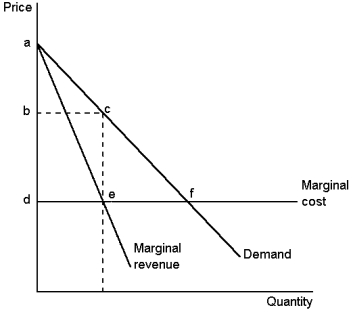 This graph depicts the demand, marginal-revenue and marginal-cost curves of a profit-maximising monopolist. Use the graph to answer the following question(s).
-Refer to Graph 15-6. If the monopoly firm is NOT allowed to price discriminate, what will the consumer surplus be?
This graph depicts the demand, marginal-revenue and marginal-cost curves of a profit-maximising monopolist. Use the graph to answer the following question(s).
-Refer to Graph 15-6. If the monopoly firm is NOT allowed to price discriminate, what will the consumer surplus be? (Multiple Choice)
4.7/5 (78)
(78) In a market characterised by monopoly, the market demand curve is:
(Multiple Choice)
4.8/5 (73)
(73) What is the monopolist's profit under the following conditions? The profit-maximising price charged for goods produced is $32. The intersection of the marginal-revenue and marginal cost-curves occurs where output is 10 units and marginal cost is $16. Average cost for 10 units of output is $12.
(Multiple Choice)
4.8/5 (72)
(72) 
Filters
- Essay(0)
- Multiple Choice(0)
- Short Answer(0)
- True False(0)
- Matching(0)