



 Chat with AI
Exam 22: Endocrine and Immune Systems

Exam 1: The Nature of Science66 Questions
Exam 2: Chemistry of Life78 Questions
Exam 3: Life Is Cellular72 Questions
Exam 4: How Cells Work64 Questions
Exam 5: Cell Division62 Questions
Exam 6: Patterns of Inheritance67 Questions
Exam 7: Chromosomes and Human Genetics68 Questions
Exam 8: What Genes Are64 Questions
Exam 9: How Genes Work64 Questions
Exam 10: Evidence for Evolution64 Questions
Exam 11: Mechanisms of Evolution64 Questions
Exam 12: Adaptation and Species64 Questions
Exam 13: The History of Life71 Questions
Exam 14: Human Evolution66 Questions
Exam 15: General Principles of Ecology64 Questions
Exam 16: Growth of Populations65 Questions
Exam 17: Communities of Organisms64 Questions
Exam 18: Ecosystems66 Questions
Exam 19: Homeostasis, Reproduction, and Development67 Questions
Exam 20: Digestive, Muscular, and Skeletal Systems66 Questions
Exam 21: Circulatory, Respiratory, Urinary, and Nervous Systems72 Questions
Exam 22: Endocrine and Immune Systems66 Questions
Exam 23: Plant Physiology64 Questions
Exam 24: Applying the Science67 Questions
Select questions type


Which of the following events is the first to occur during inflammation?
(Multiple Choice)
4.8/5  (83)
(83) Which of the following is a component of the immune system's first line of defense?
(Multiple Choice)
4.8/5 (65)
(65) Upon first exposure to a pathogen, a ________ immune response is triggered.
(Short Answer)
4.9/5 (74)
(74) The steroid hormones testosterone, estradiol, and progesterone enter target cells and bind intracellular receptors to regulate gene expression. Based on this information, which of the following statements about steroid hormones must be correct?
(Multiple Choice)
4.9/5 (74)
(74) Each T cell and each B cell binds to only one specific type of
(Multiple Choice)
4.7/5 (77)
(77) Match the chemical, cell, or tissue with the function it performs in the immune response.
-clotting factors that prevent excess blood loss
(Multiple Choice)
4.7/5 (82)
(82) A single hormone molecule can have dramatic effects on a target cell, because
(Multiple Choice)
4.8/5 (83)
(83) Neutrophils and macrophages function in the process of ________, which traps pathogens at the site of a wound.
(Short Answer)
4.9/5 (79)
(79) The primary role of the immune system's first line of defense is to
(Multiple Choice)
4.7/5 (80)
(80) Which of the following is a molecule that makes blood vessels near a wound more porous?
(Multiple Choice)
4.7/5 (79)
(79) In which of the following organs would you be LEAST likely to find mature lymphocytes?
(Multiple Choice)
4.7/5 (78)
(78) Which of the following is an example of the immune system's second line of defense?
(Multiple Choice)
4.8/5 (73)
(73) Which of the following statements accurately describes how hormones can affect a cell, as illustrated in this figure? 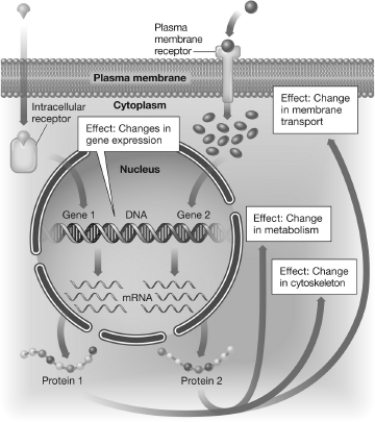
(Multiple Choice)
4.8/5 (85)
(85) Which of the following statements best explains how one hormone can regulate several different developmental events?
(Multiple Choice)
4.9/5 (70)
(70) Antidiuretic hormone (ADH) is produced by the pituitary gland when the brain detects lower-than-optimum levels of water in the body. In the kidneys, ADH promotes the uptake of water, creating more concentrated urine. ADH travels from the pituitary gland to the kidneys through the
(Multiple Choice)
4.9/5 (79)
(79) Which of the following statements accurately describes hormonal signaling, as depicted in this figure? 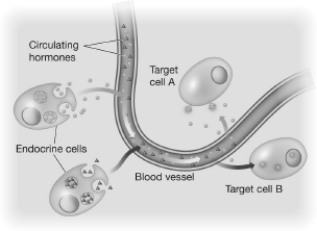
(Multiple Choice)
5.0/5 (76)
(76) Explain how the vertebrate immune system, once it has been violated, works to destroy invading pathogens. Include mechanisms of the first, second, and third lines of defense in your answer.
(Essay)
4.8/5 (75)
(75) White blood cells of the adaptive immune response provide what advantage that is lacking in white blood cells of the innate immune response?
(Multiple Choice)
5.0/5 (89)
(89) 
Filters
- Essay(0)
- Multiple Choice(0)
- Short Answer(0)
- True False(0)
- Matching(0)