



 Chat with AI
Exam 16: Growth of Populations

Exam 1: The Nature of Science66 Questions
Exam 2: Chemistry of Life78 Questions
Exam 3: Life Is Cellular72 Questions
Exam 4: How Cells Work64 Questions
Exam 5: Cell Division62 Questions
Exam 6: Patterns of Inheritance67 Questions
Exam 7: Chromosomes and Human Genetics68 Questions
Exam 8: What Genes Are64 Questions
Exam 9: How Genes Work64 Questions
Exam 10: Evidence for Evolution64 Questions
Exam 11: Mechanisms of Evolution64 Questions
Exam 12: Adaptation and Species64 Questions
Exam 13: The History of Life71 Questions
Exam 14: Human Evolution66 Questions
Exam 15: General Principles of Ecology64 Questions
Exam 16: Growth of Populations65 Questions
Exam 17: Communities of Organisms64 Questions
Exam 18: Ecosystems66 Questions
Exam 19: Homeostasis, Reproduction, and Development67 Questions
Exam 20: Digestive, Muscular, and Skeletal Systems66 Questions
Exam 21: Circulatory, Respiratory, Urinary, and Nervous Systems72 Questions
Exam 22: Endocrine and Immune Systems66 Questions
Exam 23: Plant Physiology64 Questions
Exam 24: Applying the Science67 Questions
Select questions type


Which of the following statements accurately describes information shown in this figure? 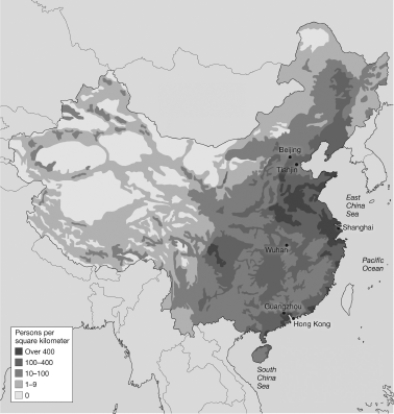

Free
(Multiple Choice)
4.8/5  (79)
(79) Correct Answer: Verified
D
A population is counted at 100 individuals in 1998. In 2006, a new count found 1,600 individuals. What is the doubling time for the population?
Free
(Multiple Choice)
4.9/5 (81)
(81) Correct Answer:Verified
VerifiedD
According to the figure shown, human populations are projected to reach carrying capacity in approximately ________ years. 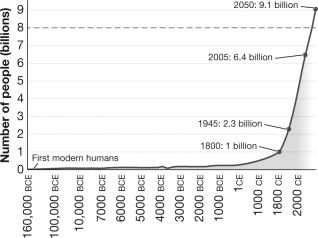
Free
(Multiple Choice)
4.9/5 (80)
(80) Correct Answer:Verified
VerifiedB
In November 2013, the one-child policy was officially relaxed to allow a second birth to some couples. Which of the following couples are now allowed a second birth?
(Multiple Choice)
4.8/5 (76)
(76) Which of the following pieces of information would be most useful in determining whether a population is undergoing logistic growth versus exponential growth?
(Multiple Choice)
4.7/5 (83)
(83) Studies of the population-size cycles seen between the snowshoe hare and the Canadian lynx showed that
(Multiple Choice)
4.9/5 (71)
(71) The carrying capacity for Paramecia caudatum as shown in this figure is 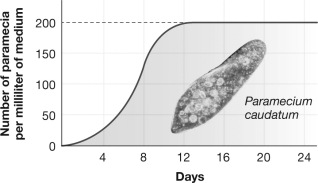
(Multiple Choice)
4.8/5 (69)
(69) A population will remain at a constant size when emigration equals immigration and
(Multiple Choice)
4.8/5 (77)
(77) Lynx feed on rabbits, and the growth curves for these two species fluctuate together. This relationship is an example of a(n)
(Multiple Choice)
4.9/5 (77)
(77) A giant puffball mushroom is capable of producing and releasing trillions of spores. With this many spores produced, why do giant puffball mushrooms undergo logistic growth in established habitats?
(Multiple Choice)
4.9/5 (72)
(72) Which of the following situations illustrates a link between the effects of density-dependent and density-independent factors?
(Multiple Choice)
4.8/5 (93)
(93) Nene, Hawaiian geese, live on Maui. Their population density is approximately 0.2 per square kilometer and Maui is approximately 1,800 square kilometers in size. Approximately how many nene live on Maui?
(Multiple Choice)
4.9/5 (73)
(73) The effects of pollution are generally considered to be density-independent because
(Multiple Choice)
4.9/5 (80)
(80) Density-dependent factors are more likely to limit population growth when
(Multiple Choice)
4.8/5 (74)
(74) Explain whether a death rate increase from influenza is an example of a density-dependent population change or a density-independent population change.
(Essay)
4.8/5 (92)
(92) If there are 100 people living in a 2-square-kilometer area, the population density is ________ people per square kilometer.
(Short Answer)
4.8/5 (76)
(76) In the figure shown, the willow tree population leveled off at 475 trees and remained stable in the early 1980s. This most likely occurred because the 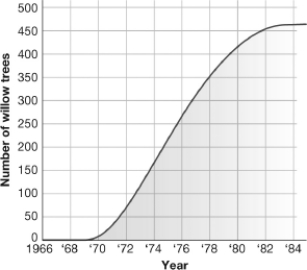
(Multiple Choice)
4.9/5 (70)
(70) 
Filters
- Essay(0)
- Multiple Choice(0)
- Short Answer(0)
- True False(0)
- Matching(0)