



 Chat with AI
Exam 7: Chromosomes and Human Genetics

Exam 1: The Nature of Science66 Questions
Exam 2: Chemistry of Life78 Questions
Exam 3: Life Is Cellular72 Questions
Exam 4: How Cells Work64 Questions
Exam 5: Cell Division62 Questions
Exam 6: Patterns of Inheritance67 Questions
Exam 7: Chromosomes and Human Genetics68 Questions
Exam 8: What Genes Are64 Questions
Exam 9: How Genes Work64 Questions
Exam 10: Evidence for Evolution64 Questions
Exam 11: Mechanisms of Evolution64 Questions
Exam 12: Adaptation and Species64 Questions
Exam 13: The History of Life71 Questions
Exam 14: Human Evolution66 Questions
Exam 15: General Principles of Ecology64 Questions
Exam 16: Growth of Populations65 Questions
Exam 17: Communities of Organisms64 Questions
Exam 18: Ecosystems66 Questions
Exam 19: Homeostasis, Reproduction, and Development67 Questions
Exam 20: Digestive, Muscular, and Skeletal Systems66 Questions
Exam 21: Circulatory, Respiratory, Urinary, and Nervous Systems72 Questions
Exam 22: Endocrine and Immune Systems66 Questions
Exam 23: Plant Physiology64 Questions
Exam 24: Applying the Science67 Questions
Select questions type


If a genetic disorder is caused by a dominant allele, individuals with which of the following genotypes would be affected by the disorder?

Free
(Multiple Choice)
4.9/5  (87)
(87) Correct Answer: Verified
C
Sickle-cell disease is an inherited chronic blood disease caused by an autosomal recessive allele. Suppose a man who is homozygous recessive for the sickle-cell gene fathers a child by a woman who is a carrier for sickle-cell. What are the chances their children will exhibit the disease?
Free
(Multiple Choice)
4.8/5 (95)
(95) Correct Answer:Verified
VerifiedC
Match each correct statement to the set of alleles listed below.
-male affected by recessive sex-linked disease
Free
(Multiple Choice)
4.9/5 (84)
(84) Correct Answer:Verified
VerifiedB
Why are dominant genetic disorders more rare than recessive disorders?
(Essay)
4.9/5 (81)
(81) A karyotype shows a chromosomal abnormality that does not change the length of any of the chromosomes. Which abnormality is indicated?
(Multiple Choice)
4.8/5 (92)
(92) If a father is affected by an X-linked condition and the mother is a carrier, what is the probability of their children being affected?
(Multiple Choice)
5.0/5 (84)
(84) During cell division a piece of a chromosome breaks off and reattaches to the same chromosome, but the piece is now in reverse order. How would this abnormality affect the chromosome?
(Multiple Choice)
4.9/5 (90)
(90) In the pedigree shown, the individual indicated represents a(n) 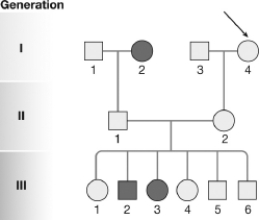
(Multiple Choice)
4.9/5 (83)
(83) An individual who carries one copy of a recessive mutated allele and one normal copy is referred to as a genetic ________.
(Short Answer)
4.9/5 (77)
(77) On chromosomes within an individual, there are ________ alleles for a given gene found on ________ chromosomes.
(Multiple Choice)
4.8/5 (89)
(89) Human males have one chromosome that females do not, known as the ________ chromosome.
(Short Answer)
4.9/5 (81)
(81) Because an individual with an XX genotype is a female, is an individual with an XO (no second sex chromosome) a male?
(Multiple Choice)
4.8/5 (88)
(88) If an individual has two alleles at a given locus that are different, the individual is said to be ________ for the gene.
(Short Answer)
4.8/5 (81)
(81) Which of the following statements would indicate a pedigree that shows the inheritance pattern of a recessive X-linked disease?
(Multiple Choice)
4.8/5 (88)
(88) Explain how two brothers might have different X chromosomes, but they must share identical Y chromosomes.
(Essay)
4.8/5 (85)
(85) Which of the following must be true for a woman who is heterozygous for a given gene?
(Multiple Choice)
4.8/5 (80)
(80) A carrier is an individual with a ________ genotype who does not express the recessive trait but can pass it along to offspring.
(Multiple Choice)
4.7/5 (89)
(89) Which of the following is true of the genetic cross shown in the figure? 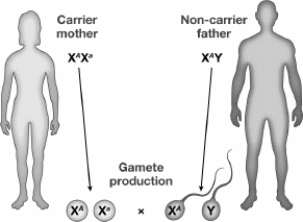
(Multiple Choice)
4.9/5 (68)
(68) 
Filters
- Essay(0)
- Multiple Choice(0)
- Short Answer(0)
- True False(0)
- Matching(0)