



 Chat with AI
Exam 12: Adaptation and Species

Exam 1: The Nature of Science66 Questions
Exam 2: Chemistry of Life78 Questions
Exam 3: Life Is Cellular72 Questions
Exam 4: How Cells Work64 Questions
Exam 5: Cell Division62 Questions
Exam 6: Patterns of Inheritance67 Questions
Exam 7: Chromosomes and Human Genetics68 Questions
Exam 8: What Genes Are64 Questions
Exam 9: How Genes Work64 Questions
Exam 10: Evidence for Evolution64 Questions
Exam 11: Mechanisms of Evolution64 Questions
Exam 12: Adaptation and Species64 Questions
Exam 13: The History of Life71 Questions
Exam 14: Human Evolution66 Questions
Exam 15: General Principles of Ecology64 Questions
Exam 16: Growth of Populations65 Questions
Exam 17: Communities of Organisms64 Questions
Exam 18: Ecosystems66 Questions
Exam 19: Homeostasis, Reproduction, and Development67 Questions
Exam 20: Digestive, Muscular, and Skeletal Systems66 Questions
Exam 21: Circulatory, Respiratory, Urinary, and Nervous Systems72 Questions
Exam 22: Endocrine and Immune Systems66 Questions
Exam 23: Plant Physiology64 Questions
Exam 24: Applying the Science67 Questions
Select questions type


The great diversity of life on Earth is caused by the formation of new species in a process known as ________.

Free
(Short Answer)
4.9/5  (92)
(92) Correct Answer: Verified
speciation
Choose two different reproductive barriers that lead to sympatric speciation and explain how they work.
Free
(Essay)
4.8/5 (80)
(80) Correct Answer:Verified
VerifiedSympatric speciation occurs when new species form in the same geographic location. Ecological, behavioral, and mechanical isolation all prevent mating from occurring. Gametic isolation prevents fertilization after mating has occurred. There are also two postzygotic barriers-zygote death and hybrid performance-that act as barriers after fertilization has occurred.
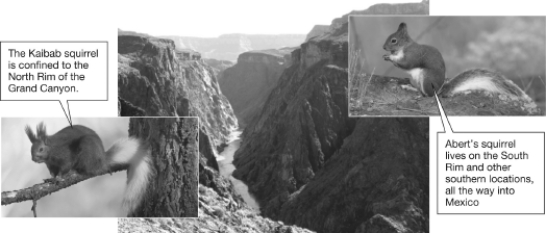
This figure shows two squirrels that represent two separate species. Explain how the geographic barrier between these two populations led to the formation of two distinct species.
(Essay)
4.9/5 (75)
(75) A large population of animals is split in two by a physical barrier. Over time, the genetic makeup of the two resulting populations becomes more and more different until each population becomes a separate species. This is an example of
(Multiple Choice)
4.8/5 (77)
(77) Two species live near each other but do not respond to each other's courtship displays. This is an example of ________ isolation, a type of prezygotic barrier.
(Short Answer)
4.8/5 (81)
(81) Which of the following correctly indicates a relationship between the morphological species concept and the biological species concept?
(Multiple Choice)
5.0/5 (91)
(91) For which of the following would a mountain range most likely represent a geographic barrier that would block gene flow?
(Multiple Choice)
4.9/5 (85)
(85) Close ecological interactions between two different species may lead to
(Multiple Choice)
4.9/5 (80)
(80) Two species evolving together in response to interactions between the two species is referred to as ________.
(Short Answer)
4.7/5 (83)
(83) Which of the following does NOT provide an example of geographic isolation?
(Multiple Choice)
4.9/5 (71)
(71) Which of the following statements gives an example of coevolution?
(Multiple Choice)
4.8/5 (64)
(64) The two squirrel species shown in the figure arose from the same ancestor. The Kaibab squirrel lives on the north rim of the Grand Canyon and Abert's squirrel lives on the south rim. Which is the most likely explanation for their speciation? 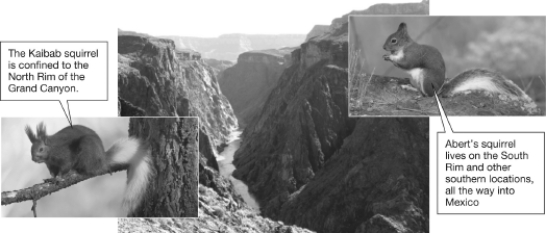
(Multiple Choice)
4.7/5 (80)
(80) Some freshwater snail eggs are accidentally introduced into a new habitat that is geographically isolated from the original population. Which of the following must occur before these snails are described as two separate species?
(Multiple Choice)
4.9/5 (77)
(77) If two populations of beetles living in isolated areas are physically different but genetically similar, would they be considered one species or two? Explain your answer.
(Essay)
4.8/5 (77)
(77) Some species of orchids attract wasps to assist them in reproduction by producing flowers that look like female wasps. The flowers fool male wasps into attempting to mate with them. As a result, the wasp is covered with pollen that it takes with it to the next flower it attempts to mate with. This example shows adaptive evolution by
(Multiple Choice)
4.8/5 (76)
(76) 
Filters
- Essay(0)
- Multiple Choice(0)
- Short Answer(0)
- True False(0)
- Matching(0)