



 Chat with AI
Exam 3: Life Is Cellular

Exam 1: The Nature of Science66 Questions
Exam 2: Chemistry of Life78 Questions
Exam 3: Life Is Cellular72 Questions
Exam 4: How Cells Work64 Questions
Exam 5: Cell Division62 Questions
Exam 6: Patterns of Inheritance67 Questions
Exam 7: Chromosomes and Human Genetics68 Questions
Exam 8: What Genes Are64 Questions
Exam 9: How Genes Work64 Questions
Exam 10: Evidence for Evolution64 Questions
Exam 11: Mechanisms of Evolution64 Questions
Exam 12: Adaptation and Species64 Questions
Exam 13: The History of Life71 Questions
Exam 14: Human Evolution66 Questions
Exam 15: General Principles of Ecology64 Questions
Exam 16: Growth of Populations65 Questions
Exam 17: Communities of Organisms64 Questions
Exam 18: Ecosystems66 Questions
Exam 19: Homeostasis, Reproduction, and Development67 Questions
Exam 20: Digestive, Muscular, and Skeletal Systems66 Questions
Exam 21: Circulatory, Respiratory, Urinary, and Nervous Systems72 Questions
Exam 22: Endocrine and Immune Systems66 Questions
Exam 23: Plant Physiology64 Questions
Exam 24: Applying the Science67 Questions
Select questions type


Match the following cellular structures with their primary function (you may need to use a function more than once).
-rough endoplasmic reticulum

Free
(Multiple Choice)
4.8/5  (68)
(68) Correct Answer: Verified
G
A white blood cell (WBC) encounters bacteria in a scrape on the knee of a child who has fallen off of his bicycle. The WBC's job is to take the bacteria inside of itself and destroy the bacteria. If the bacteria cannot be moved across the WBC membrane, how will the WBC most likely take it in?
Free
(Multiple Choice)
5.0/5 (84)
(84) Correct Answer:Verified
VerifiedD
The smooth endoplasmic reticulum
Free
(Multiple Choice)
4.8/5 (76)
(76) Correct Answer:Verified
VerifiedA
All cells have a ________ that acts as a barrier separating the cellular components from the external environment.
(Short Answer)
4.8/5 (68)
(68) Cells naturally, without using energy, respond to changes in water concentration through the process of
(Multiple Choice)
4.9/5 (96)
(96) An amoeba, a protozoan that moves by pseudopodia, approaches a smaller protozoan and extends its pseudopodia (extensions of cytoplasm in plasma membrane) around the smaller protozoan. Once the amoeba's pseudopodia completely surrounds the other protozoan, the amoeba's plasma membrane pinches off by folding back into the amoeba and creating a vesicle containing the smaller protozoan. This vesicle is now within the amoeba itself and will soon fuse with other vesicles containing digestive enzymes. This is an example of
(Multiple Choice)
4.8/5 (88)
(88) Which of the following would be likely to require facilitated diffusion to move across the plasma membrane?
(Multiple Choice)
4.8/5 (87)
(87) Using the compound light microscope in the lab room, you observe a wet mount slide preparation. You observe layers of cells that have a definite, rigid, rectangular shape; there appears to be a nucleus in all of the cells and there are many oval-shaped green structures that seem to be moving around inside of the cells in an orderly fashion. What general cell type are you most likely observing?
(Multiple Choice)
5.0/5 (83)
(83) Which of the following would be the best analogy for the function of the Golgi apparatus?
(Multiple Choice)
4.8/5 (80)
(80) There are cells in your pancreas that produce insulin, a peptide hormone important in the regulation of blood sugar levels by adjusting the metabolism of sugars and fats. Once the pancreas cells have produced the initial peptide (small string of amino acids) component of insulin, it must be finished, packaged, and shipped out of the cell. Which organelles would likely be involved in this process of finishing, packaging, and shipping of a peptide hormone? Include a brief, general description of what happens to the hormone at each organelle.
(Essay)
4.8/5 (84)
(84) Viruses use their ________ material to take over their host cell's metabolic machinery to produce the components needed for the virus to reproduce.
(Short Answer)
4.8/5 (83)
(83) Which of the following help increase the selective permeability of a phospholipid bilayer membrane?
(Multiple Choice)
4.9/5 (92)
(92) Match the following cellular structures with their primary function (you may need to use a function more than once).
-smooth endoplasmic reticulum
(Multiple Choice)
4.9/5 (78)
(78) A cell containing a nucleus, mitochondria, Golgi apparatus, both smooth and rough ER, ribosomes, cytoskeleton, a large vacuole, and chloroplasts would be an example of a typical ________ cell.
(Short Answer)
4.9/5 (73)
(73) Phospholipids are large organic molecules with a ________, polar phosphate head connected to ________, nonpolar fatty acid tails. How do these molecules arrange themselves to form a mostly impermeable barrier between a liposome and its environment?
(Multiple Choice)
4.9/5 (67)
(67) Why do scientists repeat their experiments over and over again?
(Multiple Choice)
4.9/5 (73)
(73) The flexible poles providing structure to a soft-sided tent most closely resemble the
(Multiple Choice)
4.7/5 (84)
(84) Match the following cellular structures with their primary function (you may need to use a function more than once).
-cytoskeleton
(Multiple Choice)
4.9/5 (77)
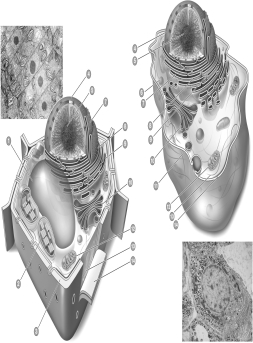
(77) Indicate which cell in this figure is the plant cell and which is the animal cell. Label all cellular structures 1-12 in both cells. Include a very brief description of each organelle's function with its label. Use an asterisk to indicate which structures are unique to plant cells.
(Essay)
4.8/5 (78)
(78) A screen door allows breezes to enter and aromas to exit but keeps out insects. Its function most resembles
(Multiple Choice)
4.8/5 (79)
(79) 
Filters
- Essay(0)
- Multiple Choice(0)
- Short Answer(0)
- True False(0)
- Matching(0)