



 Chat with AI
Exam 17: Communities of Organisms

Exam 1: The Nature of Science66 Questions
Exam 2: Chemistry of Life78 Questions
Exam 3: Life Is Cellular72 Questions
Exam 4: How Cells Work64 Questions
Exam 5: Cell Division62 Questions
Exam 6: Patterns of Inheritance67 Questions
Exam 7: Chromosomes and Human Genetics68 Questions
Exam 8: What Genes Are64 Questions
Exam 9: How Genes Work64 Questions
Exam 10: Evidence for Evolution64 Questions
Exam 11: Mechanisms of Evolution64 Questions
Exam 12: Adaptation and Species64 Questions
Exam 13: The History of Life71 Questions
Exam 14: Human Evolution66 Questions
Exam 15: General Principles of Ecology64 Questions
Exam 16: Growth of Populations65 Questions
Exam 17: Communities of Organisms64 Questions
Exam 18: Ecosystems66 Questions
Exam 19: Homeostasis, Reproduction, and Development67 Questions
Exam 20: Digestive, Muscular, and Skeletal Systems66 Questions
Exam 21: Circulatory, Respiratory, Urinary, and Nervous Systems72 Questions
Exam 22: Endocrine and Immune Systems66 Questions
Exam 23: Plant Physiology64 Questions
Exam 24: Applying the Science67 Questions
Select questions type


Define the two key pieces of information used to examine diversity within a community.

Free
(Essay)
4.8/5  (75)
(75) Correct Answer: Verified
Both relative species abundance, a comparison of how common species are, and species richness, the total number of species within the community, characterize the diversity within a given community.
Which of the following communities would be considered to have the greatest species richness?
Free
(Multiple Choice)
4.8/5 (63)
(63) Correct Answer:Verified
VerifiedA
How do ecological communities change over time?
Free
(Multiple Choice)
4.8/5 (73)
(73) Correct Answer:Verified
VerifiedA
Which of the following would probably NOT occur if a single species was removed from an ecological community?
(Multiple Choice)
4.9/5 (74)
(74) After studying the food web shown, select a reasonable outcome following the complete disappearance of wolves. 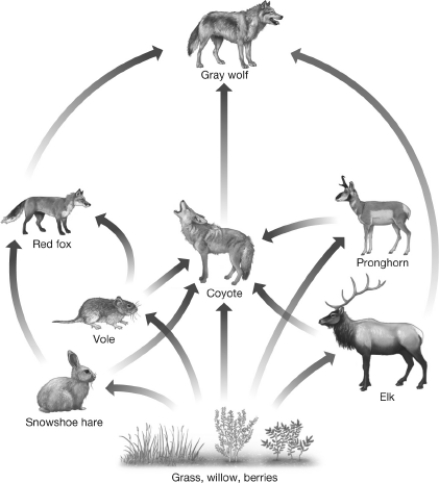
(Multiple Choice)
4.8/5 (80)
(80) Which of the following statements accurately describes an ecological community?
(Multiple Choice)
4.9/5 (77)
(77) ________ consumers feed on primary consumers as part or all of their diet.
(Short Answer)
4.8/5 (86)
(86) Communities change with respect to several timescales. An example of long-term change would be the
(Multiple Choice)
4.8/5 (89)
(89) Match each term to a statement listed below.
-a fish that consumes parasites found on a shark
(Multiple Choice)
4.8/5 (83)
(83) Undisturbed communities with species compositions that remain stable over time are referred to as
(Multiple Choice)
4.9/5 (84)
(84) Match each term to a statement listed below.
-a bird building a nest within a tree
(Multiple Choice)
4.9/5 (85)
(85) In ________ competition, species compete indirectly for a shared resource, each reducing the amount available to the other competitor.
(Multiple Choice)
4.7/5 (77)
(77) A(n) ________ is a single sequence of who eats whom in a community.
(Short Answer)
4.9/5 (73)
(73) The relationship between house pets and people would be best described as
(Multiple Choice)
4.7/5 (74)
(74) Which of the following experiments would help to identify a keystone species?
(Multiple Choice)
4.9/5 (68)
(68) Human cells contain mitochondria, which are responsible for processing the energy needed by our cells. Remember that the ancestors of mitochondria may once have been free-living prokaryotes. If mitochondria were still considered to be separate organisms within our cells, which of the following would best describe our relationship with them?
(Multiple Choice)
4.8/5 (76)
(76) Every healthy human digestive system is home to countless microorganisms. In a normal digestive system, what type of relationship would you say this is?
(Multiple Choice)
4.9/5 (81)
(81) 
Filters
- Essay(0)
- Multiple Choice(0)
- Short Answer(0)
- True False(0)
- Matching(0)