



 Chat with AI
Exam 17: Communities of Organisms

Exam 1: The Nature of Science66 Questions
Exam 2: Chemistry of Life78 Questions
Exam 3: Life Is Cellular72 Questions
Exam 4: How Cells Work64 Questions
Exam 5: Cell Division62 Questions
Exam 6: Patterns of Inheritance67 Questions
Exam 7: Chromosomes and Human Genetics68 Questions
Exam 8: What Genes Are64 Questions
Exam 9: How Genes Work64 Questions
Exam 10: Evidence for Evolution64 Questions
Exam 11: Mechanisms of Evolution64 Questions
Exam 12: Adaptation and Species64 Questions
Exam 13: The History of Life71 Questions
Exam 14: Human Evolution66 Questions
Exam 15: General Principles of Ecology64 Questions
Exam 16: Growth of Populations65 Questions
Exam 17: Communities of Organisms64 Questions
Exam 18: Ecosystems66 Questions
Exam 19: Homeostasis, Reproduction, and Development67 Questions
Exam 20: Digestive, Muscular, and Skeletal Systems66 Questions
Exam 21: Circulatory, Respiratory, Urinary, and Nervous Systems72 Questions
Exam 22: Endocrine and Immune Systems66 Questions
Exam 23: Plant Physiology64 Questions
Exam 24: Applying the Science67 Questions
Select questions type


Which of the following could represent the linear flow of energy within a food web?
(Multiple Choice)
4.9/5  (77)
(77) A(n) ________ may begin when a new habitat is formed, such as when rock and soil are deposited by a retreating glacier.
(Short Answer)
4.9/5 (79)
(79) The activity of predators has caused their prey to evolve a variety of protective characteristics. How are prey able to acquire new features?
(Multiple Choice)
4.9/5 (72)
(72) Clown fish have evolved to live safely between the stinging tentacles of certain sea anemones. The fish receive protection from predators, whereas anemone receive some food from the fish. This relationship is an example of
(Multiple Choice)
5.0/5 (74)
(74) The total number of different species living within a community is referred to as
(Multiple Choice)
4.8/5 (82)
(82) The ________ of a community has two components: the number of different species that live in the community, and the relative abundances of those species.
(Short Answer)
4.9/5 (81)
(81) Which of the following can occur when the climate of an area changes?
(Multiple Choice)
4.9/5 (94)
(94) Follicle mites live in the hair follicles of human skin. They feed on single cells but do little if any harm to the human; the mite has a stable place to live and reproduce. This is an example of ________.
(Short Answer)
4.8/5 (86)
(86) Which of the following symbols represents a mutualistic relationship?
(Multiple Choice)
4.8/5 (82)
(82) Which of the following best explains why a grass species might disappear when a meat-eating species is removed from a community?
(Multiple Choice)
4.8/5 (84)
(84) A measurement of how common one species is compared to another species is referred to as
(Multiple Choice)
4.9/5 (74)
(74) The photograph shown depicts two brightly colored butterfly species, the monarch on the right and its mimic, the viceroy, on the left. The mimicry by the viceroy allows it to 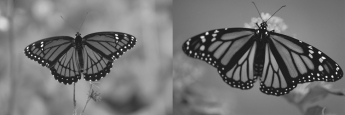
(Multiple Choice)
4.9/5 (76)
(76) The figure shown illustrates how, although pines first established themselves as the dominant tree in the Lake Michigan sand dune community, black oaks ultimately become the dominant species. What best explains the gradual reduction of the pine? 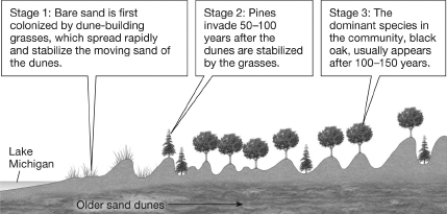
(Multiple Choice)
4.9/5 (77)
(77) Pathogens are considered a special type of parasite because they
(Multiple Choice)
4.8/5 (77)
(77) Antibiotic therapy sometimes reduces the population of gut-inhabiting microorganisms. Bloating and diarrhea often follow until the populations reestablish themselves. This observation suggests that these microorganisms participate in a(n) ________ relationship with humans.
(Multiple Choice)
4.8/5 (73)
(73) The sea star Pisaster ochraceus is a keystone species. Ten years after P. ochraceus is removed from selected intertidal communities along the Washington coast, how might those communities compare to control communities?
(Multiple Choice)
4.8/5 (77)
(77) 
Filters
- Essay(0)
- Multiple Choice(0)
- Short Answer(0)
- True False(0)
- Matching(0)