



 Chat with AI
Exam 20: Digestive, Muscular, and Skeletal Systems

Exam 1: The Nature of Science66 Questions
Exam 2: Chemistry of Life78 Questions
Exam 3: Life Is Cellular72 Questions
Exam 4: How Cells Work64 Questions
Exam 5: Cell Division62 Questions
Exam 6: Patterns of Inheritance67 Questions
Exam 7: Chromosomes and Human Genetics68 Questions
Exam 8: What Genes Are64 Questions
Exam 9: How Genes Work64 Questions
Exam 10: Evidence for Evolution64 Questions
Exam 11: Mechanisms of Evolution64 Questions
Exam 12: Adaptation and Species64 Questions
Exam 13: The History of Life71 Questions
Exam 14: Human Evolution66 Questions
Exam 15: General Principles of Ecology64 Questions
Exam 16: Growth of Populations65 Questions
Exam 17: Communities of Organisms64 Questions
Exam 18: Ecosystems66 Questions
Exam 19: Homeostasis, Reproduction, and Development67 Questions
Exam 20: Digestive, Muscular, and Skeletal Systems66 Questions
Exam 21: Circulatory, Respiratory, Urinary, and Nervous Systems72 Questions
Exam 22: Endocrine and Immune Systems66 Questions
Exam 23: Plant Physiology64 Questions
Exam 24: Applying the Science67 Questions
Select questions type


How rapidly an organism can absorb nutrients generally depends on

Free
(Multiple Choice)
4.7/5  (81)
(81) Correct Answer: Verified
A
A person has a disorder that prevents the heads of myosin molecules from being released from actin filaments. How would you expect this disorder to affect a muscle in this person's body?
Free
(Essay)
4.8/5 (86)
(86) Correct Answer:Verified
VerifiedThe heads of myosin molecules normally bind reversibly to actin filaments. The binding and sliding of myosin along actin filaments at a microscopic level causes muscle contraction. If myosin is not released, the muscle would remain in a contracted position.
Match each vitamin to the function or deficiency described below.
-vitamin K
Free
(Multiple Choice)
4.9/5 (78)
(78) Correct Answer:Verified
VerifiedE
Which of the following vitamins is NOT associated with building or maintaining bones and teeth?
(Multiple Choice)
4.7/5 (77)
(77) Match each vitamin to the function or deficiency described below.
-vitamin E
(Multiple Choice)
4.9/5 (82)
(82) Which of the following things would you expect to happen if a knee joint was formed without any cartilage?
(Multiple Choice)
4.9/5 (66)
(66) The nutrients in food enter our body by crossing through the epithelial cells that line the ________ intestine.
(Short Answer)
4.9/5 (73)
(73) Muscles that move food along the digestive tract and cause the heart to pump blood without our conscious thought are called ________ muscles.
(Short Answer)
4.8/5 (89)
(89) Match each vitamin to the function or deficiency described below.
-vitamin D
(Multiple Choice)
4.8/5 (77)
(77) Pancreatic cancer is an especially dangerous disease in humans because the pancreas is
(Multiple Choice)
4.7/5 (73)
(73) Where in the body would you expect to find voluntary muscle that has a banded appearance?
(Multiple Choice)
4.8/5 (74)
(74) ________ are small, organic nutrients that do not provide the human body with energy and are required only in small quantities; however, they help regulate metabolic processes.
(Short Answer)
4.8/5 (72)
(72) Ligaments are connective tissue that connects ________ to bone.
(Short Answer)
5.0/5 (87)
(87) Of the four classes of organic compounds that are found in organisms, ________ are capable of storing the most energy.
(Short Answer)
4.8/5 (79)
(79) Which letter in this figure identifies the site where most digestion and nutrient absorption takes place? 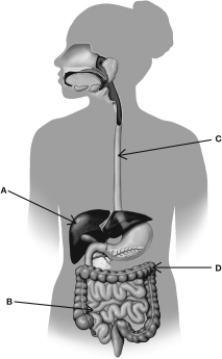
(Multiple Choice)
4.8/5 (75)
(75) Which of the following statements about the amino acids that are required by adult humans is true?
(Multiple Choice)
4.9/5 (96)
(96) A genetic mutation has altered a signaling molecule found embedded within cell membranes. This signaling molecule is most likely a
(Multiple Choice)
4.8/5 (81)
(81) 
Filters
- Essay(0)
- Multiple Choice(0)
- Short Answer(0)
- True False(0)
- Matching(0)