



 Chat with AI
Exam 3: Life Is Cellular

Exam 1: The Nature of Science66 Questions
Exam 2: Chemistry of Life78 Questions
Exam 3: Life Is Cellular72 Questions
Exam 4: How Cells Work64 Questions
Exam 5: Cell Division62 Questions
Exam 6: Patterns of Inheritance67 Questions
Exam 7: Chromosomes and Human Genetics68 Questions
Exam 8: What Genes Are64 Questions
Exam 9: How Genes Work64 Questions
Exam 10: Evidence for Evolution64 Questions
Exam 11: Mechanisms of Evolution64 Questions
Exam 12: Adaptation and Species64 Questions
Exam 13: The History of Life71 Questions
Exam 14: Human Evolution66 Questions
Exam 15: General Principles of Ecology64 Questions
Exam 16: Growth of Populations65 Questions
Exam 17: Communities of Organisms64 Questions
Exam 18: Ecosystems66 Questions
Exam 19: Homeostasis, Reproduction, and Development67 Questions
Exam 20: Digestive, Muscular, and Skeletal Systems66 Questions
Exam 21: Circulatory, Respiratory, Urinary, and Nervous Systems72 Questions
Exam 22: Endocrine and Immune Systems66 Questions
Exam 23: Plant Physiology64 Questions
Exam 24: Applying the Science67 Questions
Select questions type


In your own words, briefly point out the primary difference between prokaryotes and eukaryotes, and then explain what might keep viruses from being included in either of these categories.
(Essay)
4.9/5  (78)
(78) Match the following cellular structures with their primary function (you may need to use a function more than once).
-chloroplast
(Multiple Choice)
4.8/5 (81)
(81) Which of the following would be likely to move through a plasma membrane by simple diffusion?
(Multiple Choice)
4.9/5 (79)
(79) Match the following cellular structures with their primary function (you may need to use a function more than once).
-central vacuole
(Multiple Choice)
4.9/5 (84)
(84) A long piece of ribbon wired along both long edges is twisted into a helix and wrapped around individual pipe cleaners that have been rolled into spools; this grouping is then twisted (super coiled) again to condense it. This could be best used as a simple model for
(Multiple Choice)
4.8/5 (70)
(70) You buy a bunch of small, round, red radishes at the grocery store; they are on sale because they have been sitting in the produce aisle for a while. When you get home you remove the stems and clean them. With the first bite, you notice their texture is not as crisp and crunchy as you like. Your friend says you should refrigerate them in a bowl of water overnight. The next day the radishes are crisp and crunchy again. What is the most likely explanation of why they became crunchy again after soaking in water?
(Multiple Choice)
4.8/5 (83)
(83) A factory with an office that controls the information sent to separate rooms for each of the manufacturing and shipping processes would be analogous to
(Multiple Choice)
4.7/5 (87)
(87) Examine the figure below. If each sugar molecule represents a percentage point of sugar dissolved in the solution, what change would you expect to see in the solution level over time and why? 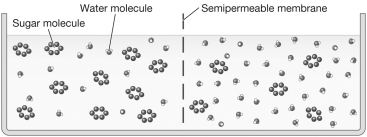
(Multiple Choice)
4.8/5 (86)
(86) An animal cell that contains an extensive network of ________ is likely to be an important source of lipids and/or hormones important in the development and functioning of that animal.
(Short Answer)
4.7/5 (62)
(62) Compare and contrast the nuclear envelope and the plasma membrane.
(Multiple Choice)
4.8/5 (84)
(84) When scientists such as J. C. Venter and Daniel Gibson engineer a cell constructed with synthetic DNA in the laboratory, do they challenge accepted cell theory? If so, which part of cell theory do they challenge? Briefly explain your answer.
(Essay)
4.8/5 (76)
(76) Dialysis tubing is a selectively permeable membrane that can be filled with a solution to simulate a cell. A piece of dialysis tubing has been filled with a cloudy white solution of 5 percent starch, 5 percent egg albumin (protein), and 5 percent glucose (a small sugar) dissolved in water to simulate a cell. This cell is weighed and then placed in a beaker of 3 percent iodine dissolved in water. When iodine and starch are mixed together, they form a bluish-black compound that is easily seen. After soaking in the yellow iodine-water solution for one hour, the cell is once again weighed. You also notice that the solution inside of the cell is now a dark blue color while the solution in the beaker is still a light yellow color from the iodine. What do you expect to happen to the weight of the cell over time and what can you deduce from the color change?
(Multiple Choice)
4.9/5 (70)
(70) 
Filters
- Essay(0)
- Multiple Choice(0)
- Short Answer(0)
- True False(0)
- Matching(0)