



 Chat with AI
Exam 3: Life Is Cellular

Exam 1: The Nature of Science66 Questions
Exam 2: Chemistry of Life78 Questions
Exam 3: Life Is Cellular72 Questions
Exam 4: How Cells Work64 Questions
Exam 5: Cell Division62 Questions
Exam 6: Patterns of Inheritance67 Questions
Exam 7: Chromosomes and Human Genetics68 Questions
Exam 8: What Genes Are64 Questions
Exam 9: How Genes Work64 Questions
Exam 10: Evidence for Evolution64 Questions
Exam 11: Mechanisms of Evolution64 Questions
Exam 12: Adaptation and Species64 Questions
Exam 13: The History of Life71 Questions
Exam 14: Human Evolution66 Questions
Exam 15: General Principles of Ecology64 Questions
Exam 16: Growth of Populations65 Questions
Exam 17: Communities of Organisms64 Questions
Exam 18: Ecosystems66 Questions
Exam 19: Homeostasis, Reproduction, and Development67 Questions
Exam 20: Digestive, Muscular, and Skeletal Systems66 Questions
Exam 21: Circulatory, Respiratory, Urinary, and Nervous Systems72 Questions
Exam 22: Endocrine and Immune Systems66 Questions
Exam 23: Plant Physiology64 Questions
Exam 24: Applying the Science67 Questions
Select questions type


If a bottle of perfume were spilled in the corner of a large lecture hall, the students sitting near that corner of the room would very quickly smell the perfume. Over time, the students sitting in the far corner of the room would smell the perfume. What phenomenon has occurred to the perfume molecules that have entered the air?
(Multiple Choice)
4.9/5  (80)
(80) Many important cellular functions in eukaryotic cells occur within membrane-enclosed organelles, such as cellular respiration occurring within the mitochondria. The membranes of the mitochondria provide a place for enzymes needed for cellular respiration to anchor and function. Prokaryotic cells must also carry out respiration but do not have mitochondria. Where is the most likely place that enzymes needed for cellular respiration are anchored and functioning?
(Multiple Choice)
4.9/5 (77)
(77) Match the following cellular structures with their primary function (you may need to use a function more than once).
-nucleus
(Multiple Choice)
4.9/5 (71)
(71) Adenine (A), thymine (T), guanine (G), and cytosine (C) are the ________ building blocks for DNA; they are organized in different combinations to code for all of the proteins needed to accomplish everything the cell does.
(Multiple Choice)
4.9/5 (91)
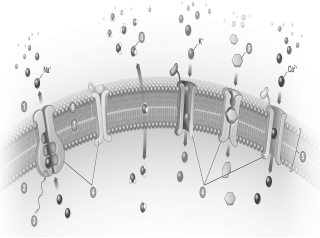
(91) Label this plasma membrane. Use the following terms: cellular environment, external environment, plasma membrane, hydrophilic heads, hydrophobic tails, energy, water, sugar, transport proteins.
(Essay)
4.9/5 (86)
(86) Match the following cellular structures with their primary function (you may need to use a function more than once).
-mitochondrion
(Multiple Choice)
4.8/5 (84)
(84) Why would hydrophilic substances such as sodium ions (Na⁺), hydrogen ions (H⁺), sugars, and amino acids be unable to simply diffuse across a plasma membrane?
(Multiple Choice)
4.8/5 (83)
(83) You are a microbiologist working with a species of bacteria that can perform photosynthesis. You know that the enzymes needed to perform photosynthesis in plant cells are closely associated with the membranes in chloroplasts. Where in the bacteria would you expect to find the enzymes needed to perform photosynthesis?
(Multiple Choice)
4.9/5 (72)
(72) Some antibiotics used to treat bacterial infections kill the bacteria by chemically punching holes in the cell wall of the bacteria, by preventing the bacteria from replicating their DNA, or by many other actions that ultimately cause cell death. Why do these antibiotics not work to kill viruses and cure people of viral infections?
(Multiple Choice)
4.7/5 (88)
(88) Match the following cellular structures with their primary function (you may need to use a function more than once).
-cell wall
(Multiple Choice)
4.8/5 (82)
(82) The plasma membrane of some white blood cells contain ________ that bind with proteins of cells such as bacteria that have invaded the human body. These special proteins tell the white blood cells those bacterial cells do not belong to that particular human and to phagocytize (eat) them.
(Multiple Choice)
4.9/5 (82)
(82) The leaves of a plant typically have different tissue layers that function in different ways. The epidermis layer functions like a covering of skin to protect the leaf while vascular bundles carry water and nutrients through the leaf. The palisade mesophyll layer is responsible for most of the photosynthesis that occurs while the spongy mesophyll layer underneath it aids in the exchange of gases (CO₂ and O₂) and water vapor. In which leaf tissues would you expect to find the highest density of chloroplasts?
(Multiple Choice)
4.7/5 (80)
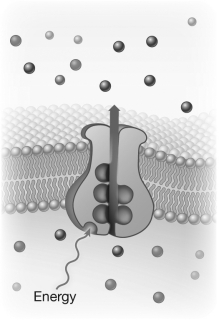
(80) This figure depicts a transport protein in a plasma membrane. The dark blue molecules represent a protein that is being transported out of the cell. Is the transport of the protein active or passive? Support your answer by describing evidence visible in the figure and stating its significance regarding your answer.
(Essay)
4.8/5 (72)
(72) The smallest and most basic units of life are microscopic, self-contained units enclosed by a water repelling membrane and are called ________.
(Short Answer)
4.9/5 (81)
(81) Examine the figure below. If each sugar molecule represents a percentage point of sugar dissolved in the solution, what change would you expect to see in the solution level over time and why? 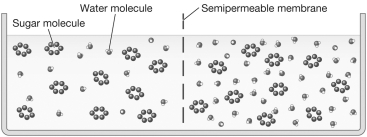
(Multiple Choice)
4.9/5 (83)
(83) You are a scientist observing a membrane through which water and some small hydrophobic molecules can freely pass along a concentration gradient from high to low. However, some sugar molecules are too large to pass through the membrane either way without the assistance of passive transport proteins. Additionally, small Na⁺ ions and some proteins can pass through the membrane against the concentration gradient, but both require the assistance of active transport proteins. What general type of membrane are you observing?
(Multiple Choice)
4.9/5 (79)
(79) Match the following cellular structures with their primary function (you may need to use a function more than once).
-Golgi apparatus
(Multiple Choice)
4.7/5 (93)
(93) Living cells have an intact phospholipid bilayer that separates the cell from its external environment; this structure is commonly referred to as the
(Multiple Choice)
4.9/5 (76)
(76) ________ transport of molecules across a selectively permeable membrane requires the input of energy from the cell whereas ________ transport of molecules across a selectively permeable membrane does not require the use of cellular energy.
(Short Answer)
4.7/5 (94)
(94) 
Filters
- Essay(0)
- Multiple Choice(0)
- Short Answer(0)
- True False(0)
- Matching(0)