



 Chat with AI
Exam 7: Chromosomes and Human Genetics

Exam 1: The Nature of Science66 Questions
Exam 2: Chemistry of Life78 Questions
Exam 3: Life Is Cellular72 Questions
Exam 4: How Cells Work64 Questions
Exam 5: Cell Division62 Questions
Exam 6: Patterns of Inheritance67 Questions
Exam 7: Chromosomes and Human Genetics68 Questions
Exam 8: What Genes Are64 Questions
Exam 9: How Genes Work64 Questions
Exam 10: Evidence for Evolution64 Questions
Exam 11: Mechanisms of Evolution64 Questions
Exam 12: Adaptation and Species64 Questions
Exam 13: The History of Life71 Questions
Exam 14: Human Evolution66 Questions
Exam 15: General Principles of Ecology64 Questions
Exam 16: Growth of Populations65 Questions
Exam 17: Communities of Organisms64 Questions
Exam 18: Ecosystems66 Questions
Exam 19: Homeostasis, Reproduction, and Development67 Questions
Exam 20: Digestive, Muscular, and Skeletal Systems66 Questions
Exam 21: Circulatory, Respiratory, Urinary, and Nervous Systems72 Questions
Exam 22: Endocrine and Immune Systems66 Questions
Exam 23: Plant Physiology64 Questions
Exam 24: Applying the Science67 Questions
Select questions type


A man with a translocation in a chromosome that does not affect gene function may not realize he has a translocation until he attempts to have a child. Explain how a translocation that does not affect the individual may become problematic during reproduction.
(Essay)
4.8/5  (74)
(74) Both members of a couple are carriers for a recessive disease allele. If the couple has four children, which of the following statements must be true?
(Multiple Choice)
4.9/5 (84)
(84) 
Does the pedigree shown most likely represent a condition that is autosomal recessive, dominant, or sex-linked? Explain your reasoning.
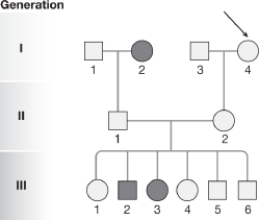
(Essay)
4.9/5 (89)
(89) If a recessive allele causes a fatal disease that kills the affected individual before he or she can reproduce, why doesn't that allele quickly become extinct in the population?
(Multiple Choice)
4.9/5 (87)
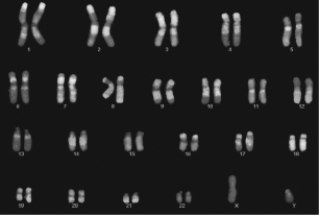
(87) Except for the sex chromosomes, all the chromosomes shown in a karyotype are numbered and are called ________.
(Short Answer)
4.7/5 (90)
(90) The parents in the figure shown are carriers of a genetic disorder. Based on the Punnett square, the allele that causes the disorder must be 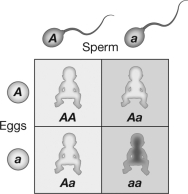
(Multiple Choice)
4.8/5 (78)
(78) 
Filters
- Essay(0)
- Multiple Choice(0)
- Short Answer(0)
- True False(0)
- Matching(0)