



 Chat with AI
Exam 7: Chromosomes and Human Genetics

Exam 1: The Nature of Science66 Questions
Exam 2: Chemistry of Life78 Questions
Exam 3: Life Is Cellular72 Questions
Exam 4: How Cells Work64 Questions
Exam 5: Cell Division62 Questions
Exam 6: Patterns of Inheritance67 Questions
Exam 7: Chromosomes and Human Genetics68 Questions
Exam 8: What Genes Are64 Questions
Exam 9: How Genes Work64 Questions
Exam 10: Evidence for Evolution64 Questions
Exam 11: Mechanisms of Evolution64 Questions
Exam 12: Adaptation and Species64 Questions
Exam 13: The History of Life71 Questions
Exam 14: Human Evolution66 Questions
Exam 15: General Principles of Ecology64 Questions
Exam 16: Growth of Populations65 Questions
Exam 17: Communities of Organisms64 Questions
Exam 18: Ecosystems66 Questions
Exam 19: Homeostasis, Reproduction, and Development67 Questions
Exam 20: Digestive, Muscular, and Skeletal Systems66 Questions
Exam 21: Circulatory, Respiratory, Urinary, and Nervous Systems72 Questions
Exam 22: Endocrine and Immune Systems66 Questions
Exam 23: Plant Physiology64 Questions
Exam 24: Applying the Science67 Questions
Select questions type


If DNA testing reveals that you carry a single allele for a particular genetic disorder but you do not currently show symptoms of the disease, is it possible that you will develop the disease later in life? Explain.
(Essay)
4.7/5  (78)
(78) Among children with parents who are both carriers of Tay-Sachs, an autosomal recessive disorder, chances are that
(Multiple Choice)
4.8/5 (88)
(88) A karyotype from an adult male indicates a chromosomal abnormality, which does not affect his health. Which of the following abnormalities is most likely seen?
(Multiple Choice)
4.8/5 (82)
(82) If the male in generation II was affected, what would the pattern of inheritance most likely be? 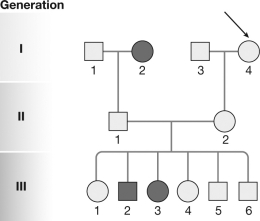
(Multiple Choice)
5.0/5 (84)
(84) In a karyotype of a male, which of the following would indicate an abnormality?
(Multiple Choice)
4.9/5 (96)
(96) A person is genetically XX and develops as a male. How can this be explained?
(Multiple Choice)
5.0/5 (85)
(85) If two parents are heterozygous for an autosomal recessive disease,
(Multiple Choice)
4.7/5 (78)
(78) Every gene in a human occupies a specific position or ________ in their chromosomes.
(Short Answer)
4.8/5 (76)
(76) A parent who is a carrier for the recessive autosomal disorder B has the genotype ________.
(Short Answer)
4.8/5 (77)
(77) What information in a pedigree would indicate a condition is likely dominant?
(Multiple Choice)
4.7/5 (80)
(80) In which of the following situations would looking at a pedigree be most useful?
(Multiple Choice)
4.8/5 (78)
(78) Most inherited human genetic disorders are inherited as ________ alleles.
(Multiple Choice)
4.8/5 (81)
(81) Which of the following genetic changes would NOT be passed from parent to child?
(Multiple Choice)
4.7/5 (66)
(66) Which of the following information is available in a Punnett square showing the inheritance pattern for an autosomal recessive disorder?
(Multiple Choice)
4.9/5 (75)
(75) The pedigree shown diagrams an X-linked gene. The individual indicated is ________ for the gene. 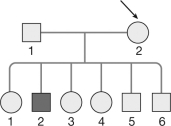
(Multiple Choice)
4.8/5 (72)
(72) A karyotype of an individual with mild mental retardation shows three copies of the X chromosome. If this individual decides to have children, how is her chromosomal abnormality likely to affect her offspring?
(Multiple Choice)
4.8/5 (87)
(87) Chromosomes that are NOT involved in determining gender are known as
(Multiple Choice)
4.7/5 (95)
(95) 
Filters
- Essay(0)
- Multiple Choice(0)
- Short Answer(0)
- True False(0)
- Matching(0)