



 Chat with AI
Exam 16: Growth of Populations

Exam 1: The Nature of Science66 Questions
Exam 2: Chemistry of Life78 Questions
Exam 3: Life Is Cellular72 Questions
Exam 4: How Cells Work64 Questions
Exam 5: Cell Division62 Questions
Exam 6: Patterns of Inheritance67 Questions
Exam 7: Chromosomes and Human Genetics68 Questions
Exam 8: What Genes Are64 Questions
Exam 9: How Genes Work64 Questions
Exam 10: Evidence for Evolution64 Questions
Exam 11: Mechanisms of Evolution64 Questions
Exam 12: Adaptation and Species64 Questions
Exam 13: The History of Life71 Questions
Exam 14: Human Evolution66 Questions
Exam 15: General Principles of Ecology64 Questions
Exam 16: Growth of Populations65 Questions
Exam 17: Communities of Organisms64 Questions
Exam 18: Ecosystems66 Questions
Exam 19: Homeostasis, Reproduction, and Development67 Questions
Exam 20: Digestive, Muscular, and Skeletal Systems66 Questions
Exam 21: Circulatory, Respiratory, Urinary, and Nervous Systems72 Questions
Exam 22: Endocrine and Immune Systems66 Questions
Exam 23: Plant Physiology64 Questions
Exam 24: Applying the Science67 Questions
Select questions type


Which of the following has NOT been shown to be a consequence of China's one-child policy?
(Multiple Choice)
5.0/5  (93)
(93) Which of the following populations would be most vulnerable to an outbreak of disease?
(Multiple Choice)
4.8/5 (77)
(77) This figure shows that the human population was small and relatively stable for nearly 12,000 years but has increased dramatically in the past 200 years. How might this increase in population growth be explained? 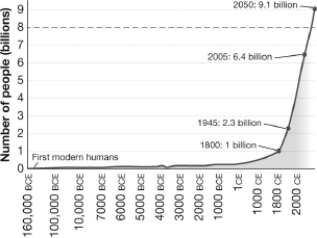
(Multiple Choice)
4.8/5 (75)
(75) Which of the following would likely occur as a population reaches carrying capacity?
(Multiple Choice)
4.8/5 (72)
(72) Use a specific example to explain how population density may change for people living in one country without any change in population size.
(Essay)
4.7/5 (82)
(82) The carrying capacity of owls in an Alaskan forest is seven per square kilometer. What will happen if twelve owls are confined to a 1-square-kilometer area?
(Multiple Choice)
4.8/5 (87)
(87) Is it reasonable to expect that all habitats suitable for a given organism will have the same carrying capacity for that organism?
(Multiple Choice)
4.7/5 (77)
(77) Match each term to a statement listed below.
-total number of individuals in a population within a given area
(Multiple Choice)
4.9/5 (83)
(83) If we humans do not limit our population growth rate, we will exceed the ________ of our environment, leading to a larger population than the environment can support.
(Short Answer)
4.8/5 (88)
(88) Which of the following statements does NOT explain why population density is often difficult to measure?
(Multiple Choice)
4.9/5 (83)
(83) A population of 100 individuals has a doubling time of 25 years. What size will this population be in 100 years?
(Multiple Choice)
4.9/5 (84)
(84) This graph shows the growth of a population of Paramecium caudatum. The greatest amount of daily growth occurred when the population was at approximately ________ percent of its carrying capacity. 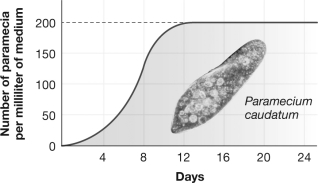
(Multiple Choice)
4.9/5 (77)
(77) According to the figure shown, human populations began to experience exponential growth around 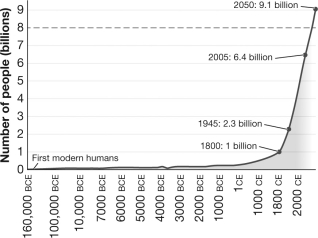
(Multiple Choice)
4.7/5 (66)
(66) Which of the following populations would be most likely to experience a J-shaped growth pattern?
(Multiple Choice)
4.8/5 (79)
(79) Which of the following factors has probably contributed the least to declining fertility rates in China over the past 50 years?
(Multiple Choice)
5.0/5 (79)
(79) Match each term to a statement listed below.
-unlimited growth of a population with no constraint on resources
(Multiple Choice)
4.8/5 (73)
(73) One measure of population growth is the period in which a population increases to twice its size. This is referred to as the ________ of the population.
(Short Answer)
4.8/5 (81)
(81) 
Filters
- Essay(0)
- Multiple Choice(0)
- Short Answer(0)
- True False(0)
- Matching(0)