



 Chat with AI
Exam 22: Endocrine and Immune Systems

Exam 1: The Nature of Science66 Questions
Exam 2: Chemistry of Life78 Questions
Exam 3: Life Is Cellular72 Questions
Exam 4: How Cells Work64 Questions
Exam 5: Cell Division62 Questions
Exam 6: Patterns of Inheritance67 Questions
Exam 7: Chromosomes and Human Genetics68 Questions
Exam 8: What Genes Are64 Questions
Exam 9: How Genes Work64 Questions
Exam 10: Evidence for Evolution64 Questions
Exam 11: Mechanisms of Evolution64 Questions
Exam 12: Adaptation and Species64 Questions
Exam 13: The History of Life71 Questions
Exam 14: Human Evolution66 Questions
Exam 15: General Principles of Ecology64 Questions
Exam 16: Growth of Populations65 Questions
Exam 17: Communities of Organisms64 Questions
Exam 18: Ecosystems66 Questions
Exam 19: Homeostasis, Reproduction, and Development67 Questions
Exam 20: Digestive, Muscular, and Skeletal Systems66 Questions
Exam 21: Circulatory, Respiratory, Urinary, and Nervous Systems72 Questions
Exam 22: Endocrine and Immune Systems66 Questions
Exam 23: Plant Physiology64 Questions
Exam 24: Applying the Science67 Questions
Select questions type


Which of the following is most likely to be the target of a T cell?
(Multiple Choice)
4.7/5  (75)
(75) ________ cells remain in our body after the initial exposure to a disease-causing organism, and they help the immune system recognize that particular organism during a second exposure.
(Short Answer)
4.8/5 (69)
(69) Hormones often alter ________ by turning a certain gene or group of genes on or off.
(Short Answer)
4.9/5 (86)
(86) Match the chemical, cell, or tissue with the function it performs in the immune response.
-molecules secreted by immune cells for initiation and regulation of immune responses
(Multiple Choice)
4.9/5 (79)
(79) Which of the following organs coordinate(s) communication between the endocrine system and the nervous system?
(Multiple Choice)
4.8/5 (78)
(78) White blood cells of the innate immune response ________, whereas white blood cells of the adaptive immune response ________.
(Multiple Choice)
4.9/5 (88)
(88) In the vertebrate immune response to a pathogen, which of the following would occur first?
(Multiple Choice)
4.9/5 (77)
(77) Create a table that lists components of the immune system's first, second, and third lines of defense. You must list at least two examples in each column.
(Essay)
4.9/5 (75)
(75) Why is it important that white blood cells are able to travel outside the human circulatory system?
(Multiple Choice)
5.0/5 (77)
(77) In preparation for your Biology exam, you study endocrine signaling with a classmate. Your classmate suggests that all forms of signaling require receptors in order to affect target cells. Do you agree with your classmate? Explain why or why not.
(Essay)
5.0/5 (81)
(81) Which of the following statements about memory cells is true?
(Multiple Choice)
4.9/5 (78)
(78) How do phagocytes of the innate immune system differ in function from lymphocytes of the adaptive immune system?
(Essay)
4.8/5 (83)
(83) Which of the following statements accurately describes hormonal signaling, as depicted in this figure? 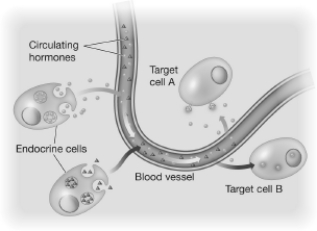
(Multiple Choice)
5.0/5 (81)
(81) Match the chemical, cell, or tissue with the function it performs in the immune response.
-phagocytize pathogens during inflammation
(Multiple Choice)
4.8/5 (67)
(67) In hormonal signaling, are target cells typically close to or far away from endocrine cells? Explain your answer.
(Essay)
4.9/5 (81)
(81) Which of the following prevents both blood loss and the invasion of pathogens in vertebrates?
(Multiple Choice)
4.8/5 (87)
(87) 
Filters
- Essay(0)
- Multiple Choice(0)
- Short Answer(0)
- True False(0)
- Matching(0)