



 Chat with AI
Exam 14: Human Evolution

Exam 1: The Nature of Science66 Questions
Exam 2: Chemistry of Life78 Questions
Exam 3: Life Is Cellular72 Questions
Exam 4: How Cells Work64 Questions
Exam 5: Cell Division62 Questions
Exam 6: Patterns of Inheritance67 Questions
Exam 7: Chromosomes and Human Genetics68 Questions
Exam 8: What Genes Are64 Questions
Exam 9: How Genes Work64 Questions
Exam 10: Evidence for Evolution64 Questions
Exam 11: Mechanisms of Evolution64 Questions
Exam 12: Adaptation and Species64 Questions
Exam 13: The History of Life71 Questions
Exam 14: Human Evolution66 Questions
Exam 15: General Principles of Ecology64 Questions
Exam 16: Growth of Populations65 Questions
Exam 17: Communities of Organisms64 Questions
Exam 18: Ecosystems66 Questions
Exam 19: Homeostasis, Reproduction, and Development67 Questions
Exam 20: Digestive, Muscular, and Skeletal Systems66 Questions
Exam 21: Circulatory, Respiratory, Urinary, and Nervous Systems72 Questions
Exam 22: Endocrine and Immune Systems66 Questions
Exam 23: Plant Physiology64 Questions
Exam 24: Applying the Science67 Questions
Select questions type


You are a researcher excavating a site in a cave in Israel. There are many layers of sediment and primitive artifacts (flint tools for cutting and scraping) from ancestral Homo species within the cave. As you work your way deeper and deeper through the layers, you notice that artifacts in the deeper layers (laid before 350,000 years ago) do not show any signs of having been exposed to fire. Artifacts in layers less than 350 tya show rapidly increasing evidence of exposure to fire. Your colleagues working in nearby caves and caves scattered around the eastern Mediterranean Sea have found similar evidence dating in the same time frames. The evidence is also consistent with that of European sites. What does this suggest about the use of fire by ancestral humans?
(Multiple Choice)
4.8/5  (94)
(94) It is possible that modern humans may have comingled with which of these other ancestors?
(Multiple Choice)
4.9/5 (94)
(94) Fossilized hominin bones have been found in Germany along with some tools and evidence of charred and fossilized bones from large animals dating to about 350,000 years ago. The hominin bones bear resemblance to both Homo erectus and Homo sapiens. Which of the following is the most likely possible identity of these fossils?
(Multiple Choice)
4.7/5 (83)
(83) The first vertebrates to evolve lacked jaws and had skeletons made from a strong flexible tissue called cartilage. The lamprey is a modern example of this ancient group of vertebrates known as
(Multiple Choice)
4.8/5 (90)
(90) Using this hominin evolutionary tree, indicate roughly when DNA from Neanderthals would have been introduced to the human genome if that Neanderthal DNA was a remnant from a common hominin ancestor. Support your answer by indicating which hominin would be the most likely candidate as the ancestor.
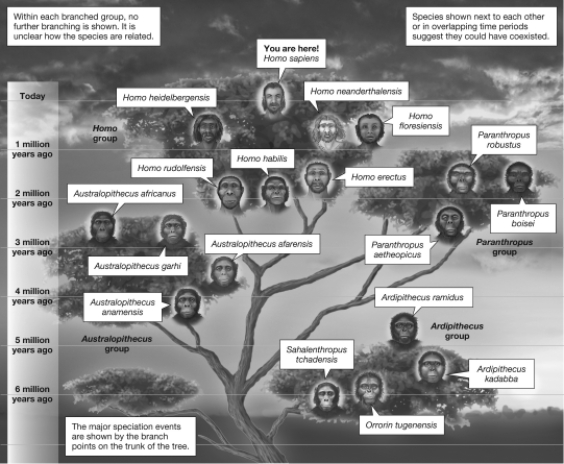
(Essay)
4.7/5 (74)
(74) Fossils from different species of the genus Homo dating from 1.7-1.9 mya have been found in ecologically diverse areas across central Asia, China, and Indonesia. These species appear to be closely related to Homo erectus. Which of the following is a likely explanation of these findings?
(Multiple Choice)
4.7/5 (89)
(89) 
Filters
- Essay(0)
- Multiple Choice(0)
- Short Answer(0)
- True False(0)
- Matching(0)