



 Chat with AI
Exam 14: Human Evolution

Exam 1: The Nature of Science66 Questions
Exam 2: Chemistry of Life78 Questions
Exam 3: Life Is Cellular72 Questions
Exam 4: How Cells Work64 Questions
Exam 5: Cell Division62 Questions
Exam 6: Patterns of Inheritance67 Questions
Exam 7: Chromosomes and Human Genetics68 Questions
Exam 8: What Genes Are64 Questions
Exam 9: How Genes Work64 Questions
Exam 10: Evidence for Evolution64 Questions
Exam 11: Mechanisms of Evolution64 Questions
Exam 12: Adaptation and Species64 Questions
Exam 13: The History of Life71 Questions
Exam 14: Human Evolution66 Questions
Exam 15: General Principles of Ecology64 Questions
Exam 16: Growth of Populations65 Questions
Exam 17: Communities of Organisms64 Questions
Exam 18: Ecosystems66 Questions
Exam 19: Homeostasis, Reproduction, and Development67 Questions
Exam 20: Digestive, Muscular, and Skeletal Systems66 Questions
Exam 21: Circulatory, Respiratory, Urinary, and Nervous Systems72 Questions
Exam 22: Endocrine and Immune Systems66 Questions
Exam 23: Plant Physiology64 Questions
Exam 24: Applying the Science67 Questions
Select questions type


Fossil evidence indicates that the first members of the genus Homo arose approximately ________ years ago.
(Multiple Choice)
4.8/5  (78)
(78) Which of the following categories of the Linnaean hierarchy would include the broadest range of related organisms?
(Multiple Choice)
4.9/5 (92)
(92) When a group of organisms like Homo erectus expands to take on new ecological roles forming new species of hominins who are able to live in a broad range of new environments, that group is said to have undergone ________.
(Short Answer)
4.8/5 (96)
(96) Which of the following groupings of animals are most closely related to each other?
(Multiple Choice)
4.8/5 (86)
(86) The fossil of a male hominin is discovered, and it appears to share traits with both humans and Neanderthals. What could mitochondrial-DNA sequencing and whole-genome DNA sequencing tell you about the fossil's parents?
(Essay)
4.9/5 (82)
(82) Would a hominin evolutionary tree look thin and spindly or full and bushy?
(Multiple Choice)
4.9/5 (77)
(77) Examine the following Hominin evolutionary tree. Which of the following genera are most closely related? 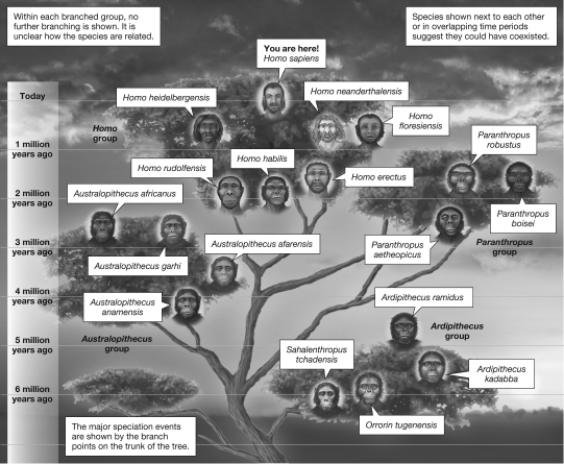
(Multiple Choice)
4.8/5 (77)
(77) If evidence indicates that Homo erectus and Homo habilis used stone tools and may have been able to use fire, which of the following is also likely?
(Multiple Choice)
4.8/5 (83)
(83) You are evaluating DNA from a fossil and hypothesize that the mother was a Neanderthal and the father was a human. Which of the following would support your hypothesis?
(Multiple Choice)
4.9/5 (79)
(79) You are camping in the south central United States when one evening you happen across an animal with several "armored" plates covering its back and shoulders. The plates are bony and separated by thin bands of flexible skin. The belly of this short-legged quadruped is covered with skin and soft fur. You also notice four young ones scurrying along with the adult. This animal most likely belongs to which class?
(Multiple Choice)
4.8/5 (81)
(81) The correct two-word Latin, scientific name, for modern humans is
(Multiple Choice)
4.8/5 (77)
(77) Match the following levels of human classification with the appropriate levels of the Linnaean hierarchy.
-Genus
(Multiple Choice)
4.8/5 (91)
(91) Members of the "human" branch of the ape family, including modern humans as well as our extinct relatives, are properly referred to as ________.
(Short Answer)
4.8/5 (83)
(83) Match the following levels of human classification with the appropriate levels of the Linnaean hierarchy.
-Order
(Multiple Choice)
4.9/5 (62)
(62) If your mitochondrial DNA was sequenced and compared to the sequence of mitochondrial DNA isolated from your mother's paternal grandmother (the mother of your mom's dad) would you expect to see a significant match to yours and why?
(Multiple Choice)
4.8/5 (78)
(78) Fossil evidence from around the world indicates that anatomically modern humans first evolved in Africa about 195,000-200,000 years ago from a population of archaic Homo sapiens and then successfully migrated to and inhabited almost all continents by 13,000 years ago. During literally tens of thousands of years, modern humans lived alongside other ________ populations, eventually replacing them.
(Short Answer)
4.7/5 (69)
(69) The phylum Chordata includes several subgroups of organisms. To which of these subgroups would humans belong?
(Multiple Choice)
5.0/5 (67)
(67) 
Filters
- Essay(0)
- Multiple Choice(0)
- Short Answer(0)
- True False(0)
- Matching(0)