



 Chat with AI
Exam 14: Human Evolution

Exam 1: The Nature of Science66 Questions
Exam 2: Chemistry of Life78 Questions
Exam 3: Life Is Cellular72 Questions
Exam 4: How Cells Work64 Questions
Exam 5: Cell Division62 Questions
Exam 6: Patterns of Inheritance67 Questions
Exam 7: Chromosomes and Human Genetics68 Questions
Exam 8: What Genes Are64 Questions
Exam 9: How Genes Work64 Questions
Exam 10: Evidence for Evolution64 Questions
Exam 11: Mechanisms of Evolution64 Questions
Exam 12: Adaptation and Species64 Questions
Exam 13: The History of Life71 Questions
Exam 14: Human Evolution66 Questions
Exam 15: General Principles of Ecology64 Questions
Exam 16: Growth of Populations65 Questions
Exam 17: Communities of Organisms64 Questions
Exam 18: Ecosystems66 Questions
Exam 19: Homeostasis, Reproduction, and Development67 Questions
Exam 20: Digestive, Muscular, and Skeletal Systems66 Questions
Exam 21: Circulatory, Respiratory, Urinary, and Nervous Systems72 Questions
Exam 22: Endocrine and Immune Systems66 Questions
Exam 23: Plant Physiology64 Questions
Exam 24: Applying the Science67 Questions
Select questions type


In the eighteenth century, a Swedish naturalist devised a system of biological classification known as ________.
(Short Answer)
4.9/5  (89)
(89) Examine the skulls shown in this figure. What can be said regarding trends in braincase size and teeth over time? 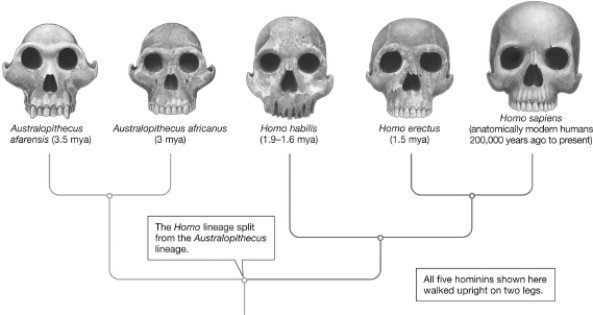
(Multiple Choice)
4.8/5 (80)
(80) What evidence would support the hypothesis that Neanderthals evolved sometime after hominins migrated out of Africa?
(Multiple Choice)
4.8/5 (77)
(77) What does the positioning of the toe indicated by the arrow in this figure suggest about the owner of this fossil hominid foot? 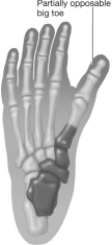
(Multiple Choice)
4.9/5 (71)
(71) Match the following levels of human classification with the appropriate levels of the Linnaean hierarchy.
-Class
(Multiple Choice)
4.8/5 (81)
(81) What evidence would support the hypothesis that a male Homo sapiens mated with a female Homo neanderthalensis and produced offspring?
(Essay)
4.8/5 (79)
(79) Which of the following could NOT be used to describe humans?
(Multiple Choice)
4.8/5 (83)
(83) Fossilized foot bones show that some hominids living between 3 and 3.5 mya walked upright but had partially opposable big toes. This suggests that
(Multiple Choice)
4.8/5 (89)
(89) List in order from most exclusive to most inclusive the seven levels of the Linnaean hierarchy of biological classification.
(Essay)
4.9/5 (65)
(65) Which of the following best describes the source of your mitochondrial DNA?
(Multiple Choice)
4.7/5 (84)
(84) Consider that fossils of Homo erectus dating between 1.66 to 1.85 mya have been found scattered across Eastern Europe through China and Southeast Asia and dating back to 2.4 mya in Africa. The earliest known specimens of anatomically modern Homo sapiens in Africa date back to roughly 200,000 years ago and 40,000 to 60,000 years ago across Europe and Asia with some at 115,000 years ago in India. Additionally, Homo neanderthalensis was present across Europe by 150,000 years ago and then spread into western Asia. What does this suggest about the "out-of-Africa" hypothesis?
(Multiple Choice)
4.7/5 (79)
(79) Which of the following categories of the Linnaean hierarchy would include the most closely related organisms?
(Multiple Choice)
4.9/5 (70)
(70) Which of the following adaptations was NOT required to facilitate the evolution of animal life on land?
(Multiple Choice)
4.9/5 (66)
(66) The infamous American outlaw, Jesse Woodson James, died April 3, 1882. His body was originally interred on the James' farm but was later moved to Mt. Olivet Cemetery in Kearney, Nebraska. Some people have hypothesized that his death was staged. Researchers have exhumed the body and analyzed mitochondrial DNA found in the teeth with that of mitochondrial DNA from hair samples from the James' farm burial site; they matched. These samples were then compared to the mitochondrial DNA of Jesse's sister Susan's great-grandson and her great-great-grandson. Which of the following would support the hypothesis that the body buried in Mt. Olivet Cemetery is NOT Jesse James?
(Multiple Choice)
5.0/5 (76)
(76) Match the following levels of human classification with the appropriate levels of the Linnaean hierarchy.
-Phylum
(Multiple Choice)
4.7/5 (83)
(83) You are on an archaeological dig in Africa when you find a collection of stone tools along with several skeletons in a cave. These bipedal skeletons date to about 3.5 million years ago and show no evidence of a partially opposable toe. Measurements indicate the brains would have been a little less than a third of the volume of modern humans. The teeth found on these skeletons look more like those of an ape than those of a human. Your skeletal discovery is most likely which of the following?
(Multiple Choice)
4.7/5 (80)
(80) Consider that fossils of Homo erectus dating between 1.66 to 1.85 mya have been found scattered across Eastern Europe through China and Southeast Asia and dating back to 2.4 mya in Africa. The earliest known specimens of anatomically modern Homo sapiens in Africa date back to roughly 200,000 years ago and 40,000 to 60,000 years ago across Europe and Asia with some at 115,000 years ago in India. Additionally, Homo neanderthalensis was present across Europe by 150,000 years ago and then spread into western Asia. If there were no evidence indicating the presence of any other early Homo species in Europe, which of the following hypotheses might be supported by this information?
(Multiple Choice)
4.8/5 (84)
(84) According to this evolutionary tree, when did hominins branch away from the other apes? 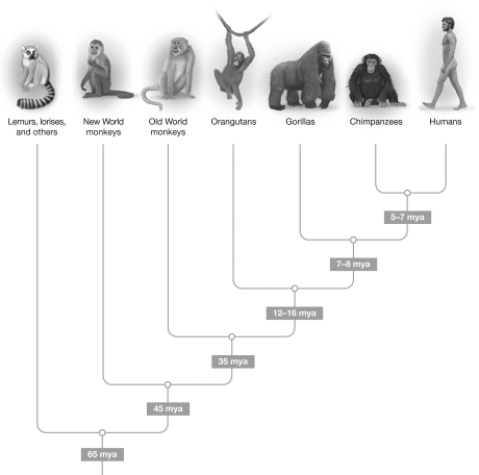
(Multiple Choice)
4.9/5 (87)
(87) 
Filters
- Essay(0)
- Multiple Choice(0)
- Short Answer(0)
- True False(0)
- Matching(0)