



 Chat with AI
Exam 16: Oligopoly

Exam 1: Ten Principles of Economics237 Questions
Exam 2: Thinking Like an Economist267 Questions
Exam 3: Interdependence and the Gains From Trade217 Questions
Exam 4: The Market Forces of Supply and Demand303 Questions
Exam 5: Elasticity and Its Applications282 Questions
Exam 6: Supply, demand, and Government Policies252 Questions
Exam 7: Consumers, producers, and the Efficiency of Markets248 Questions
Exam 8: Application: the Costs of Taxation245 Questions
Exam 9: Application: International Trade245 Questions
Exam 10: Externalities288 Questions
Exam 11: Public Goods and Common Resources258 Questions
Exam 12: The Design of the Tax System328 Questions
Exam 13: The Costs of Production303 Questions
Exam 14: Firms in Competitive Markets271 Questions
Exam 15: Monopoly306 Questions
Exam 16: Oligopoly291 Questions
Exam 17: Monopolistic Competition257 Questions
Exam 18: The Markets for the Factors of Production284 Questions
Exam 19: Earnings and Discrimination286 Questions
Exam 20: Income Inequality and Poverty247 Questions
Exam 21: The Theory of Consumer Choice238 Questions
Exam 22: Frontiers of Microeconomics199 Questions
Exam 23: Measuring a Nations Income215 Questions
Exam 24: Measuring the Cost of Living208 Questions
Exam 25: Production and Growth240 Questions
Exam 26: Saving, investment, and the Financial System282 Questions
Exam 27: The Basic Tools of Finance249 Questions
Exam 28: Unemployment242 Questions
Exam 29: The Monetary System277 Questions
Exam 30: Money Growth and Inflation224 Questions
Exam 31: Open-Economy Macroeconomics: Basic Concepts256 Questions
Exam 32: A Macroeconomic Theory of the Open Economy217 Questions
Exam 33: Aggregate Demand and Aggregate Supply302 Questions
Exam 34: The Influence of Monetary and Fiscal Policy on Aggregate Demand249 Questions
Exam 35: The Short Run Trade Off Between Inflation and Unemployment246 Questions
Exam 36: Five Debates Over Macroeconomic Policy140 Questions
Select questions type


Table 16-3
The information in the table below shows the total demand for premium-channel digital cable TV subscriptions in a small urban market. Assume that each digital cable TV operator pays a fixed cost of $100,000 (per year) to provide premium digital channels in the market area and that the marginal cost of providing the premium channel service to a household is zero.
 -Refer to Table 16-3.Assume that there are two profit-maximizing digital cable TV companies operating in this market.Further assume that they are not able to collude on the price and quantity of premium digital channel subscriptions to sell.How many premium digital channel cable TV subscriptions will be sold altogether when this market reaches a Nash equilibrium?
 (Multiple Choice)
4.8/5  (70)
(70) Even when allowed to collude,firms in an oligopoly may choose to cheat on their agreements with the rest of the cartel.Why?
(Essay)
4.9/5 (82)
(82) When firms have agreements among themselves on the quantity to produce and the price at which to sell output,we refer to their form of organization as a
(Multiple Choice)
4.9/5 (74)
(74) Scenario 16-2
Imagine that two oil companies, Big Petro Inc. and Gargantuan Gas, own adjacent oil fields. Under the fields is a common pool of oil worth $48 million. Drilling a well to recover oil costs $2 million per well. If each company drills one well, each will get half of the oil and earn a $22 million profit ($24 million in revenue - $2 million in costs). Assume that having X percent of the total wells means that a company will collect X percent of the total revenue.
-Refer to Scenario 16-2.If Big Petro Inc.were to drill a second well and Gargantuan Gas also drilled a second well,what would Big Petro Inc's profit be?
(Multiple Choice)
4.8/5 (66)
(66) Table 16-12
 -Refer to Table 16-12.This table shows a game played between two players,A and B.The payoffs in the table are shown as (Payoff to A,Payoff to B).Which of the following outcomes represents a Nash equilibrium in the game?
 (Multiple Choice)
4.9/5 (80)
(80) After initial success,the OPEC cartel saw the price of oil and the revenues of its members decline due,in part,to
(Multiple Choice)
4.9/5 (83)
(83) The players in a two-person game are choosing between Strategy X and Strategy Y.If the second player chooses Strategy X,the first player's best outcome is to select X.If the second player chooses Strategy Y,the first player's best outcome is to select X.For the first player,Strategy X is called a
(Multiple Choice)
4.8/5 (73)
(73) Table 16-17
Amy and Heather are two college roommates who both prefer a clean common space in their dorm room, but neither enjoys cleaning. The roommates must each make a decision to either clean or not clean the dorm room's common space. The payoff table for this situation is provided below. The payoffs in each cell are shown as (Amy, Heather).
 -Refer to Table 16-17.If Amy chooses Clean,what will Heather choose to do? And if Amy chooses Clean,what will Heather's payoff equal?
 (Multiple Choice)
4.7/5 (86)
(86) Assuming that oligopolists do not have the opportunity to collude,once they have reached the Nash equilibrium,it
(Multiple Choice)
4.8/5 (97)
(97) Self-interest will typically cause a duopoly's (i) total level of output to exceed the monopoly level.
(ii) total level of output to exceed the competitive level.
(iii) price to fall short of the monopoly price.
(Multiple Choice)
4.8/5 (70)
(70) One key difference between an oligopoly market and a competitive market is that oligopolistic firms
(Multiple Choice)
4.8/5 (65)
(65) An agreement among firms regarding price and/or production levels is called
(Multiple Choice)
4.8/5 (81)
(81) Resale price maintenance prevents retailers from competing on price.
(True/False)
4.8/5 (83)
(83) Table 16-11
 -Refer to Table 16-11.This table shows a game played between two players,A and B.The payoffs in the table are shown as (Payoff to A,Payoff to B).Which of the following statements about this game is true?
 (Multiple Choice)
5.0/5 (71)
(71) If duopolists individually pursue their own self-interest when deciding how much to produce,the amount they will produce collectively will
(Multiple Choice)
4.8/5 (92)
(92) Table 16-10
Two discount superstores (Ultimate Saver and SuperDuper Saver) in a growing urban area are interested in expanding their market share. Both are interested in expanding the size of their store and parking lot to accommodate potential growth in their customer base. The following game depicts the strategic outcomes that result from the game. Growth-related profits of the two discount superstores are shown in the table below.
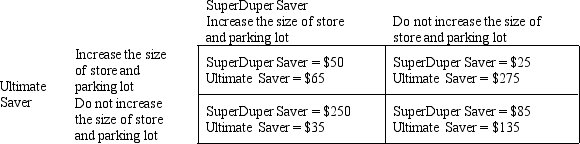 -Refer to Table 16-10.If both stores follow a dominant strategy,Ultimate Saver's growth-related profits will be
 (Multiple Choice)
4.8/5 (70)
(70) Scenario 16-2
Imagine that two oil companies, Big Petro Inc. and Gargantuan Gas, own adjacent oil fields. Under the fields is a common pool of oil worth $48 million. Drilling a well to recover oil costs $2 million per well. If each company drills one well, each will get half of the oil and earn a $22 million profit ($24 million in revenue - $2 million in costs). Assume that having X percent of the total wells means that a company will collect X percent of the total revenue.
-Refer to Scenario 16-2.Gargantuan Gas's dominant strategy would lead to what sort of well-drilling behavior?
(Multiple Choice)
4.7/5 (72)
(72) If Levi Strauss & Co.were to require every retailer that carried its clothing to charge customers $42 for each pair of jeans,Levi Strauss & Co.would be practicing
(Multiple Choice)
4.9/5 (86)
(86) 
Filters
- Essay(0)
- Multiple Choice(0)
- Short Answer(0)
- True False(0)
- Matching(0)