



 Chat with AI
Exam 16: Oligopoly

Exam 1: Ten Principles of Economics237 Questions
Exam 2: Thinking Like an Economist267 Questions
Exam 3: Interdependence and the Gains From Trade217 Questions
Exam 4: The Market Forces of Supply and Demand303 Questions
Exam 5: Elasticity and Its Applications282 Questions
Exam 6: Supply, demand, and Government Policies252 Questions
Exam 7: Consumers, producers, and the Efficiency of Markets248 Questions
Exam 8: Application: the Costs of Taxation245 Questions
Exam 9: Application: International Trade245 Questions
Exam 10: Externalities288 Questions
Exam 11: Public Goods and Common Resources258 Questions
Exam 12: The Design of the Tax System328 Questions
Exam 13: The Costs of Production303 Questions
Exam 14: Firms in Competitive Markets271 Questions
Exam 15: Monopoly306 Questions
Exam 16: Oligopoly291 Questions
Exam 17: Monopolistic Competition257 Questions
Exam 18: The Markets for the Factors of Production284 Questions
Exam 19: Earnings and Discrimination286 Questions
Exam 20: Income Inequality and Poverty247 Questions
Exam 21: The Theory of Consumer Choice238 Questions
Exam 22: Frontiers of Microeconomics199 Questions
Exam 23: Measuring a Nations Income215 Questions
Exam 24: Measuring the Cost of Living208 Questions
Exam 25: Production and Growth240 Questions
Exam 26: Saving, investment, and the Financial System282 Questions
Exam 27: The Basic Tools of Finance249 Questions
Exam 28: Unemployment242 Questions
Exam 29: The Monetary System277 Questions
Exam 30: Money Growth and Inflation224 Questions
Exam 31: Open-Economy Macroeconomics: Basic Concepts256 Questions
Exam 32: A Macroeconomic Theory of the Open Economy217 Questions
Exam 33: Aggregate Demand and Aggregate Supply302 Questions
Exam 34: The Influence of Monetary and Fiscal Policy on Aggregate Demand249 Questions
Exam 35: The Short Run Trade Off Between Inflation and Unemployment246 Questions
Exam 36: Five Debates Over Macroeconomic Policy140 Questions
Select questions type


Because each oligopolist cares about its own profit rather than the collective profit of all the oligopolists together,
(Multiple Choice)
4.9/5  (76)
(76) Table 16-9
Each year the United States considers renewal of Most Favored Nation (MFN) trading status with China. Historically, legislators have made threats of not renewing MFN status because of human rights abuses in China. The non renewal of MFN trading status is likely to involve some retaliatory measures by China. The payoff table below shows the potential economic gains associated with a game in which China may impose trade sanctions against U.S. firms and the United States may not renew MFN status with China. The table contains the dollar value of all trade-flow benefits to the United States and China.
 -Refer to Table 16-9.If trade negotiators are able to communicate effectively about the consequences of various trade policies (i.e.,enter into an agreement about the policy they should adopt),then we would expect the countries to agree to which outcome?
 (Multiple Choice)
5.0/5 (68)
(68) Assume that Apple Computer has entered into an enforceable resale price maintenance agreement with Computer Super Stores Inc.(CSS Inc.)and Wal-Mart.Which of the following will always be true?
(Multiple Choice)
4.9/5 (76)
(76) A law that encourages market competition by prohibiting firms from gaining or exercising excessive market power is
(Multiple Choice)
4.8/5 (86)
(86) Table 16-1
The following table shows the percentage of output supplied by the top eight firms in four different industries.
 -Refer to Table 16-1.Which industry has the lowest concentratio ratio?
 (Multiple Choice)
4.9/5 (65)
(65) Oligopolists may well be able to reach their preferred,cooperative outcome if
(Multiple Choice)
4.9/5 (79)
(79) A firm in a monopolistically competitive market is similar to a monopolist in the sense that it
(Multiple Choice)
4.9/5 (72)
(72) Table 16-6
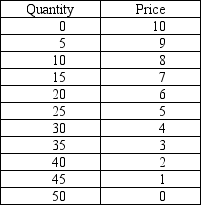 -Refer to Table 16-6.This table shows the demand schedule for a particular product.Suppose the marginal cost to produce this product is constant at $2 per unit.If this market is served by two duopolists who choose their production levels independently,acting in their own self-interest,what is the Nash equilibrium production level for each firm?
 (Multiple Choice)
4.7/5 (89)
(89) A situation in which firms choose their best strategy given the strategies chosen by the other firms in the market is called
(Multiple Choice)
4.9/5 (66)
(66) One way that public policy encourages cooperation among oligopolists is through antitrust law.
(True/False)
4.7/5 (90)
(90) Which of these situations produces the largest profits for oligopolists?
(Multiple Choice)
4.8/5 (77)
(77) The practice of requiring someone to buy two or more items together,rather than separately,is called
(Multiple Choice)
4.8/5 (78)
(78) Scenario 16-5
Assume that a local bank sells two services, checking accounts and ATM card services. Mr. Donethat is willing to pay $8 a month for the bank to service his checking account and $2 a month for unlimited use of his ATM card. Ms. Beenthere is willing to pay only $5 for a checking account, but is willing to pay $9 for unlimited use of her ATM card. Assume that the bank can provide each of these services at zero marginal cost.
-Refer to Scenario 16-5.If the bank is unable to use tying,what is the profit-maximizing price to charge for a checking account?
(Multiple Choice)
4.9/5 (76)
(76) To move the allocation of resources closer to the social optimum,policymakers should typically try to induce firms in an oligopoly to
(Multiple Choice)
4.8/5 (88)
(88) Table 16-16
Consider a small town that has two grocery stores from which residents can choose to buy a gallon of milk. The store owners each must make a decision to set a high milk price or a low milk price. The payoff table, showing profit per week, is provided below. The profit in each cell is shown as (Store 1, Store 2).
 -Refer to Table 16-16.What is the Nash Equilibrium of this price-setting game?
 (Multiple Choice)
4.8/5 (80)
(80) The equilibrium quantity in markets characterized by oligopoly is
(Multiple Choice)
4.8/5 (74)
(74) 
Filters
- Essay(0)
- Multiple Choice(0)
- Short Answer(0)
- True False(0)
- Matching(0)