



 Chat with AI
Exam 16: Oligopoly

Exam 1: Ten Principles of Economics237 Questions
Exam 2: Thinking Like an Economist267 Questions
Exam 3: Interdependence and the Gains From Trade217 Questions
Exam 4: The Market Forces of Supply and Demand303 Questions
Exam 5: Elasticity and Its Applications282 Questions
Exam 6: Supply, demand, and Government Policies252 Questions
Exam 7: Consumers, producers, and the Efficiency of Markets248 Questions
Exam 8: Application: the Costs of Taxation245 Questions
Exam 9: Application: International Trade245 Questions
Exam 10: Externalities288 Questions
Exam 11: Public Goods and Common Resources258 Questions
Exam 12: The Design of the Tax System328 Questions
Exam 13: The Costs of Production303 Questions
Exam 14: Firms in Competitive Markets271 Questions
Exam 15: Monopoly306 Questions
Exam 16: Oligopoly291 Questions
Exam 17: Monopolistic Competition257 Questions
Exam 18: The Markets for the Factors of Production284 Questions
Exam 19: Earnings and Discrimination286 Questions
Exam 20: Income Inequality and Poverty247 Questions
Exam 21: The Theory of Consumer Choice238 Questions
Exam 22: Frontiers of Microeconomics199 Questions
Exam 23: Measuring a Nations Income215 Questions
Exam 24: Measuring the Cost of Living208 Questions
Exam 25: Production and Growth240 Questions
Exam 26: Saving, investment, and the Financial System282 Questions
Exam 27: The Basic Tools of Finance249 Questions
Exam 28: Unemployment242 Questions
Exam 29: The Monetary System277 Questions
Exam 30: Money Growth and Inflation224 Questions
Exam 31: Open-Economy Macroeconomics: Basic Concepts256 Questions
Exam 32: A Macroeconomic Theory of the Open Economy217 Questions
Exam 33: Aggregate Demand and Aggregate Supply302 Questions
Exam 34: The Influence of Monetary and Fiscal Policy on Aggregate Demand249 Questions
Exam 35: The Short Run Trade Off Between Inflation and Unemployment246 Questions
Exam 36: Five Debates Over Macroeconomic Policy140 Questions
Select questions type


An equilibrium in which each firm in an oligopoly maximizes profit,given the actions of its rivals,is called
(Multiple Choice)
4.8/5  (75)
(75) Table 16-1
The following table shows the percentage of output supplied by the top eight firms in four different industries.
 -Refer to Table 16-1.What is the concentration ratio in Industry B?
 (Multiple Choice)
4.8/5 (83)
(83) Hot-dog vendors on the beach fail to cooperate with one another on the quantity of hot-dogs they should sell to earn monopoly profits.A consequence of their failure is that,relative to the outcome the vendors would like, (i) the quantity of hot dogs supplied is closer to the socially optimal level.
(ii) the price of hot dogs is closer to marginal cost.
(iii) the hot-dog market at the beach is less competitive.
(Multiple Choice)
4.7/5 (73)
(73) Table 16-6
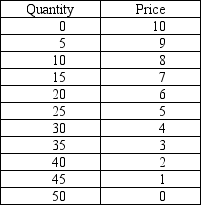 -Refer to Table 16-6.This table shows the demand schedule for a particular product.Suppose that the marginal cost to produce this product is constant at $2 per unit and that the fixed cost of producing this product is $10.If the market is served by two duopolists who each,acting in their own self-interest,choose the Nash equilibrium level of production,how much profit will each firm earn?
 (Multiple Choice)
4.8/5 (64)
(64) The Clayton Act of 1914 allows those harmed by illegal arrangements to restrain trade to
(Multiple Choice)
4.8/5 (71)
(71) Table 16-15
 -Refer to Table 16-15.This table shows a game played between two firms,A and B.Each firm must decide how much output to produce.The profits for each firm are shown in the table as (Profit for A,Profit for B).The Nash equilibrium in this game is
 (Multiple Choice)
4.9/5 (78)
(78) The practice of selling a product to retailers and requiring the retailers to charge a specific price for the product is called
(Multiple Choice)
4.7/5 (79)
(79) In a particular town,Metrovision and Cableview are the only two providers of cable TV service.Metrovision and Cableview constitute a
(Multiple Choice)
4.8/5 (67)
(67) Table 16-5
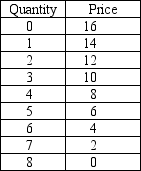 -Refer to Table 16-5.This table shows the demand schedule for a particular product.Suppose the market for this product is served by two firms who each chooses its output independently.If the marginal cost to produce this product is $0,what is the Nash equilibrium production level for each firm?
 (Multiple Choice)
4.8/5 (81)
(81) In a competitive market,strategic interactions among the firms are not important.
(True/False)
4.9/5 (77)
(77) Table 16-19
Brian and Matt own the only two bicycle repair shops in town. Each must choose between a low price for repair work and a high price. The annual economic profit from each strategy is indicated in the table. The profits are shown as (Matt, Brian) in each cell.
 -Refer to Table 16-19.Which of the following statements is correct?
 (Multiple Choice)
4.7/5 (72)
(72) Table 16-1
The following table shows the percentage of output supplied by the top eight firms in four different industries.
-Refer to Table 16-1.What is the concentration ratio in Industry C?
-Refer to Table 16-1.What is the concentration ratio in Industry C? (Multiple Choice)
4.8/5 (85)
(85) Table 16-6
-Refer to Table 16-6.This table shows the demand schedule for a particular product.Suppose the market for this product is served by two duopolists who have formed a cartel and are colluding to set the price and quantity in this market.If the marginal cost to produce this product is $2,what price will the cartel set in this market?
-Refer to Table 16-6.This table shows the demand schedule for a particular product.Suppose the market for this product is served by two duopolists who have formed a cartel and are colluding to set the price and quantity in this market.If the marginal cost to produce this product is $2,what price will the cartel set in this market? (Multiple Choice)
4.7/5 (69)
(69) Table 16-18
The Chicken Game is named for a contest in which drivers test their courage by driving straight at each other. John and Paul have a common interest to avoid crashing into each other, but they also have a personal, competing interest to not turn first to demonstrate their courage to those observing the contest. The payoff table for this situation is provided below. The payoffs are shown as (John, Paul).
 -Refer to Table 16-18.How many Nash equilibria are there in this Chicken game?
 (Multiple Choice)
4.8/5 (79)
(79) Table 16-16
Consider a small town that has two grocery stores from which residents can choose to buy a gallon of milk. The store owners each must make a decision to set a high milk price or a low milk price. The payoff table, showing profit per week, is provided below. The profit in each cell is shown as (Store 1, Store 2).
 -Refer to Table 16-16.If grocery store 1 sets a high price,what price should grocery store 2 set? And what will grocery store 2's payoff equal?
 (Multiple Choice)
4.9/5 (90)
(90) To increase their individual profits,members of a cartel have an incentive to
(Multiple Choice)
4.7/5 (69)
(69) The "arms race" is similar to which of the following economic scenarios?
(Multiple Choice)
4.9/5 (69)
(69) Table 16-18
The Chicken Game is named for a contest in which drivers test their courage by driving straight at each other. John and Paul have a common interest to avoid crashing into each other, but they also have a personal, competing interest to not turn first to demonstrate their courage to those observing the contest. The payoff table for this situation is provided below. The payoffs are shown as (John, Paul).
-Refer to Table 16-18.If Paul chooses Drive Straight,what will John choose to do and what will John's payoff equal?
-Refer to Table 16-18.If Paul chooses Drive Straight,what will John choose to do and what will John's payoff equal? (Multiple Choice)
4.7/5 (93)
(93) 
Filters
- Essay(0)
- Multiple Choice(0)
- Short Answer(0)
- True False(0)
- Matching(0)