



 Chat with AI
Exam 16: Oligopoly

Exam 1: Ten Principles of Economics237 Questions
Exam 2: Thinking Like an Economist267 Questions
Exam 3: Interdependence and the Gains From Trade217 Questions
Exam 4: The Market Forces of Supply and Demand303 Questions
Exam 5: Elasticity and Its Applications282 Questions
Exam 6: Supply, demand, and Government Policies252 Questions
Exam 7: Consumers, producers, and the Efficiency of Markets248 Questions
Exam 8: Application: the Costs of Taxation245 Questions
Exam 9: Application: International Trade245 Questions
Exam 10: Externalities288 Questions
Exam 11: Public Goods and Common Resources258 Questions
Exam 12: The Design of the Tax System328 Questions
Exam 13: The Costs of Production303 Questions
Exam 14: Firms in Competitive Markets271 Questions
Exam 15: Monopoly306 Questions
Exam 16: Oligopoly291 Questions
Exam 17: Monopolistic Competition257 Questions
Exam 18: The Markets for the Factors of Production284 Questions
Exam 19: Earnings and Discrimination286 Questions
Exam 20: Income Inequality and Poverty247 Questions
Exam 21: The Theory of Consumer Choice238 Questions
Exam 22: Frontiers of Microeconomics199 Questions
Exam 23: Measuring a Nations Income215 Questions
Exam 24: Measuring the Cost of Living208 Questions
Exam 25: Production and Growth240 Questions
Exam 26: Saving, investment, and the Financial System282 Questions
Exam 27: The Basic Tools of Finance249 Questions
Exam 28: Unemployment242 Questions
Exam 29: The Monetary System277 Questions
Exam 30: Money Growth and Inflation224 Questions
Exam 31: Open-Economy Macroeconomics: Basic Concepts256 Questions
Exam 32: A Macroeconomic Theory of the Open Economy217 Questions
Exam 33: Aggregate Demand and Aggregate Supply302 Questions
Exam 34: The Influence of Monetary and Fiscal Policy on Aggregate Demand249 Questions
Exam 35: The Short Run Trade Off Between Inflation and Unemployment246 Questions
Exam 36: Five Debates Over Macroeconomic Policy140 Questions
Select questions type


Table 16-18
The Chicken Game is named for a contest in which drivers test their courage by driving straight at each other. John and Paul have a common interest to avoid crashing into each other, but they also have a personal, competing interest to not turn first to demonstrate their courage to those observing the contest. The payoff table for this situation is provided below. The payoffs are shown as (John, Paul).
 -Refer to Table 16-18.What is Paul's dominant strategy?
 (Multiple Choice)
4.8/5  (79)
(79) In the case of oligopoly markets,self-interest prevents cooperation and leads to an inferior outcome for the firms that are involved.
(True/False)
4.8/5 (75)
(75) The manufacturer of Bozz Radios sells radios to retail stores for $500 each,and it requires the retail stores to charge customers $550 per radio.Any retailer that charges less than $550 would violate its contract with Bozz Radios.What do economists call this business practice?
(Multiple Choice)
4.9/5 (70)
(70) Table 16-16
Consider a small town that has two grocery stores from which residents can choose to buy a gallon of milk. The store owners each must make a decision to set a high milk price or a low milk price. The payoff table, showing profit per week, is provided below. The profit in each cell is shown as (Store 1, Store 2).
 -Refer to Table 16-16.What is grocery store 1's dominant strategy?
 (Multiple Choice)
4.8/5 (77)
(77) Consider the diagram below which shows the market demand curve for a particular product.Suppose this market is served by two duopolists who each face the marginal cost curve shown in the diagram.The marginal revenue curve that a monopolist would face in this market is also shown.Which of the following statements is true? 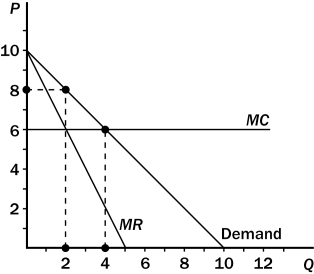
(Multiple Choice)
4.8/5 (97)
(97) Scenario 16-5
Assume that a local bank sells two services, checking accounts and ATM card services. Mr. Donethat is willing to pay $8 a month for the bank to service his checking account and $2 a month for unlimited use of his ATM card. Ms. Beenthere is willing to pay only $5 for a checking account, but is willing to pay $9 for unlimited use of her ATM card. Assume that the bank can provide each of these services at zero marginal cost.
-Refer to Scenario 16-5.If the bank is unable to use tying,what is the profit-maximizing price to charge for unlimited use of an ATM card?
(Multiple Choice)
4.9/5 (92)
(92) Although the practice of predatory pricing is a common claim in antitrust suits,some economists are skeptical of this argument because they believe
(Multiple Choice)
4.8/5 (90)
(90) Table 16-7
Suppose the countries of Xania and Pluntia share the world supply of water. Suppose that the marginal cost of bottling water is a constant $4 per gallon, and the demand for water is described by the following schedule:
 -Refer to Table 16-7.If there were many suppliers of bottled water,what would be the price and quantity?
 (Multiple Choice)
4.9/5 (89)
(89) An oligopolist will increase production if the output effect is
(Multiple Choice)
4.9/5 (83)
(83) Table 16-2
The following table shows the total output produced by the top six firms as well as the total industry output for four industries.
 -Refer to Table 16-2.Which industry has the highest concentration ratio?
 (Multiple Choice)
4.8/5 (76)
(76) If nations such as Germany,Japan,and the United States prohibited international trade in automobiles,a likely effect would be that
(Multiple Choice)
4.9/5 (87)
(87) Which of the following will weaken OPEC's effect on the world price of oil? (i) Member countries abide by the regulatory policy set forth under the original collusive agreement.
(ii) Member countries increase their own production.
(iii) Member countries set their level of production in order to capture a larger share of the total profit available.
(Multiple Choice)
4.9/5 (78)
(78) For cartels,as the number of firms (members of the cartel)increases,
(Multiple Choice)
4.7/5 (66)
(66) Table 16-13
 -Refer to Table 16-13.This table shows a game played between two players,A and B.The payoffs in the table are shown as (Payoff to A,Payoff to B).Which of the following outcomes represents a Nash equilibrium in the game?
 (Multiple Choice)
4.9/5 (75)
(75) Oligopolies can end up looking like competitive markets if the number of firms is
(Multiple Choice)
4.8/5 (77)
(77) 
Filters
- Essay(0)
- Multiple Choice(0)
- Short Answer(0)
- True False(0)
- Matching(0)