



 Chat with AI
Exam 16: Oligopoly

Exam 1: Ten Principles of Economics237 Questions
Exam 2: Thinking Like an Economist267 Questions
Exam 3: Interdependence and the Gains From Trade217 Questions
Exam 4: The Market Forces of Supply and Demand303 Questions
Exam 5: Elasticity and Its Applications282 Questions
Exam 6: Supply, demand, and Government Policies252 Questions
Exam 7: Consumers, producers, and the Efficiency of Markets248 Questions
Exam 8: Application: the Costs of Taxation245 Questions
Exam 9: Application: International Trade245 Questions
Exam 10: Externalities288 Questions
Exam 11: Public Goods and Common Resources258 Questions
Exam 12: The Design of the Tax System328 Questions
Exam 13: The Costs of Production303 Questions
Exam 14: Firms in Competitive Markets271 Questions
Exam 15: Monopoly306 Questions
Exam 16: Oligopoly291 Questions
Exam 17: Monopolistic Competition257 Questions
Exam 18: The Markets for the Factors of Production284 Questions
Exam 19: Earnings and Discrimination286 Questions
Exam 20: Income Inequality and Poverty247 Questions
Exam 21: The Theory of Consumer Choice238 Questions
Exam 22: Frontiers of Microeconomics199 Questions
Exam 23: Measuring a Nations Income215 Questions
Exam 24: Measuring the Cost of Living208 Questions
Exam 25: Production and Growth240 Questions
Exam 26: Saving, investment, and the Financial System282 Questions
Exam 27: The Basic Tools of Finance249 Questions
Exam 28: Unemployment242 Questions
Exam 29: The Monetary System277 Questions
Exam 30: Money Growth and Inflation224 Questions
Exam 31: Open-Economy Macroeconomics: Basic Concepts256 Questions
Exam 32: A Macroeconomic Theory of the Open Economy217 Questions
Exam 33: Aggregate Demand and Aggregate Supply302 Questions
Exam 34: The Influence of Monetary and Fiscal Policy on Aggregate Demand249 Questions
Exam 35: The Short Run Trade Off Between Inflation and Unemployment246 Questions
Exam 36: Five Debates Over Macroeconomic Policy140 Questions
Select questions type


As the number of firms in an oligopoly increases,the quantity of output produced (i) decreases.
(ii) increases.
(iii) eventually approaches the socially-optimal level.
(Multiple Choice)
4.8/5  (82)
(82) Table 16-14
 -Refer to Table 16-14.This table shows a game played between two firms,A and B.The firms must choose how much output to produce.The profit for each firm is shown in the table as (Profit for A,Profit for B).Which of the following outcomes represent the Nash equilibrium in this game?
 (Multiple Choice)
4.8/5 (90)
(90) Table 16-10
Two discount superstores (Ultimate Saver and SuperDuper Saver) in a growing urban area are interested in expanding their market share. Both are interested in expanding the size of their store and parking lot to accommodate potential growth in their customer base. The following game depicts the strategic outcomes that result from the game. Growth-related profits of the two discount superstores are shown in the table below.
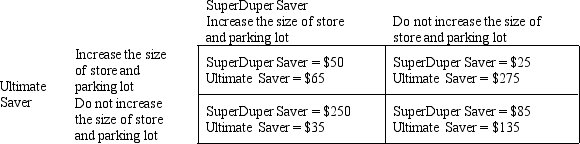 -Refer to Table 16-10.When this game reaches a Nash equilibrium,the dollar value of growth-related profits will be
 (Multiple Choice)
4.8/5 (85)
(85) Scenario 16-5
Assume that a local bank sells two services, checking accounts and ATM card services. Mr. Donethat is willing to pay $8 a month for the bank to service his checking account and $2 a month for unlimited use of his ATM card. Ms. Beenthere is willing to pay only $5 for a checking account, but is willing to pay $9 for unlimited use of her ATM card. Assume that the bank can provide each of these services at zero marginal cost.
-Refer to Scenario 16-5.How much additional profit can the bank earn by switching to the use of a tying strategy to price checking accounts and ATM service rather than pricing these services separately?
(Multiple Choice)
4.8/5 (74)
(74) As a group,oligopolists would always earn the highest profit if they would
(Multiple Choice)
4.8/5 (80)
(80) Total profit for an oligopolist is less than that of a perfectly competitive firm.
(True/False)
4.8/5 (87)
(87) If,in a particular market,firms sell identical products,then the market is (i) perfectly competitive.
(ii) monopolistically competitive.
(iii) an oligopoly.
(Multiple Choice)
4.8/5 (93)
(93) Very often,the reason that players can solve the prisoners' dilemma and reach the most profitable outcome is that
(Multiple Choice)
4.9/5 (74)
(74) Table 16-19
Brian and Matt own the only two bicycle repair shops in town. Each must choose between a low price for repair work and a high price. The annual economic profit from each strategy is indicated in the table. The profits are shown as (Matt, Brian) in each cell.
 -Refer to Table 16-19.Which of the following statements is correct if Brian and Matt will play this game only once?
 (Multiple Choice)
4.7/5 (90)
(90) In the story of the prisoners' dilemma,one prisoner is always better off confessing,no matter what the other prisoner does.
(True/False)
4.8/5 (90)
(90) Monopolistically competitive firms are typically characterized by
(Multiple Choice)
4.8/5 (80)
(80) Table 16-18
The Chicken Game is named for a contest in which drivers test their courage by driving straight at each other. John and Paul have a common interest to avoid crashing into each other, but they also have a personal, competing interest to not turn first to demonstrate their courage to those observing the contest. The payoff table for this situation is provided below. The payoffs are shown as (John, Paul).
 -Refer to Table 16-18.If Paul chooses Turn,what will John choose to do and what will John's payoff equal?
 (Multiple Choice)
4.7/5 (88)
(88) In imperfectly competitive markets,increasing production will increase the quantity sold,but will also decrease the price of all units sold.This concept is known as the
(Multiple Choice)
4.8/5 (93)
(93) Table 16-8
Two cigarette manufacturers (Firm A and Firm B) are faced with lawsuits from states to recover the healthcare related expenses associated with cigarette smoking. Both cigarette firms have evidence that indicates that cigarette smoke causes lung cancer (and other related illnesses). State prosecutors do not have access to the same data used by cigarette manufacturers and thus will have difficulty recovering full costs without the help of at least one cigarette firm study. Each firm has been presented with an opportunity to lower its liability in the suit if it cooperates with attorneys representing the states.
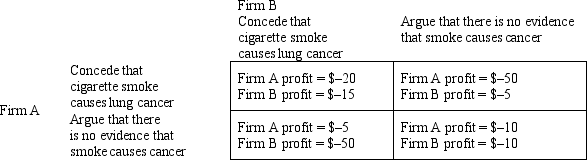 -Refer to Table 16-8.If both firms follow a dominant strategy,Firm A's profits (losses)will be
 (Multiple Choice)
4.8/5 (73)
(73) Table 16-17
Amy and Heather are two college roommates who both prefer a clean common space in their dorm room, but neither enjoys cleaning. The roommates must each make a decision to either clean or not clean the dorm room's common space. The payoff table for this situation is provided below. The payoffs in each cell are shown as (Amy, Heather).
 -Refer to Table 16-17.If Heather chooses Don't Clean,what will Amy choose to do? And if Heather chooses Don't Clean,what will Amy's payoff equal?
 (Multiple Choice)
4.7/5 (85)
(85) In 1971,Congress passed a law that banned cigarette advertising on television.After the ban it is most likely that the (i) profits of cigarette companies increased.
(ii) prices of cigarettes increased.
(iii) total costs incurred by cigarette companies increased.
(Multiple Choice)
4.9/5 (72)
(72) Ford and General Motors are considering expanding into the Vietnamese automobile market.Devise a simple prisoners' dilemma game to demonstrate the strategic considerations that are relevant to this decision.
(Essay)
4.8/5 (83)
(83) The Sherman Antitrust Act prohibits competing firms from even talking about fixing prices.
(True/False)
4.8/5 (77)
(77) 
Filters
- Essay(0)
- Multiple Choice(0)
- Short Answer(0)
- True False(0)
- Matching(0)