



 Chat with AI
Exam 16: Oligopoly

Exam 1: Ten Principles of Economics237 Questions
Exam 2: Thinking Like an Economist267 Questions
Exam 3: Interdependence and the Gains From Trade217 Questions
Exam 4: The Market Forces of Supply and Demand303 Questions
Exam 5: Elasticity and Its Applications282 Questions
Exam 6: Supply, demand, and Government Policies252 Questions
Exam 7: Consumers, producers, and the Efficiency of Markets248 Questions
Exam 8: Application: the Costs of Taxation245 Questions
Exam 9: Application: International Trade245 Questions
Exam 10: Externalities288 Questions
Exam 11: Public Goods and Common Resources258 Questions
Exam 12: The Design of the Tax System328 Questions
Exam 13: The Costs of Production303 Questions
Exam 14: Firms in Competitive Markets271 Questions
Exam 15: Monopoly306 Questions
Exam 16: Oligopoly291 Questions
Exam 17: Monopolistic Competition257 Questions
Exam 18: The Markets for the Factors of Production284 Questions
Exam 19: Earnings and Discrimination286 Questions
Exam 20: Income Inequality and Poverty247 Questions
Exam 21: The Theory of Consumer Choice238 Questions
Exam 22: Frontiers of Microeconomics199 Questions
Exam 23: Measuring a Nations Income215 Questions
Exam 24: Measuring the Cost of Living208 Questions
Exam 25: Production and Growth240 Questions
Exam 26: Saving, investment, and the Financial System282 Questions
Exam 27: The Basic Tools of Finance249 Questions
Exam 28: Unemployment242 Questions
Exam 29: The Monetary System277 Questions
Exam 30: Money Growth and Inflation224 Questions
Exam 31: Open-Economy Macroeconomics: Basic Concepts256 Questions
Exam 32: A Macroeconomic Theory of the Open Economy217 Questions
Exam 33: Aggregate Demand and Aggregate Supply302 Questions
Exam 34: The Influence of Monetary and Fiscal Policy on Aggregate Demand249 Questions
Exam 35: The Short Run Trade Off Between Inflation and Unemployment246 Questions
Exam 36: Five Debates Over Macroeconomic Policy140 Questions
Select questions type


Scenario 16-4
Consider two cigarette companies, PM Inc. and Brown Inc. If neither company advertises, the two companies split the market and earn $50 million each. If they both advertise, they again split the market, but profits are lower by $10 million since each company must bear the cost of advertising. Yet if one company advertises while the other does not, the one that advertises attracts customers from the other. In this case, the company that advertises earns $60 million while the company that does not advertise earns only $30 million.
-Refer to Scenario 16-4.What is PM Inc.'s dominant strategy?
(Multiple Choice)
4.8/5  (93)
(93) If duopolists individually pursue their own self-interest when deciding how much to produce,the profit-maximizing price they will charge for their product will be
(Multiple Choice)
5.0/5 (69)
(69) What happens when the prisoners' dilemma game is repeated numerous times in an oligopoly market? (i) The firms may well reach the monopoly outcome.
(ii) The firms may well reach the competitive outcome.
(iii) Buyers of the oligopolists' product will likely be worse off as a result.
(Multiple Choice)
4.9/5 (74)
(74) Explain how the output effect and the price effect influence the production decision of the individual oligopolist.
(Essay)
4.9/5 (71)
(71) Table 16-7
Suppose the countries of Xania and Pluntia share the world supply of water. Suppose that the marginal cost of bottling water is a constant $4 per gallon, and the demand for water is described by the following schedule:
 -Refer to Table 16-7.Suppose Xania and Pluntia form a cartel and decide to split the market evenly.What level of production should Pluntia choose to maximize profit assuming Xania will stick to the agreement?
 (Multiple Choice)
4.9/5 (83)
(83) Which government entity is charged with investigating and enforcing antitrust laws?
(Multiple Choice)
4.8/5 (88)
(88) In a typical cartel agreement,the cartel maximizes profit when it
(Multiple Choice)
5.0/5 (76)
(76) Which of the following would be most likely to contribute to the breakdown of a cartel in a natural resource (e.g.,bauxite)market?
(Multiple Choice)
4.8/5 (72)
(72) Table 16-1
The following table shows the percentage of output supplied by the top eight firms in four different industries.
 -Refer to Table 16-1.Which industry has the highest concentration ratio?
 (Multiple Choice)
4.8/5 (80)
(80) The story of the prisoners' dilemma contains a general lesson that applies to any group trying to maintain cooperation among its members.
(True/False)
4.9/5 (78)
(78) The cigarette industry consists of large firms that compete vigorously through advertising which is directed at creating fantasy and image.Economists would characterize this industry as
(Multiple Choice)
4.8/5 (78)
(78) Table 16-10
Two discount superstores (Ultimate Saver and SuperDuper Saver) in a growing urban area are interested in expanding their market share. Both are interested in expanding the size of their store and parking lot to accommodate potential growth in their customer base. The following game depicts the strategic outcomes that result from the game. Growth-related profits of the two discount superstores are shown in the table below.
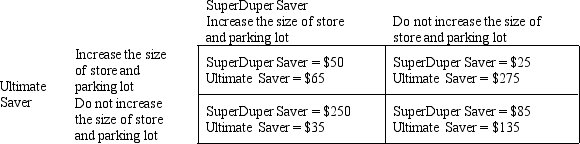 -Refer to Table 16-10.Suppose the owners of SuperDuper Saver and Ultimate Saver meet for a friendly game of golf one afternoon and happen to discuss a strategy to optimize growth related profit.They should both agree to
 (Multiple Choice)
4.7/5 (61)
(61) Which of the following prohibits executives of competing firms from even talking about fixing prices?
(Multiple Choice)
4.8/5 (83)
(83) There are two types of markets in which firms face some competition yet are still able to have some control over the prices of their products.The names given to these market structures are
(Multiple Choice)
4.9/5 (98)
(98) Scenario 16-2
Imagine that two oil companies, Big Petro Inc. and Gargantuan Gas, own adjacent oil fields. Under the fields is a common pool of oil worth $48 million. Drilling a well to recover oil costs $2 million per well. If each company drills one well, each will get half of the oil and earn a $22 million profit ($24 million in revenue - $2 million in costs). Assume that having X percent of the total wells means that a company will collect X percent of the total revenue.
-Refer to Scenario 16-2.If Big Petro Inc.were to drill a second well,what would its profit be if Gargantuan Gas did not drill a second well?
(Multiple Choice)
4.8/5 (76)
(76) The likely outcome of the standard prisoners' dilemma is that
(Multiple Choice)
4.8/5 (65)
(65) 
Filters
- Essay(0)
- Multiple Choice(0)
- Short Answer(0)
- True False(0)
- Matching(0)