



 Chat with AI
Exam 16: Oligopoly

Exam 1: Ten Principles of Economics237 Questions
Exam 2: Thinking Like an Economist267 Questions
Exam 3: Interdependence and the Gains From Trade217 Questions
Exam 4: The Market Forces of Supply and Demand303 Questions
Exam 5: Elasticity and Its Applications282 Questions
Exam 6: Supply, demand, and Government Policies252 Questions
Exam 7: Consumers, producers, and the Efficiency of Markets248 Questions
Exam 8: Application: the Costs of Taxation245 Questions
Exam 9: Application: International Trade245 Questions
Exam 10: Externalities288 Questions
Exam 11: Public Goods and Common Resources258 Questions
Exam 12: The Design of the Tax System328 Questions
Exam 13: The Costs of Production303 Questions
Exam 14: Firms in Competitive Markets271 Questions
Exam 15: Monopoly306 Questions
Exam 16: Oligopoly291 Questions
Exam 17: Monopolistic Competition257 Questions
Exam 18: The Markets for the Factors of Production284 Questions
Exam 19: Earnings and Discrimination286 Questions
Exam 20: Income Inequality and Poverty247 Questions
Exam 21: The Theory of Consumer Choice238 Questions
Exam 22: Frontiers of Microeconomics199 Questions
Exam 23: Measuring a Nations Income215 Questions
Exam 24: Measuring the Cost of Living208 Questions
Exam 25: Production and Growth240 Questions
Exam 26: Saving, investment, and the Financial System282 Questions
Exam 27: The Basic Tools of Finance249 Questions
Exam 28: Unemployment242 Questions
Exam 29: The Monetary System277 Questions
Exam 30: Money Growth and Inflation224 Questions
Exam 31: Open-Economy Macroeconomics: Basic Concepts256 Questions
Exam 32: A Macroeconomic Theory of the Open Economy217 Questions
Exam 33: Aggregate Demand and Aggregate Supply302 Questions
Exam 34: The Influence of Monetary and Fiscal Policy on Aggregate Demand249 Questions
Exam 35: The Short Run Trade Off Between Inflation and Unemployment246 Questions
Exam 36: Five Debates Over Macroeconomic Policy140 Questions
Select questions type


Table 16-12
 -Refer to Table 16-12.This table shows a game played between two players,A and B.The payoffs in the table are shown as (Payoff to A,Payoff to B).Which of the following statements regarding this game is true?
 (Multiple Choice)
4.9/5  (94)
(94) Table 16-17
Amy and Heather are two college roommates who both prefer a clean common space in their dorm room, but neither enjoys cleaning. The roommates must each make a decision to either clean or not clean the dorm room's common space. The payoff table for this situation is provided below. The payoffs in each cell are shown as (Amy, Heather).
 -Refer to Table 16-17.What is Heather's dominant strategy?
 (Multiple Choice)
4.8/5 (78)
(78) Table 16-16
Consider a small town that has two grocery stores from which residents can choose to buy a gallon of milk. The store owners each must make a decision to set a high milk price or a low milk price. The payoff table, showing profit per week, is provided below. The profit in each cell is shown as (Store 1, Store 2).
 -Refer to Table 16-16.If grocery store 2 sets a high price,what price should grocery store 1 set? And what will grocery store 1's payoff equal?
 (Multiple Choice)
5.0/5 (79)
(79) Dave and Andy are competitors in a local market.Each is trying to decide if it is better to advertise on TV,on radio,or not at all.If they both advertise on TV,each will earn a profit of $4,000.If they both advertise on radio,each will earn a profit of $7,000.If neither advertises at all,each will earn a profit of $10,000.If one advertises on TV and other advertises on radio,then the one advertising on TV will earn $6,000 and the other will earn $5,000.If one advertises on TV and the other does not advertise,then the one advertising on TV will earn $11,000 and the other will earn $2,000.If one advertises on radio and the other does not advertise,then the one advertising on radio will earn $12,000 and the other will earn $4,000.If both follow their dominant strategy,then Dave will
(Multiple Choice)
4.7/5 (78)
(78) Which of the following groups or entities has the authority to initiate legal suits to enforce antitrust laws?
(Multiple Choice)
4.8/5 (83)
(83) During the 1990s,the members of OPEC operated independently from one another,causing the world market for crude oil to become close to
(Multiple Choice)
4.8/5 (77)
(77) Assume that Peach Computers has entered into a resale price maintenance agreement with Computer Super Stores Inc.(CSS Inc.)but not with CompuMart.In this case,
(Multiple Choice)
4.8/5 (98)
(98) OPEC can be classified as a (i) group whose concern is to control production levels of oil.
(ii) cartel.
(iii) resale price maintenance group.
(Multiple Choice)
4.8/5 (91)
(91) Total profit for all firms in an oligopolistic market is greater than that of a monopolist,assuming no price-fixing occurs in the market.
(True/False)
4.8/5 (67)
(67) A key issue in the Microsoft case involved whether or not the bundling of the Windows operating system with an Internet browser was an example of
(Multiple Choice)
4.9/5 (86)
(86) Table 16-2
The following table shows the total output produced by the top six firms as well as the total industry output for four industries.
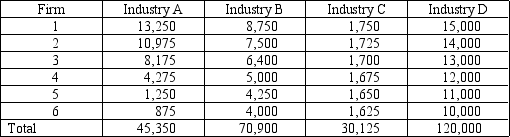 -Refer to Table 16-2.What is the concentration ratio for Industry D?
 (Multiple Choice)
4.8/5 (74)
(74) As the number of firms in an oligopoly increases,the price approaches
(Multiple Choice)
4.9/5 (76)
(76) Table 16-17
Amy and Heather are two college roommates who both prefer a clean common space in their dorm room, but neither enjoys cleaning. The roommates must each make a decision to either clean or not clean the dorm room's common space. The payoff table for this situation is provided below. The payoffs in each cell are shown as (Amy, Heather).
-Refer to Table 16-17.What is Amy's dominant strategy?
-Refer to Table 16-17.What is Amy's dominant strategy? (Multiple Choice)
4.9/5 (86)
(86) The profit-maximizing price for a monopoly is a price that
(Multiple Choice)
4.8/5 (90)
(90) Table 16-2
The following table shows the total output produced by the top six firms as well as the total industry output for four industries.
-Refer to Table 16-2.What is the concentration ratio for Industry B?
-Refer to Table 16-2.What is the concentration ratio for Industry B? (Multiple Choice)
4.9/5 (71)
(71) Table 16-17
Amy and Heather are two college roommates who both prefer a clean common space in their dorm room, but neither enjoys cleaning. The roommates must each make a decision to either clean or not clean the dorm room's common space. The payoff table for this situation is provided below. The payoffs in each cell are shown as (Amy, Heather).
-Refer to Table 16-17.If Amy chooses Don't Clean,what will Heather choose to do? And if Amy chooses Don't Clean,what will Heather's payoff equal?
-Refer to Table 16-17.If Amy chooses Don't Clean,what will Heather choose to do? And if Amy chooses Don't Clean,what will Heather's payoff equal? (Multiple Choice)
4.8/5 (80)
(80) Table 16-2
The following table shows the total output produced by the top six firms as well as the total industry output for four industries.
-Refer to Table 16-2.What is the concentration ratio for Industry A?
-Refer to Table 16-2.What is the concentration ratio for Industry A? (Multiple Choice)
4.9/5 (75)
(75) 
Filters
- Essay(0)
- Multiple Choice(0)
- Short Answer(0)
- True False(0)
- Matching(0)