



 Chat with AI
Exam 16: Oligopoly

Exam 1: Ten Principles of Economics237 Questions
Exam 2: Thinking Like an Economist267 Questions
Exam 3: Interdependence and the Gains From Trade217 Questions
Exam 4: The Market Forces of Supply and Demand303 Questions
Exam 5: Elasticity and Its Applications282 Questions
Exam 6: Supply, demand, and Government Policies252 Questions
Exam 7: Consumers, producers, and the Efficiency of Markets248 Questions
Exam 8: Application: the Costs of Taxation245 Questions
Exam 9: Application: International Trade245 Questions
Exam 10: Externalities288 Questions
Exam 11: Public Goods and Common Resources258 Questions
Exam 12: The Design of the Tax System328 Questions
Exam 13: The Costs of Production303 Questions
Exam 14: Firms in Competitive Markets271 Questions
Exam 15: Monopoly306 Questions
Exam 16: Oligopoly291 Questions
Exam 17: Monopolistic Competition257 Questions
Exam 18: The Markets for the Factors of Production284 Questions
Exam 19: Earnings and Discrimination286 Questions
Exam 20: Income Inequality and Poverty247 Questions
Exam 21: The Theory of Consumer Choice238 Questions
Exam 22: Frontiers of Microeconomics199 Questions
Exam 23: Measuring a Nations Income215 Questions
Exam 24: Measuring the Cost of Living208 Questions
Exam 25: Production and Growth240 Questions
Exam 26: Saving, investment, and the Financial System282 Questions
Exam 27: The Basic Tools of Finance249 Questions
Exam 28: Unemployment242 Questions
Exam 29: The Monetary System277 Questions
Exam 30: Money Growth and Inflation224 Questions
Exam 31: Open-Economy Macroeconomics: Basic Concepts256 Questions
Exam 32: A Macroeconomic Theory of the Open Economy217 Questions
Exam 33: Aggregate Demand and Aggregate Supply302 Questions
Exam 34: The Influence of Monetary and Fiscal Policy on Aggregate Demand249 Questions
Exam 35: The Short Run Trade Off Between Inflation and Unemployment246 Questions
Exam 36: Five Debates Over Macroeconomic Policy140 Questions
Select questions type


An oligopoly is a market with only a few sellers,each offering a similar or identical product.
(True/False)
4.9/5  (70)
(70) A perfectly competitive market has many firms offering an essentially identical product.
(True/False)
4.8/5 (67)
(67) When oligopolistic firms interacting with one another each choose their best strategy given the strategies chosen by other firms in the market,we have
(Multiple Choice)
5.0/5 (88)
(88) Scenario 16-3
Consider two countries, Eudora and Inhabii, that are engaged in an arms race. Each country must decide whether to build new weapons or to disarm existing weapons. Each country prefers to have more arms than the other because a large arsenal gives it more influence in world affairs. But each country also prefers to live in a world safe from the other country's weapons. The following table shows the possible outcomes for each decision combination. The numbers in each cell represent the country's ranking of the outcome.
 -Refer to Scenario 16-3.If Inhabii chooses to build new weapons,the country of Eudora will
 (Multiple Choice)
4.7/5 (79)
(79) Individual profit earned by Dave,the oligopolist,depends on which of the following? (i) The quantity of output that Dave produces
(ii) The quantities of output that the other firms in the market produce
(iii) The extent of collusion between Dave and the other firms in the market
(Multiple Choice)
4.8/5 (71)
(71) Table 16-4
Imagine a small town in which only two residents, Tony and Jill, own wells that produce safe drinking water. Each week Tony and Jill work together to decide how many gallons of water to pump, to bring the water to town, and to sell it at whatever price the market will bear. To keep things simple, suppose that Tony and Jill can pump as much water as they want without cost so that the marginal cost of water equals zero.
The weekly town demand schedule and total revenue schedule for water is shown in the table below.
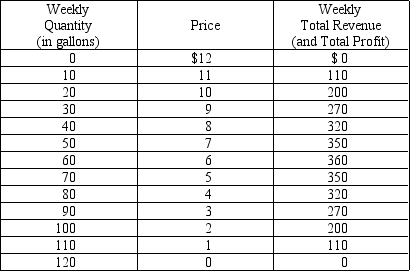 -Refer to Table 16-4.As long as Tony and Jill operate as a profit-maximizing monopoly,what will their weekly revenue equal?
 (Multiple Choice)
4.9/5 (83)
(83) There is no magic number of firms that defines whether a market is an oligopoly or not.
(True/False)
4.8/5 (87)
(87) Table 16-9
Each year the United States considers renewal of Most Favored Nation (MFN) trading status with China. Historically, legislators have made threats of not renewing MFN status because of human rights abuses in China. The non renewal of MFN trading status is likely to involve some retaliatory measures by China. The payoff table below shows the potential economic gains associated with a game in which China may impose trade sanctions against U.S. firms and the United States may not renew MFN status with China. The table contains the dollar value of all trade-flow benefits to the United States and China.
 -Refer to Table 16-9.Pursuing its own best interests,China will impose trade sanctions against U.S.firms
 (Multiple Choice)
4.7/5 (82)
(82) The theory of oligopoly provides another reason that free trade can benefit all countries because (i) as the number of firms within a given market increases,the price of the good falls.
(ii) increased competition leads to smaller deadweight losses.
(iii) profit increases with the level of competition for oligopoly firms.
(Multiple Choice)
4.9/5 (83)
(83) Table 16-3
The information in the table below shows the total demand for premium-channel digital cable TV subscriptions in a small urban market. Assume that each digital cable TV operator pays a fixed cost of $100,000 (per year) to provide premium digital channels in the market area and that the marginal cost of providing the premium channel service to a household is zero.
 -Refer to Table 16-3.Assume that there are two digital cable TV companies operating in this market.If they are able to collude on the price and quantity of subscriptions to sell,what price (P)will they charge,and how many subscriptions (Q)will they sell collectively?
 (Multiple Choice)
4.7/5 (94)
(94) When price is above marginal cost,selling one more unit at the current price will increase profit.This concept is known as the
(Multiple Choice)
4.7/5 (80)
(80) A lack of cooperation by oligopolists trying to maintain monopoly profits
(Multiple Choice)
4.8/5 (86)
(86) Table 16-18
The Chicken Game is named for a contest in which drivers test their courage by driving straight at each other. John and Paul have a common interest to avoid crashing into each other, but they also have a personal, competing interest to not turn first to demonstrate their courage to those observing the contest. The payoff table for this situation is provided below. The payoffs are shown as (John, Paul).
 -Refer to Table 16-18.What is John's dominant strategy?
 (Multiple Choice)
4.7/5 (62)
(62) Table 16-16
Consider a small town that has two grocery stores from which residents can choose to buy a gallon of milk. The store owners each must make a decision to set a high milk price or a low milk price. The payoff table, showing profit per week, is provided below. The profit in each cell is shown as (Store 1, Store 2).
 -Refer to Table 16-16.If grocery store 1 sets a low price,what price should grocery store 2 set? And what will grocery store 2's payoff equal?
 (Multiple Choice)
4.9/5 (76)
(76) 
Filters
- Essay(0)
- Multiple Choice(0)
- Short Answer(0)
- True False(0)
- Matching(0)