



 Chat with AI
Exam 16: Oligopoly

Exam 1: Ten Principles of Economics237 Questions
Exam 2: Thinking Like an Economist267 Questions
Exam 3: Interdependence and the Gains From Trade217 Questions
Exam 4: The Market Forces of Supply and Demand303 Questions
Exam 5: Elasticity and Its Applications282 Questions
Exam 6: Supply, demand, and Government Policies252 Questions
Exam 7: Consumers, producers, and the Efficiency of Markets248 Questions
Exam 8: Application: the Costs of Taxation245 Questions
Exam 9: Application: International Trade245 Questions
Exam 10: Externalities288 Questions
Exam 11: Public Goods and Common Resources258 Questions
Exam 12: The Design of the Tax System328 Questions
Exam 13: The Costs of Production303 Questions
Exam 14: Firms in Competitive Markets271 Questions
Exam 15: Monopoly306 Questions
Exam 16: Oligopoly291 Questions
Exam 17: Monopolistic Competition257 Questions
Exam 18: The Markets for the Factors of Production284 Questions
Exam 19: Earnings and Discrimination286 Questions
Exam 20: Income Inequality and Poverty247 Questions
Exam 21: The Theory of Consumer Choice238 Questions
Exam 22: Frontiers of Microeconomics199 Questions
Exam 23: Measuring a Nations Income215 Questions
Exam 24: Measuring the Cost of Living208 Questions
Exam 25: Production and Growth240 Questions
Exam 26: Saving, investment, and the Financial System282 Questions
Exam 27: The Basic Tools of Finance249 Questions
Exam 28: Unemployment242 Questions
Exam 29: The Monetary System277 Questions
Exam 30: Money Growth and Inflation224 Questions
Exam 31: Open-Economy Macroeconomics: Basic Concepts256 Questions
Exam 32: A Macroeconomic Theory of the Open Economy217 Questions
Exam 33: Aggregate Demand and Aggregate Supply302 Questions
Exam 34: The Influence of Monetary and Fiscal Policy on Aggregate Demand249 Questions
Exam 35: The Short Run Trade Off Between Inflation and Unemployment246 Questions
Exam 36: Five Debates Over Macroeconomic Policy140 Questions
Select questions type


The paradoxical nature of oligopoly can be demonstrated by the fact that,even though the monopoly outcome is best for the oligopolists,
(Multiple Choice)
4.8/5  (67)
(67) Table 16-8
Two cigarette manufacturers (Firm A and Firm B) are faced with lawsuits from states to recover the healthcare related expenses associated with cigarette smoking. Both cigarette firms have evidence that indicates that cigarette smoke causes lung cancer (and other related illnesses). State prosecutors do not have access to the same data used by cigarette manufacturers and thus will have difficulty recovering full costs without the help of at least one cigarette firm study. Each firm has been presented with an opportunity to lower its liability in the suit if it cooperates with attorneys representing the states.
 -Refer to Table 16-8.If both firms follow a dominant strategy,Firm B's profits (losses)will be
 (Multiple Choice)
4.8/5 (75)
(75) The Sherman Antitrust Act prohibits price-fixing in the sense that
(Multiple Choice)
4.8/5 (81)
(81) Briefly contrast the difference between equilibrium market outcomes in a monopoly,oligopoly,and perfect competition.
(Essay)
4.8/5 (82)
(82) Scenario 16-4
Consider two cigarette companies, PM Inc. and Brown Inc. If neither company advertises, the two companies split the market and earn $50 million each. If they both advertise, they again split the market, but profits are lower by $10 million since each company must bear the cost of advertising. Yet if one company advertises while the other does not, the one that advertises attracts customers from the other. In this case, the company that advertises earns $60 million while the company that does not advertise earns only $30 million.
-Refer to Scenario 16-4.What will these two companies do if they behave as individual profit maximizers?
(Multiple Choice)
4.9/5 (77)
(77) An oligopoly would tend to restrict output and drive up price if
(Multiple Choice)
4.8/5 (73)
(73) When strategic interactions are important to pricing and production decisions,a typical firm will
(Multiple Choice)
4.8/5 (83)
(83) If all of the oligopolists in a market collude to form a cartel,total profit for the cartel is less than that of a monopolist.
(True/False)
4.8/5 (82)
(82) If there are many firms participating in a market,the market is either
(Multiple Choice)
4.9/5 (78)
(78) Table 16-11
 -Refer to Table 16-11.This table shows a game played between two players,A and B.The payoffs in the table are shown as (Payoff to A,Payoff to B).Which outcome is the Nash equilibrium in this game?
 (Multiple Choice)
5.0/5 (82)
(82) Why would lack of cooperation between criminal suspects be desirable for society as a whole?
(Multiple Choice)
4.8/5 (81)
(81) If a person can prove that she was damaged by an illegal arrangement to restrain trade,that person can sue and recover
(Multiple Choice)
4.9/5 (73)
(73) Table 16-5
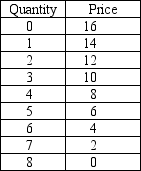 -Refer to Table 16-5.This table shows the demand schedule for a particular product.Suppose the market for this product is served by two firm who collude and form a cartel.What price will the cartel charge in this market if the marginal cost of production is $0?
 (Multiple Choice)
4.8/5 (97)
(97) What do economists call a market structure in which there are many firms selling products that are similar but not identical?
(Multiple Choice)
4.8/5 (85)
(85) When prisoners' dilemma games are repeated over and over,sometimes the threat of penalty causes both parties to cooperate.
(True/False)
4.9/5 (87)
(87) Firms do not need to be concerned about striking a balance between the price effect and the output effect when making production decisions in which of the following types of markets?
(Multiple Choice)
4.9/5 (74)
(74) Who wrote,"People of the same trade seldom meet together,but the conversation ends in a conspiracy against the public,or in some diversion to raise prices."?
(Multiple Choice)
4.7/5 (80)
(80) 
Filters
- Essay(0)
- Multiple Choice(0)
- Short Answer(0)
- True False(0)
- Matching(0)