



 Chat with AI
Exam 16: Oligopoly

Exam 1: Ten Principles of Economics237 Questions
Exam 2: Thinking Like an Economist267 Questions
Exam 3: Interdependence and the Gains From Trade217 Questions
Exam 4: The Market Forces of Supply and Demand303 Questions
Exam 5: Elasticity and Its Applications282 Questions
Exam 6: Supply, demand, and Government Policies252 Questions
Exam 7: Consumers, producers, and the Efficiency of Markets248 Questions
Exam 8: Application: the Costs of Taxation245 Questions
Exam 9: Application: International Trade245 Questions
Exam 10: Externalities288 Questions
Exam 11: Public Goods and Common Resources258 Questions
Exam 12: The Design of the Tax System328 Questions
Exam 13: The Costs of Production303 Questions
Exam 14: Firms in Competitive Markets271 Questions
Exam 15: Monopoly306 Questions
Exam 16: Oligopoly291 Questions
Exam 17: Monopolistic Competition257 Questions
Exam 18: The Markets for the Factors of Production284 Questions
Exam 19: Earnings and Discrimination286 Questions
Exam 20: Income Inequality and Poverty247 Questions
Exam 21: The Theory of Consumer Choice238 Questions
Exam 22: Frontiers of Microeconomics199 Questions
Exam 23: Measuring a Nations Income215 Questions
Exam 24: Measuring the Cost of Living208 Questions
Exam 25: Production and Growth240 Questions
Exam 26: Saving, investment, and the Financial System282 Questions
Exam 27: The Basic Tools of Finance249 Questions
Exam 28: Unemployment242 Questions
Exam 29: The Monetary System277 Questions
Exam 30: Money Growth and Inflation224 Questions
Exam 31: Open-Economy Macroeconomics: Basic Concepts256 Questions
Exam 32: A Macroeconomic Theory of the Open Economy217 Questions
Exam 33: Aggregate Demand and Aggregate Supply302 Questions
Exam 34: The Influence of Monetary and Fiscal Policy on Aggregate Demand249 Questions
Exam 35: The Short Run Trade Off Between Inflation and Unemployment246 Questions
Exam 36: Five Debates Over Macroeconomic Policy140 Questions
Select questions type


Martha and Oleg are competitors in a local market and each is trying to decide if it is worthwhile to advertise.If both of them advertise,each will earn a profit of $5,000.If neither of them advertise,each will earn a profit of $10,000.If one advertises and the other doesn't,then the one who advertises will earn a profit of $15,000 and the other will earn $7,000.To make the most money,Martha
(Multiple Choice)
5.0/5  (81)
(81) Laurel and Janet are competitors in a local market and each is trying to decide if it is worthwhile to advertise.If both of them advertise,each will earn a profit of $5,000.If neither of them advertise,each will earn a profit of $10,000.If one advertises and the other doesn't,then the one who advertises will earn a profit of $12,000 and the other will earn $2,000.In this version of the prisoner's dilemma,if the game is played only once,Laurel should
(Multiple Choice)
4.9/5 (80)
(80) The game that oligopolists play in trying to reach the oligopoly outcome is similar to the game that the two prisoners play in the prisoners' dilemma.
(True/False)
4.9/5 (81)
(81) When firms are faced with making strategic choices in order to maximize profit,economists typically use
(Multiple Choice)
4.9/5 (86)
(86) A special kind of imperfectly competitive market that has only two firms is called
(Multiple Choice)
4.9/5 (76)
(76) Firms in industries that have competitors but,at the same time,do not face so much competition that they are price takers,are operating in either a(n)
(Multiple Choice)
4.9/5 (67)
(67) Table 16-14
 -Refer to Table 16-14.This table shows a game played between two firms,A and B.In this game each firm must decide how much output to produce.The profit for each firm is given in the table as (Profit for A,Profit for B).In this game
 (Multiple Choice)
4.8/5 (79)
(79) When individuals are damaged by an illegal arrangement to restrain trade,which law allows them to pursue civil action and recover up to three times the damages sustained?
(Multiple Choice)
4.8/5 (81)
(81) In a duopoly situation,the logic of self-interest results in a total output level that
(Multiple Choice)
4.8/5 (86)
(86) Table 16-9
Each year the United States considers renewal of Most Favored Nation (MFN) trading status with China. Historically, legislators have made threats of not renewing MFN status because of human rights abuses in China. The non renewal of MFN trading status is likely to involve some retaliatory measures by China. The payoff table below shows the potential economic gains associated with a game in which China may impose trade sanctions against U.S. firms and the United States may not renew MFN status with China. The table contains the dollar value of all trade-flow benefits to the United States and China.
 -Refer to Table 16-9.When this game reaches a Nash equilibrium,the value of trade flow benefits will be
 (Multiple Choice)
4.8/5 (73)
(73) Scenario 16-1
Assume that the countries of Irun and Urun are the only two producers of crude oil. Further assume that both countries have entered into an agreement to maintain certain production levels in order to maximize profits. In the world market for oil, the demand curve is downward sloping.
-Refer to Scenario 16-1.The agreed-upon production level between the two countries will invariably be
(Multiple Choice)
4.9/5 (75)
(75) When all consumers are charged the same price and that price exceeds marginal cost,the result is a deadweight loss for society.
(True/False)
4.9/5 (78)
(78) Table 16-4
Imagine a small town in which only two residents, Tony and Jill, own wells that produce safe drinking water. Each week Tony and Jill work together to decide how many gallons of water to pump, to bring the water to town, and to sell it at whatever price the market will bear. To keep things simple, suppose that Tony and Jill can pump as much water as they want without cost so that the marginal cost of water equals zero.
The weekly town demand schedule and total revenue schedule for water is shown in the table below.
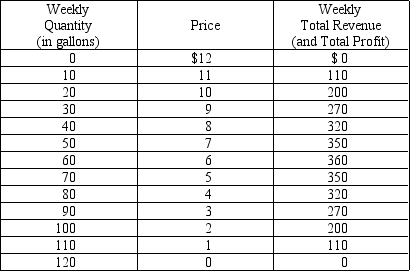 -Refer to Table 16-4.Suppose the town enacts new antitrust laws that prohibit Tony and Jill from operating as a monopolist.What will the new price of water end up being once the Nash equilibrium is reached?
 (Multiple Choice)
4.9/5 (80)
(80) Consider a market served by a monopolist,Firm A.A new firm,Firm B,enters the market and,as a result,Firm A lowers its price to try to drive Firm B out of the market.This practice is known as
(Multiple Choice)
4.8/5 (82)
(82) 
Filters
- Essay(0)
- Multiple Choice(0)
- Short Answer(0)
- True False(0)
- Matching(0)