



 Chat with AI
Exam 20: Income Inequality and Poverty

Exam 1: Ten Principles of Economics237 Questions
Exam 2: Thinking Like an Economist267 Questions
Exam 3: Interdependence and the Gains From Trade217 Questions
Exam 4: The Market Forces of Supply and Demand303 Questions
Exam 5: Elasticity and Its Applications282 Questions
Exam 6: Supply, demand, and Government Policies252 Questions
Exam 7: Consumers, producers, and the Efficiency of Markets248 Questions
Exam 8: Application: the Costs of Taxation245 Questions
Exam 9: Application: International Trade245 Questions
Exam 10: Externalities288 Questions
Exam 11: Public Goods and Common Resources258 Questions
Exam 12: The Design of the Tax System328 Questions
Exam 13: The Costs of Production303 Questions
Exam 14: Firms in Competitive Markets271 Questions
Exam 15: Monopoly306 Questions
Exam 16: Oligopoly291 Questions
Exam 17: Monopolistic Competition257 Questions
Exam 18: The Markets for the Factors of Production284 Questions
Exam 19: Earnings and Discrimination286 Questions
Exam 20: Income Inequality and Poverty247 Questions
Exam 21: The Theory of Consumer Choice238 Questions
Exam 22: Frontiers of Microeconomics199 Questions
Exam 23: Measuring a Nations Income215 Questions
Exam 24: Measuring the Cost of Living208 Questions
Exam 25: Production and Growth240 Questions
Exam 26: Saving, investment, and the Financial System282 Questions
Exam 27: The Basic Tools of Finance249 Questions
Exam 28: Unemployment242 Questions
Exam 29: The Monetary System277 Questions
Exam 30: Money Growth and Inflation224 Questions
Exam 31: Open-Economy Macroeconomics: Basic Concepts256 Questions
Exam 32: A Macroeconomic Theory of the Open Economy217 Questions
Exam 33: Aggregate Demand and Aggregate Supply302 Questions
Exam 34: The Influence of Monetary and Fiscal Policy on Aggregate Demand249 Questions
Exam 35: The Short Run Trade Off Between Inflation and Unemployment246 Questions
Exam 36: Five Debates Over Macroeconomic Policy140 Questions
Select questions type


In the United States in 2003,the bottom fifth of the income distribution had incomes below $19,250.

Free
(True/False)
4.8/5  (77)
(77) Correct Answer: Verified
False
The poverty line is not adjusted for which of the following?
Free
(Multiple Choice)
4.9/5 (64)
(64) Correct Answer:Verified
VerifiedD
As a result of the trade-off between income equality and incentives to work,an optimal redistribution policy
Free
(Multiple Choice)
4.9/5 (83)
(83) Correct Answer:Verified
VerifiedD
Proponents of welfare reform claim that programs that do not establish a time limit on recipient benefits harm children by
(Multiple Choice)
4.8/5 (85)
(85) The poverty line is based on the percentage of people who cannot afford an adequate diet.
(True/False)
4.8/5 (79)
(79) In the parable of the leaky bucket,a fundamental problem with government redistribution programs is identified.As long as the government only has "leaky buckets" at its disposal,
(Multiple Choice)
4.7/5 (93)
(93) Economists who support minimum-wage legislation are likely to believe that the
(Multiple Choice)
4.8/5 (65)
(65) The poverty rate is a measure of the percentage of people whose incomes fall below
(Multiple Choice)
4.9/5 (86)
(86) Figure 20-2
Poverty Rates by Age
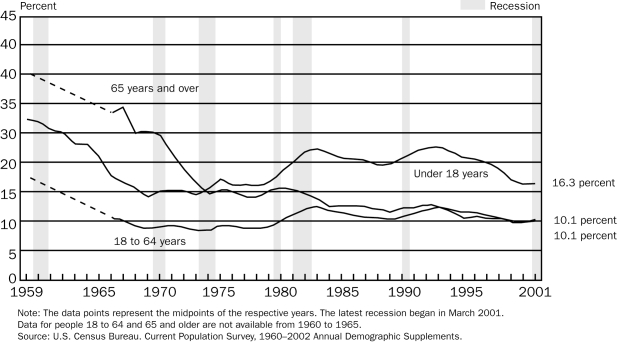 -Refer to Figure 20-2.In 1968,the percent of children under age 18 in poverty is
 (Multiple Choice)
4.9/5 (82)
(82) Libertarianism identifies a redistribution of income role for government when
(Multiple Choice)
4.8/5 (68)
(68) Table 20-2
Poverty Thresholds in 2002, by Size of Family and Number of Related Children Under 18 Years
[Dollars]
 Source: U. S. Bureau of the Census, Current Population Survey.
-Refer to Table 20-2.What is the poverty line for a 75 year old individual?
Source: U. S. Bureau of the Census, Current Population Survey.
-Refer to Table 20-2.What is the poverty line for a 75 year old individual? (Multiple Choice)
4.9/5 (84)
(84) Assume that the government proposes a negative income tax that calculates taxes owed by the following formula,
Taxes Owed = (1/3 × Income)- $10,000.
Compute the tax that would be owed given each level of income.
a.$120,000
b.$90,000
c.$60,000
d.$30,000
e.$0
(Essay)
4.9/5 (75)
(75) Scenario 20-1
Suppose that a society is made up of five families whose incomes are as follows:
$120,000; $90,000; $30,000; $30,000; and $18,000.
The federal government is considering two potential income tax plans:
Plan A is a negative income tax plan where the taxes owed equal 1/3 of income minus $20,000.
Plan B is a two-tiered plan where the poverty line is $35,000; families earning over $35,000 pay 10% of their income in taxes, and families earning less than $35,000 pay no income tax.
-Refer to Scenario 20-1.Assuming that utility is directly proportional to the cash value of after-tax income,which government policy would an advocate of libertarianism prefer?
(Multiple Choice)
4.8/5 (85)
(85) The poverty line is an absolute standard and is based on the cost of providing an adequate diet.
(True/False)
4.8/5 (74)
(74) In general,libertarians would argue that which of the following is more important than equal outcomes?
(Multiple Choice)
4.8/5 (91)
(91) When the government redistributes income to achieve greater equality,it
(Multiple Choice)
4.9/5 (80)
(80) Suppose that Family A borrows money when its car breaks down and saves money when the wife receives a holiday bonus from her employer.Suppose that Family B borrows money to buy elaborate birthday presents for the children and spends the husband's holiday bonus on a vacation to Florida.Which of the following is correct?
(Multiple Choice)
4.9/5 (72)
(72) The movement of individuals among income classes is likely to be caused by
(Multiple Choice)
4.7/5 (80)
(80) The income level below which families are said to be poor is known as the
(Multiple Choice)
4.8/5 (87)
(87) 
Filters
- Essay(0)
- Multiple Choice(0)
- Short Answer(0)
- True False(0)
- Matching(0)