



 Chat with AI
Exam 20: Income Inequality and Poverty

Exam 1: Ten Principles of Economics237 Questions
Exam 2: Thinking Like an Economist267 Questions
Exam 3: Interdependence and the Gains From Trade217 Questions
Exam 4: The Market Forces of Supply and Demand303 Questions
Exam 5: Elasticity and Its Applications282 Questions
Exam 6: Supply, demand, and Government Policies252 Questions
Exam 7: Consumers, producers, and the Efficiency of Markets248 Questions
Exam 8: Application: the Costs of Taxation245 Questions
Exam 9: Application: International Trade245 Questions
Exam 10: Externalities288 Questions
Exam 11: Public Goods and Common Resources258 Questions
Exam 12: The Design of the Tax System328 Questions
Exam 13: The Costs of Production303 Questions
Exam 14: Firms in Competitive Markets271 Questions
Exam 15: Monopoly306 Questions
Exam 16: Oligopoly291 Questions
Exam 17: Monopolistic Competition257 Questions
Exam 18: The Markets for the Factors of Production284 Questions
Exam 19: Earnings and Discrimination286 Questions
Exam 20: Income Inequality and Poverty247 Questions
Exam 21: The Theory of Consumer Choice238 Questions
Exam 22: Frontiers of Microeconomics199 Questions
Exam 23: Measuring a Nations Income215 Questions
Exam 24: Measuring the Cost of Living208 Questions
Exam 25: Production and Growth240 Questions
Exam 26: Saving, investment, and the Financial System282 Questions
Exam 27: The Basic Tools of Finance249 Questions
Exam 28: Unemployment242 Questions
Exam 29: The Monetary System277 Questions
Exam 30: Money Growth and Inflation224 Questions
Exam 31: Open-Economy Macroeconomics: Basic Concepts256 Questions
Exam 32: A Macroeconomic Theory of the Open Economy217 Questions
Exam 33: Aggregate Demand and Aggregate Supply302 Questions
Exam 34: The Influence of Monetary and Fiscal Policy on Aggregate Demand249 Questions
Exam 35: The Short Run Trade Off Between Inflation and Unemployment246 Questions
Exam 36: Five Debates Over Macroeconomic Policy140 Questions
Select questions type


Which of the following programs would be favored by philosopher John Rawls and why?
(Multiple Choice)
4.7/5  (90)
(90) The invisible hand of the marketplace acts to allocate resources efficiently,but it does not necessarily ensure that resources are allocated fairly.
(True/False)
4.7/5 (72)
(72) Suppose that a family saves and borrows to buffer itself against changes in income.These actions relate to which problem in measuring inequality?
(Multiple Choice)
4.9/5 (67)
(67) Government programs that take money from high-income people and give it to low-income people typically
(Multiple Choice)
4.9/5 (88)
(88) The economic life cycle describes how young people usually have higher savings rates than middle-aged people.
(True/False)
4.7/5 (73)
(73) Which political philosophy focuses on the process of determining the distribution of income rather than on the outcome?
(Multiple Choice)
4.8/5 (81)
(81) When a government policy alters the distribution of income to achieve greater income equality,which of the following will happen?
(Multiple Choice)
4.8/5 (82)
(82) Table 20-2
Poverty Thresholds in 2002, by Size of Family and Number of Related Children Under 18 Years
[Dollars]
 Source: U. S. Bureau of the Census, Current Population Survey.
-Refer to Table 20-2.What is the poverty line for a family of three with one child?
Source: U. S. Bureau of the Census, Current Population Survey.
-Refer to Table 20-2.What is the poverty line for a family of three with one child? (Multiple Choice)
4.7/5 (81)
(81) Because people can borrow when they are young,the life cycle theory would suggest that one's standard of living depends on
(Multiple Choice)
4.8/5 (59)
(59) About four out of five millionaires in the United States earned their money rather than inherited it.
(True/False)
4.9/5 (78)
(78) Table 20-2
Poverty Thresholds in 2002, by Size of Family and Number of Related Children Under 18 Years
[Dollars]
Source: U. S. Bureau of the Census, Current Population Survey.
-Refer to Table 20-2.What is the poverty line for a family of six with three children?
Source: U. S. Bureau of the Census, Current Population Survey.
-Refer to Table 20-2.What is the poverty line for a family of six with three children? (Multiple Choice)
4.8/5 (81)
(81) Which of the following is not a question that economists try to answer when measuring the distribution of income?
(Multiple Choice)
4.9/5 (83)
(83) Figure 20-3
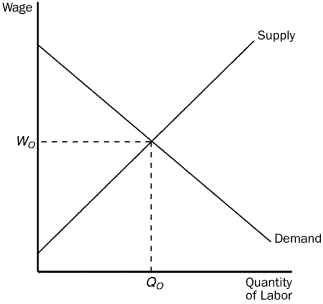 -Refer to Figure 20-3.An effective minimum wage would be set at a level
 (Multiple Choice)
4.9/5 (80)
(80) A government's policy of redistributing income makes the income distribution more equitable,
(Multiple Choice)
4.9/5 (96)
(96) 
Filters
- Essay(0)
- Multiple Choice(0)
- Short Answer(0)
- True False(0)
- Matching(0)