



 Chat with AI
Exam 20: Income Inequality and Poverty

Exam 1: Ten Principles of Economics237 Questions
Exam 2: Thinking Like an Economist267 Questions
Exam 3: Interdependence and the Gains From Trade217 Questions
Exam 4: The Market Forces of Supply and Demand303 Questions
Exam 5: Elasticity and Its Applications282 Questions
Exam 6: Supply, demand, and Government Policies252 Questions
Exam 7: Consumers, producers, and the Efficiency of Markets248 Questions
Exam 8: Application: the Costs of Taxation245 Questions
Exam 9: Application: International Trade245 Questions
Exam 10: Externalities288 Questions
Exam 11: Public Goods and Common Resources258 Questions
Exam 12: The Design of the Tax System328 Questions
Exam 13: The Costs of Production303 Questions
Exam 14: Firms in Competitive Markets271 Questions
Exam 15: Monopoly306 Questions
Exam 16: Oligopoly291 Questions
Exam 17: Monopolistic Competition257 Questions
Exam 18: The Markets for the Factors of Production284 Questions
Exam 19: Earnings and Discrimination286 Questions
Exam 20: Income Inequality and Poverty247 Questions
Exam 21: The Theory of Consumer Choice238 Questions
Exam 22: Frontiers of Microeconomics199 Questions
Exam 23: Measuring a Nations Income215 Questions
Exam 24: Measuring the Cost of Living208 Questions
Exam 25: Production and Growth240 Questions
Exam 26: Saving, investment, and the Financial System282 Questions
Exam 27: The Basic Tools of Finance249 Questions
Exam 28: Unemployment242 Questions
Exam 29: The Monetary System277 Questions
Exam 30: Money Growth and Inflation224 Questions
Exam 31: Open-Economy Macroeconomics: Basic Concepts256 Questions
Exam 32: A Macroeconomic Theory of the Open Economy217 Questions
Exam 33: Aggregate Demand and Aggregate Supply302 Questions
Exam 34: The Influence of Monetary and Fiscal Policy on Aggregate Demand249 Questions
Exam 35: The Short Run Trade Off Between Inflation and Unemployment246 Questions
Exam 36: Five Debates Over Macroeconomic Policy140 Questions
Select questions type


"The government should punish crimes and enforce voluntary agreements but not redistribute income." This statement is most closely associated with which political philosophy?
(Multiple Choice)
4.8/5  (79)
(79) "The government should choose policies to maximize the total utility of society." This statement is most closely associated with which political philosophy?
(Multiple Choice)
4.7/5 (77)
(77) Opponents of legislation that proposes to limit the time a family can receive welfare benefits are most likely to argue that time limits are undesirable because
(Multiple Choice)
5.0/5 (93)
(93) Economists refer to the regular pattern of income variation over a person's lifetime as the
(Multiple Choice)
4.8/5 (81)
(81) In 2003,what percentage of U.S.families had income levels below $98,200?
(Multiple Choice)
4.8/5 (92)
(92) The country that has the highest degree of income inequality is
(Multiple Choice)
4.9/5 (82)
(82) In 2003,the poverty rate in the United States was approximately
(Multiple Choice)
4.8/5 (88)
(88) When incentives to earn income are distorted by income redistribution programs,
(Multiple Choice)
4.9/5 (78)
(78) Raising total utility is the prime objective of which political philosophy?
(Multiple Choice)
4.7/5 (65)
(65) Table 20-2
Poverty Thresholds in 2002, by Size of Family and Number of Related Children Under 18 Years
[Dollars]
 Source: U. S. Bureau of the Census, Current Population Survey.
-Refer to Table 20-2.What is the poverty line for a family of eight with two children?
Source: U. S. Bureau of the Census, Current Population Survey.
-Refer to Table 20-2.What is the poverty line for a family of eight with two children? (Multiple Choice)
4.7/5 (88)
(88) "An extra dollar of income gives more additional satisfaction to a poor person than to a rich person." This is an important assumption of which political philosophy?
(Multiple Choice)
4.8/5 (97)
(97) Government vouchers to purchase food,also known as food stamps,are an example of
(Multiple Choice)
5.0/5 (71)
(71) Fewer than three percent of families are poor for eight or more years.
(True/False)
4.9/5 (82)
(82) Figure 20-1
Number of Poor
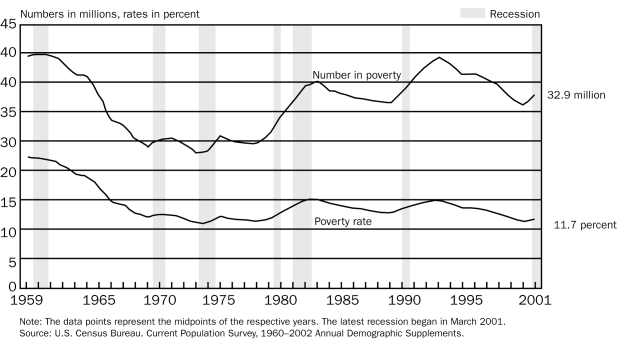 -Refer to Figure 20-1.Between 1965 and 2001,during recessions (the shaded bars)the number of individuals in poverty has
 (Multiple Choice)
4.9/5 (66)
(66) The poverty line in the country of Abbyville is $15,000.The distribution of income for Abbyville is as follows: 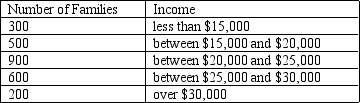 The poverty rate in Abbyville is
 (Multiple Choice)
4.7/5 (85)
(85) 
Filters
- Essay(0)
- Multiple Choice(0)
- Short Answer(0)
- True False(0)
- Matching(0)