



 Chat with AI
Exam 20: Income Inequality and Poverty

Exam 1: Ten Principles of Economics237 Questions
Exam 2: Thinking Like an Economist267 Questions
Exam 3: Interdependence and the Gains From Trade217 Questions
Exam 4: The Market Forces of Supply and Demand303 Questions
Exam 5: Elasticity and Its Applications282 Questions
Exam 6: Supply, demand, and Government Policies252 Questions
Exam 7: Consumers, producers, and the Efficiency of Markets248 Questions
Exam 8: Application: the Costs of Taxation245 Questions
Exam 9: Application: International Trade245 Questions
Exam 10: Externalities288 Questions
Exam 11: Public Goods and Common Resources258 Questions
Exam 12: The Design of the Tax System328 Questions
Exam 13: The Costs of Production303 Questions
Exam 14: Firms in Competitive Markets271 Questions
Exam 15: Monopoly306 Questions
Exam 16: Oligopoly291 Questions
Exam 17: Monopolistic Competition257 Questions
Exam 18: The Markets for the Factors of Production284 Questions
Exam 19: Earnings and Discrimination286 Questions
Exam 20: Income Inequality and Poverty247 Questions
Exam 21: The Theory of Consumer Choice238 Questions
Exam 22: Frontiers of Microeconomics199 Questions
Exam 23: Measuring a Nations Income215 Questions
Exam 24: Measuring the Cost of Living208 Questions
Exam 25: Production and Growth240 Questions
Exam 26: Saving, investment, and the Financial System282 Questions
Exam 27: The Basic Tools of Finance249 Questions
Exam 28: Unemployment242 Questions
Exam 29: The Monetary System277 Questions
Exam 30: Money Growth and Inflation224 Questions
Exam 31: Open-Economy Macroeconomics: Basic Concepts256 Questions
Exam 32: A Macroeconomic Theory of the Open Economy217 Questions
Exam 33: Aggregate Demand and Aggregate Supply302 Questions
Exam 34: The Influence of Monetary and Fiscal Policy on Aggregate Demand249 Questions
Exam 35: The Short Run Trade Off Between Inflation and Unemployment246 Questions
Exam 36: Five Debates Over Macroeconomic Policy140 Questions
Select questions type


In the United States,a typical worker's income peaks around age
(Multiple Choice)
5.0/5  (82)
(82) Susan won $2,000 at the blackjack tables on her birthday.Her winnings are an example of
(Multiple Choice)
4.8/5 (66)
(66) When a government enacts policies that redistribute income,which of the following will not occur?
(Multiple Choice)
4.8/5 (61)
(61) Although globalization has reduced income inequality,the number of people living in extreme poverty has remained unchanged.
(True/False)
4.8/5 (84)
(84) When the government taxes income as part of a redistribution program,
(Multiple Choice)
4.7/5 (83)
(83) The maximin criterion is attributed to which political philosophy?
(Multiple Choice)
4.7/5 (74)
(74) Raising the welfare of the worst-off person in society is an important goal of which political philosophy?
(Multiple Choice)
4.8/5 (70)
(70) Libertarians believe that the government should enforce individual rights to ensure that all people have the same opportunities to use their talents to achieve success.
(True/False)
4.9/5 (76)
(76) Utilitarians believe that the proper goal of the government is to maximize the sum of the utilities of everyone in society.
(True/False)
4.9/5 (81)
(81) Which of the following is associated with worldwide economic growth?
(Multiple Choice)
4.8/5 (77)
(77) Explain the concept of diminishing marginal utility,and describe the role that it plays in the utilitarian argument for the redistribution of income.
(Essay)
4.9/5 (93)
(93) Briefly describe the three prominent schools of thought in political philosophy.Identify one of the most well-known philosophers in each school.
(Essay)
4.9/5 (78)
(78) Explain what information is contained in the poverty rate statistic.Are there problems in using an absolute scale to measure poverty? If so,explain them.
(Essay)
4.8/5 (86)
(86) Table 20-2
Poverty Thresholds in 2002, by Size of Family and Number of Related Children Under 18 Years
[Dollars]
 Source: U. S. Bureau of the Census, Current Population Survey.
-Refer to Table 20-2.What is the poverty line for a family with one 35-year-old adult and one child?
Source: U. S. Bureau of the Census, Current Population Survey.
-Refer to Table 20-2.What is the poverty line for a family with one 35-year-old adult and one child? (Multiple Choice)
4.9/5 (64)
(64) In the Temporary Assistance for Needy Families program,most families
(Multiple Choice)
4.8/5 (82)
(82) Which of the following does not explain the rise in income inequality from 1970 to 2003?
(Multiple Choice)
4.8/5 (82)
(82) Figure 20-2
Poverty Rates by Age
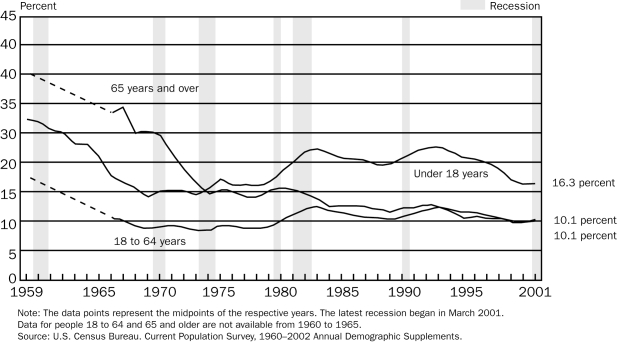 -Refer to Figure 20-2.In 2001,the percent of children under age 18 in poverty is
 (Multiple Choice)
4.9/5 (78)
(78) 
Filters
- Essay(0)
- Multiple Choice(0)
- Short Answer(0)
- True False(0)
- Matching(0)