



 Chat with AI
Exam 20: Income Inequality and Poverty

Exam 1: Ten Principles of Economics237 Questions
Exam 2: Thinking Like an Economist267 Questions
Exam 3: Interdependence and the Gains From Trade217 Questions
Exam 4: The Market Forces of Supply and Demand303 Questions
Exam 5: Elasticity and Its Applications282 Questions
Exam 6: Supply, demand, and Government Policies252 Questions
Exam 7: Consumers, producers, and the Efficiency of Markets248 Questions
Exam 8: Application: the Costs of Taxation245 Questions
Exam 9: Application: International Trade245 Questions
Exam 10: Externalities288 Questions
Exam 11: Public Goods and Common Resources258 Questions
Exam 12: The Design of the Tax System328 Questions
Exam 13: The Costs of Production303 Questions
Exam 14: Firms in Competitive Markets271 Questions
Exam 15: Monopoly306 Questions
Exam 16: Oligopoly291 Questions
Exam 17: Monopolistic Competition257 Questions
Exam 18: The Markets for the Factors of Production284 Questions
Exam 19: Earnings and Discrimination286 Questions
Exam 20: Income Inequality and Poverty247 Questions
Exam 21: The Theory of Consumer Choice238 Questions
Exam 22: Frontiers of Microeconomics199 Questions
Exam 23: Measuring a Nations Income215 Questions
Exam 24: Measuring the Cost of Living208 Questions
Exam 25: Production and Growth240 Questions
Exam 26: Saving, investment, and the Financial System282 Questions
Exam 27: The Basic Tools of Finance249 Questions
Exam 28: Unemployment242 Questions
Exam 29: The Monetary System277 Questions
Exam 30: Money Growth and Inflation224 Questions
Exam 31: Open-Economy Macroeconomics: Basic Concepts256 Questions
Exam 32: A Macroeconomic Theory of the Open Economy217 Questions
Exam 33: Aggregate Demand and Aggregate Supply302 Questions
Exam 34: The Influence of Monetary and Fiscal Policy on Aggregate Demand249 Questions
Exam 35: The Short Run Trade Off Between Inflation and Unemployment246 Questions
Exam 36: Five Debates Over Macroeconomic Policy140 Questions
Select questions type


In the United States approximately 80 percent of millionaires did not inherit their wealth.This statement is an example of
(Multiple Choice)
4.9/5  (69)
(69) Measures of poverty that fail to account for the value of in-kind transfers
(Multiple Choice)
4.9/5 (76)
(76) In 2003,what percentage of U.S.families had income levels above $98,200?
(Multiple Choice)
5.0/5 (90)
(90) Why is it difficult to compare household income distributions among countries?
(Multiple Choice)
4.7/5 (89)
(89) The poverty line in the country of Spencerville is $20,000.The distribution of income for Spencerville is as follows: 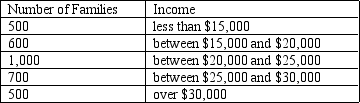 The poverty rate in Spencerville is
 (Multiple Choice)
4.8/5 (81)
(81) Which of the following is not an advantage of the Earned Income Tax Credit (EITC)?
(Multiple Choice)
4.8/5 (72)
(72) Which of the following is not an example of in-kind transfers?
(Multiple Choice)
4.7/5 (99)
(99) If the value of in-kind transfers are taken into account,the number of families living in poverty in the United States would
(Multiple Choice)
4.7/5 (82)
(82) Economic mobility in the United States means that fewer than
(Multiple Choice)
4.9/5 (85)
(85) When the government enacts policies to make the distribution of income more equitable,it distorts incentives,alters behavior,and makes the allocation of resources less efficient.
(True/False)
4.8/5 (83)
(83) The table below reflects the levels of total utility received from income for each of four members of a society.
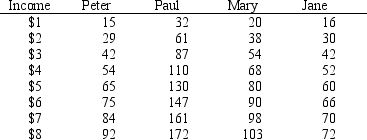 a.Assume that the society has the following income distribution:
Peter $3
Paul $7
Mary $5
Jane $3
Is it possible for the government to increase total aggregate utility by redistributing income among members of society? Explain your answer.
b.Assume that the government has $19 to allocate among the four members of society.(Assume that no one has any income to start with.) If the government is interested in distributing income in a way that maximizes aggregate total utility, how should it distribute the $19 of income?
c.Does the table above describe a situation characterized by diminishing marginal utility? Explain your answer.
a.Assume that the society has the following income distribution:
Peter $3
Paul $7
Mary $5
Jane $3
Is it possible for the government to increase total aggregate utility by redistributing income among members of society? Explain your answer.
b.Assume that the government has $19 to allocate among the four members of society.(Assume that no one has any income to start with.) If the government is interested in distributing income in a way that maximizes aggregate total utility, how should it distribute the $19 of income?
c.Does the table above describe a situation characterized by diminishing marginal utility? Explain your answer. (Essay)
4.8/5 (82)
(82) Economists who study economic mobility have found that the income of a grandfather and his grandson's income are
(Multiple Choice)
4.8/5 (88)
(88) Suppose that income is subject to constant marginal utility.From a utilitarian perspective,
(Multiple Choice)
4.9/5 (81)
(81) 
Filters
- Essay(0)
- Multiple Choice(0)
- Short Answer(0)
- True False(0)
- Matching(0)