



 Chat with AI
Exam 16: Oligopoly

Exam 1: Ten Principles of Economics237 Questions
Exam 2: Thinking Like an Economist267 Questions
Exam 3: Interdependence and the Gains From Trade217 Questions
Exam 4: The Market Forces of Supply and Demand303 Questions
Exam 5: Elasticity and Its Applications282 Questions
Exam 6: Supply, demand, and Government Policies252 Questions
Exam 7: Consumers, producers, and the Efficiency of Markets248 Questions
Exam 8: Application: the Costs of Taxation245 Questions
Exam 9: Application: International Trade245 Questions
Exam 10: Externalities288 Questions
Exam 11: Public Goods and Common Resources258 Questions
Exam 12: The Design of the Tax System328 Questions
Exam 13: The Costs of Production303 Questions
Exam 14: Firms in Competitive Markets271 Questions
Exam 15: Monopoly306 Questions
Exam 16: Oligopoly291 Questions
Exam 17: Monopolistic Competition257 Questions
Exam 18: The Markets for the Factors of Production284 Questions
Exam 19: Earnings and Discrimination286 Questions
Exam 20: Income Inequality and Poverty247 Questions
Exam 21: The Theory of Consumer Choice238 Questions
Exam 22: Frontiers of Microeconomics199 Questions
Exam 23: Measuring a Nations Income215 Questions
Exam 24: Measuring the Cost of Living208 Questions
Exam 25: Production and Growth240 Questions
Exam 26: Saving, investment, and the Financial System282 Questions
Exam 27: The Basic Tools of Finance249 Questions
Exam 28: Unemployment242 Questions
Exam 29: The Monetary System277 Questions
Exam 30: Money Growth and Inflation224 Questions
Exam 31: Open-Economy Macroeconomics: Basic Concepts256 Questions
Exam 32: A Macroeconomic Theory of the Open Economy217 Questions
Exam 33: Aggregate Demand and Aggregate Supply302 Questions
Exam 34: The Influence of Monetary and Fiscal Policy on Aggregate Demand249 Questions
Exam 35: The Short Run Trade Off Between Inflation and Unemployment246 Questions
Exam 36: Five Debates Over Macroeconomic Policy140 Questions
Select questions type


Larger cartels have a greater probability of reaching the monopoly outcome than do smaller cartels.
(True/False)
4.8/5  (75)
(75) Table 16-1
The following table shows the percentage of output supplied by the top eight firms in four different industries.
 -Refer to Table 16-1.What is the concentration ratio in Industry D?
 (Multiple Choice)
4.7/5 (76)
(76) The U.S.market for locomotives is divided between two producers: General Electric has 70 percent of the market and General Motors has 30 percent.This market is an example of
(Multiple Choice)
4.9/5 (90)
(90) Assume that demand for a product that is produced at zero marginal cost is reflected in the table below.
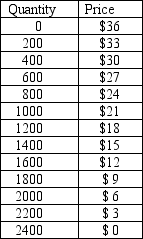 a.What is the profit-maximizing level of production for a group of oligopolistic firms that operate as a cartel?
b.Assume that this market is characterized by a duopoly in which collusive agreements are illegal.What market price and quantity will be associated with a profit-maximizing Nash equilibrium?
a.What is the profit-maximizing level of production for a group of oligopolistic firms that operate as a cartel?
b.Assume that this market is characterized by a duopoly in which collusive agreements are illegal.What market price and quantity will be associated with a profit-maximizing Nash equilibrium? (Essay)
4.9/5 (73)
(73) Table 16-9
Each year the United States considers renewal of Most Favored Nation (MFN) trading status with China. Historically, legislators have made threats of not renewing MFN status because of human rights abuses in China. The non renewal of MFN trading status is likely to involve some retaliatory measures by China. The payoff table below shows the potential economic gains associated with a game in which China may impose trade sanctions against U.S. firms and the United States may not renew MFN status with China. The table contains the dollar value of all trade-flow benefits to the United States and China.
 -Refer to Table 16-9.If both countries follow a dominant strategy,the value of trade flow benefits for the United States will be
 (Multiple Choice)
4.9/5 (72)
(72) Table 16-17
Amy and Heather are two college roommates who both prefer a clean common space in their dorm room, but neither enjoys cleaning. The roommates must each make a decision to either clean or not clean the dorm room's common space. The payoff table for this situation is provided below. The payoffs in each cell are shown as (Amy, Heather).
 -Refer to Table 16-17.If Heather chooses Clean,what will Amy choose to do? And if Heather chooses Clean,what will Amy's payoff equal?
 (Multiple Choice)
4.7/5 (83)
(83) Table 16-7
Suppose the countries of Xania and Pluntia share the world supply of water. Suppose that the marginal cost of bottling water is a constant $4 per gallon, and the demand for water is described by the following schedule:
 -Refer to Table 16-7.If Xania and Pluntia formed a cartel and decided to split the market evenly,what would Pluntia's production be if Pluntia maintained the agreement?
 (Multiple Choice)
4.9/5 (88)
(88) 
Filters
- Essay(0)
- Multiple Choice(0)
- Short Answer(0)
- True False(0)
- Matching(0)