Multiple Choice
Table 16-3
The information in the table below shows the total demand for premium-channel digital cable TV subscriptions in a small urban market. Assume that each digital cable TV operator pays a fixed cost of $100,000 (per year) to provide premium digital channels in the market area and that the marginal cost of providing the premium channel service to a household is zero.
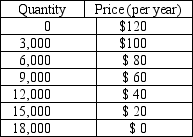
-Refer to Table 16-3.Assume that there are two profit-maximizing digital cable TV companies operating in this market.Further assume that they are not able to collude on the price and quantity of premium digital channel subscriptions to sell.How many premium digital channel cable TV subscriptions will be sold altogether when this market reaches a Nash equilibrium?
A) 3,000
B) 6,000
C) 9,000
D) 12,000
Correct Answer:

Verified
Correct Answer:
Verified
Q11: In 1971,Congress passed a law that banned
Q41: When firms have agreements among themselves on
Q63: Ford and General Motors are considering expanding
Q92: The Sherman Antitrust Act prohibits competing firms
Q172: Even when allowed to collude, firms in
Q236: Table 16-8<br>Two cigarette manufacturers (Firm A and
Q237: Table 16-17<br>Amy and Heather are two college
Q244: In a game,a dominant strategy is,by definition,<br>A)the
Q245: Scenario 16-2<br>Imagine that two oil companies, Big
Q246: Table 16-12<br> <img src="https://d2lvgg3v3hfg70.cloudfront.net/TB2178/.jpg" alt="Table 16-12