



 Chat with AI
Exam 7: Physics

Exam 1: Behavioral Sciences343 Questions
Exam 2: Biochemistry307 Questions
Exam 3: Biology319 Questions
Exam 4: Critical Analysis & Reasoning Skills358 Questions
Exam 5: General Chemistry317 Questions
Exam 6: Organic Chemistry191 Questions
Exam 7: Physics200 Questions
Select questions type


Different substances have different thermal conductivities k, which measure how well heat is transferred by molecular collisions. The heat flow rate per unit area H is defined by:  where ΔT is the difference in temperature over a distance L. The tiled part of a floor in a room feels colder than the carpeted part because:
 (Multiple Choice)
4.9/5  (76)
(76) Passage
Osteoporosis is a degenerative bone condition in which healthy bone degenerates into porous bone. Because bone provides the structural integrity that allows the musculoskeletal system to bear weight, osteoporosis is associated with a higher risk of bone fracture.Researchers conducted an experiment designed to assess the strength and elasticity of osteoporotic bone relative to normal bone. Osteoporotic and normal bone samples with identical physical dimensions were collected and placed within an pneumatic compression device, as shown in Figure 1.
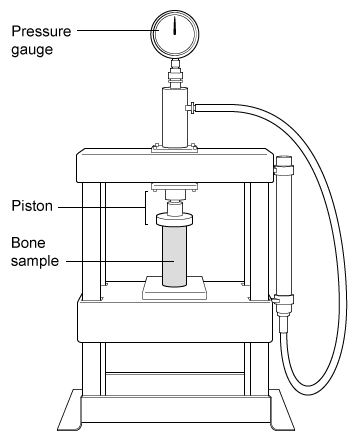 Figure 1 Bone compression device loaded with a bone sampleThe force required to compress the bone samples longitudinally (lengthwise) by a given distance was measured, with the results shown in Figure 2.
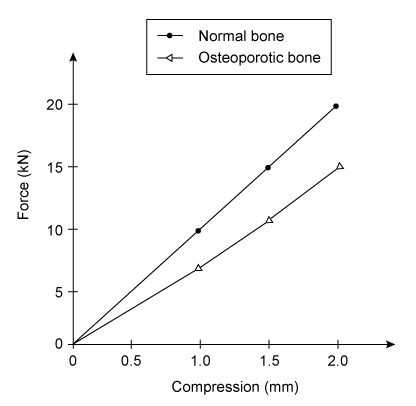 Figure 2 Relationship between force and compression for normal and osteoporotic bonesResearchers observed that bone samples returned to their original dimensions for deformations not exceeding 1% of the original length L0. For each deformation, the associated strain ε is defined as the change in length of an object ΔL divided by the object's original length (Equation 1).
 Equation 1Based on these observations, researchers concluded that both osteoporotic bone and normal bone behaved as an elastic material under a wide range of applied forces.
-Compared to osteoporotic bone, the work required to compress normal bone by 2 mm is:
Figure 1 Bone compression device loaded with a bone sampleThe force required to compress the bone samples longitudinally (lengthwise) by a given distance was measured, with the results shown in Figure 2.
Figure 2 Relationship between force and compression for normal and osteoporotic bonesResearchers observed that bone samples returned to their original dimensions for deformations not exceeding 1% of the original length L0. For each deformation, the associated strain ε is defined as the change in length of an object ΔL divided by the object's original length (Equation 1).
Equation 1Based on these observations, researchers concluded that both osteoporotic bone and normal bone behaved as an elastic material under a wide range of applied forces.
-Compared to osteoporotic bone, the work required to compress normal bone by 2 mm is: (Multiple Choice)
4.8/5 (86)
(86) Passage
In mass spectrometry, a sample's molecules are ionized in a vacuum and then exposed to a uniform electric field created by a high-voltage plate in the acceleration chamber. The electric field accelerates the ions until they arrive at the next section of the device, designated as the separation chamber. In this section, the drifting ions are sorted by their mass-to-charge ratio (m/q).The separation chamber in a time-of-flight mass spectrometer (TOF-MS) is linear and has no electric or magnetic fields. The ions travel at a constant velocity through the chamber until they reach the detector. The time it takes for an ion to reach the detector depends on its m/q ratio.
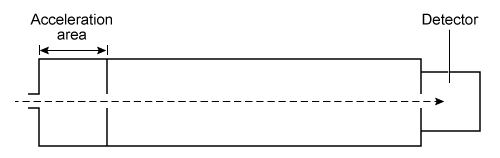 Figure 1 Time-of-flight mass spectrometerA magnetic sector mass spectrometer (MS-MS) has a curved separation chamber where a magnetic field is generated. The magnetic field exerts a centripetal force on drifting ions, bending their trajectories into curved paths. The radius of the curvature depends on the ion's m/q.
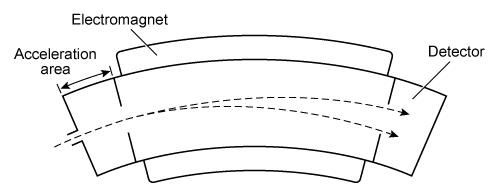 Figure 2 Magnetic sector mass spectrometerThe centripetal force (F) acting on a particle can be determined from its mass (m) and velocity (v) and the radius (r) of the curved path:F = mv2/rEquation 1
-What is the magnitude of the electric field generated in the acceleration chamber if the potential difference is 3,000 V over a distance of 50 cm?
Figure 1 Time-of-flight mass spectrometerA magnetic sector mass spectrometer (MS-MS) has a curved separation chamber where a magnetic field is generated. The magnetic field exerts a centripetal force on drifting ions, bending their trajectories into curved paths. The radius of the curvature depends on the ion's m/q.
Figure 2 Magnetic sector mass spectrometerThe centripetal force (F) acting on a particle can be determined from its mass (m) and velocity (v) and the radius (r) of the curved path:F = mv2/rEquation 1
-What is the magnitude of the electric field generated in the acceleration chamber if the potential difference is 3,000 V over a distance of 50 cm? (Multiple Choice)
4.9/5 (88)
(88) A swimmer enters a straight river at Point A and attempts to swim directly across to the opposite shore. Instead, the swimmer arrives at Point B diagonally downstream on the opposite shore after 80 seconds of swimming. If the river is 30 m wide and flows downstream at a velocity of 0.5 m/s, what is the minimum distance between Points A and B? (Note: Assume the swimmer does not act to oppose the flow of the river.)
(Multiple Choice)
4.7/5 (86)
(86) Passage
The humerus bone in the upper arm and the radius bone in the lower arm can be modeled as a lever with the elbow joint as the pivot point. Movement about the elbow results from a combination of internal and external forces acting on these bones. The primary internal force is generated from contractions of skeletal muscles; a 1-cm2 cross-sectional area of skeletal muscle can generate a maximum of 7 × 10⁶ dynes of force (1 dyn = 1 g⋅cm/s2). Friction between the humerus and the radius at the elbow is another internal force that can affect arm movements. As people age, cartilage degeneration decreases the lubrication between bones, which increases the coefficients of static and kinetic friction.The contraction of the biceps, a skeletal muscle in the upper arm, exerts a pulling force on the radius in the lower arm. If the torque generated by this muscle exceeds that of any opposing internal and external forces, the arm curls about the elbow. This specific type of movement is known as a concentric muscle contraction.The following experiments were performed with a 30-year-old male subject. Electrodes were placed around the subject's biceps and attached to an electromyograph, a device that measures the electrical activity of skeletal muscle contractions. The estimated weight of the subject's lower arm is 45 N, and the subject's lower arm segments to the elbow are shown in Table 1.Table 1 Lower Arm Segment Lengths
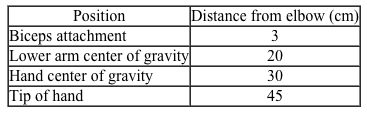 Experiment 1The subject kept his entire arm stationary and in a fixed position while holding balls of varying masses. The upper arm was perpendicular to the ground, and the lower arm was parallel to the ground (Figure 1).
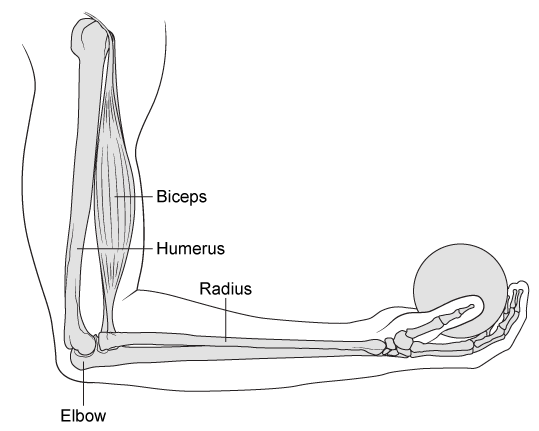 Figure 1 The fixed position of the arm during Experiment 1Experiment 2The subject kept his upper arm stationary and perpendicular to the ground while lifting and lowering balls of varying masses.
Adapted from N. Ozkaya, Fundamentals of Biomechanics. (C) 2016 Springer.
-During Experiment 2, the subject lifts a ball with a mass m a vertical distance d1 and then lowers the ball a greater vertical distance d2. What is the net work done by gravity on the ball?
Experiment 1The subject kept his entire arm stationary and in a fixed position while holding balls of varying masses. The upper arm was perpendicular to the ground, and the lower arm was parallel to the ground (Figure 1).
Figure 1 The fixed position of the arm during Experiment 1Experiment 2The subject kept his upper arm stationary and perpendicular to the ground while lifting and lowering balls of varying masses.
Adapted from N. Ozkaya, Fundamentals of Biomechanics. (C) 2016 Springer.
-During Experiment 2, the subject lifts a ball with a mass m a vertical distance d1 and then lowers the ball a greater vertical distance d2. What is the net work done by gravity on the ball? (Multiple Choice)
4.9/5 (80)
(80) Passage
In hemodynamics, blood flow through the cardiovascular system can be modeled as an electric circuit in which the blood serves as electricity, the blood vessels as resistive wires, and the heart as a battery (see Figure 1).
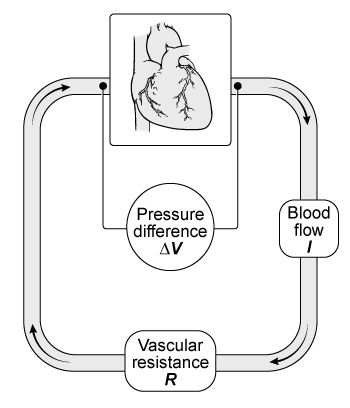 Figure 1 Cardiovascular circuit modelOhm's law states that the voltage drop ΔV across each element, the current I flowing through it, and its electrical resistance R are related by ΔV = IR. In a blood vessel, pressure difference between one vessel and the next ΔP replaces ΔV, volumetric blood flow Q replaces I, and vascular resistance R replaces electrical resistance. Therefore, Ohm's law for blood flow in a vessel isΔP = QREquation 1Vascular resistance is due to the blood's viscosity η and the dimensions of the vessel through which it flows. Assuming blood vessels are cylinders, R can be approximated as
 Equation 2where L is the length of the vessel, and r is its inner radius. If Equation 2 is combined with Equation 1, the resulting equation is Poiseuille law.In a study of the circulatory system in rats, researchers measured the intravascular blood pressure of the mesenteric blood vessels. The mesentery is the set of tissues that holds the intestines in place. Blood flows in the following order: aorta, superior mesenteric artery (SMA), arterial arcade, venous arcade, superior mesenteric vein (SMV).For the procedure, catheters with pressure transducers were inserted into each vessel via laparotomy. Laparotomy is an invasive procedure that involves a surgical incision into the abdominal cavity. Blood pressure measurements were taken simultaneously at the proximal end (beginning) of each blood vessel.
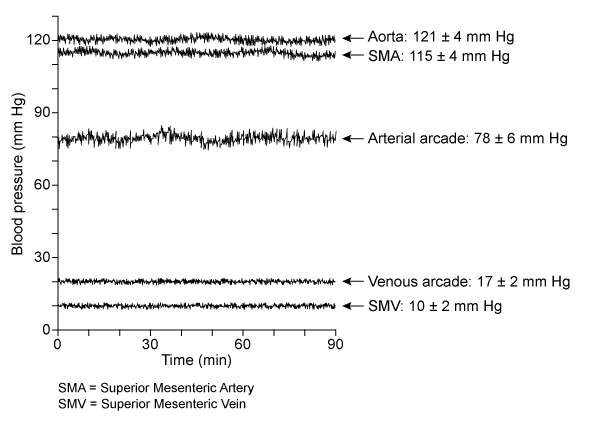 Figure 2 Mesenteric blood pressure profile of rats (Note: SMA = superior mesenteric artery; SMV = superior mesenteric vein.)
-In the image shown, a simplified cardiovascular system is modeled as an electrical circuit. Which of the following would occur if the blood flow to the brain is blocked? (Assume that the blood pressure supplied by the heart remains unchanged.)
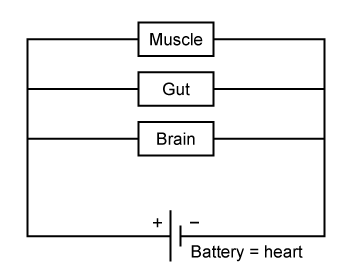
Figure 1 Cardiovascular circuit modelOhm's law states that the voltage drop ΔV across each element, the current I flowing through it, and its electrical resistance R are related by ΔV = IR. In a blood vessel, pressure difference between one vessel and the next ΔP replaces ΔV, volumetric blood flow Q replaces I, and vascular resistance R replaces electrical resistance. Therefore, Ohm's law for blood flow in a vessel isΔP = QREquation 1Vascular resistance is due to the blood's viscosity η and the dimensions of the vessel through which it flows. Assuming blood vessels are cylinders, R can be approximated as
Equation 2where L is the length of the vessel, and r is its inner radius. If Equation 2 is combined with Equation 1, the resulting equation is Poiseuille law.In a study of the circulatory system in rats, researchers measured the intravascular blood pressure of the mesenteric blood vessels. The mesentery is the set of tissues that holds the intestines in place. Blood flows in the following order: aorta, superior mesenteric artery (SMA), arterial arcade, venous arcade, superior mesenteric vein (SMV).For the procedure, catheters with pressure transducers were inserted into each vessel via laparotomy. Laparotomy is an invasive procedure that involves a surgical incision into the abdominal cavity. Blood pressure measurements were taken simultaneously at the proximal end (beginning) of each blood vessel.
Figure 2 Mesenteric blood pressure profile of rats (Note: SMA = superior mesenteric artery; SMV = superior mesenteric vein.)
-In the image shown, a simplified cardiovascular system is modeled as an electrical circuit. Which of the following would occur if the blood flow to the brain is blocked? (Assume that the blood pressure supplied by the heart remains unchanged.) (Multiple Choice)
4.9/5 (92)
(92) A concave mirror has a 4-m radius of curvature. This mirror will focus distant objects at a location that is approximately:
(Multiple Choice)
4.9/5 (70)
(70) Passage
Nitrogen is extremely cold in its liquid phase. It is used in the cryopreservation of small tissue samples and in cryosurgery to freeze and destroy diseased tissues. Liquid nitrogen can be produced from nitrogen gas using the Hampson-Linde cycle (Figure 1).
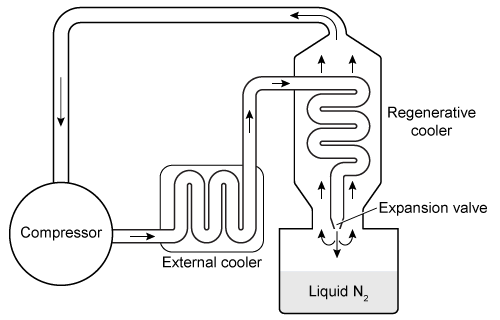 Figure 1 Hampson-Linde cycle apparatus used to liquefy nitrogenThe cycle begins by compressing nitrogen gas and forcing it through a coil in an external cooler that contains dry ice. The gas proceeds to a heat exchanger, where it cools further due to the countercurrent heat exchange with colder nitrogen gas returning from a later stage of the cycle; this process is known as regenerative cooling. The gas is subsequently forced through a narrow valve, where it expands and cools significantly upon exiting. As a result, a portion of the gas becomes liquefied.The temperature change of the gas exiting the valve is described by the Joule-Thomson effect, which occurs without heat transfer with the surroundings. Finally, the liquefied nitrogen is collected, and the remaining gas is sent through the regenerative cooler back to the compressor to reenter the cycle. The physical properties of nitrogen are given in Table 1.Table 1 Thermal Properties of Nitrogen
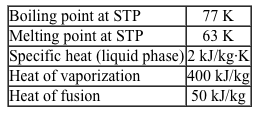 -Which of the following graphs best illustrates how the temperature of nitrogen gas changes as it is cooled past its condensation point?
Figure 1 Hampson-Linde cycle apparatus used to liquefy nitrogenThe cycle begins by compressing nitrogen gas and forcing it through a coil in an external cooler that contains dry ice. The gas proceeds to a heat exchanger, where it cools further due to the countercurrent heat exchange with colder nitrogen gas returning from a later stage of the cycle; this process is known as regenerative cooling. The gas is subsequently forced through a narrow valve, where it expands and cools significantly upon exiting. As a result, a portion of the gas becomes liquefied.The temperature change of the gas exiting the valve is described by the Joule-Thomson effect, which occurs without heat transfer with the surroundings. Finally, the liquefied nitrogen is collected, and the remaining gas is sent through the regenerative cooler back to the compressor to reenter the cycle. The physical properties of nitrogen are given in Table 1.Table 1 Thermal Properties of Nitrogen
-Which of the following graphs best illustrates how the temperature of nitrogen gas changes as it is cooled past its condensation point? (Multiple Choice)
4.7/5 (73)
(73) Passage
Hydrostatic weighing is a technique used to determine an individual's overall body density. The weight of the individual is measured when their body is completely submerged in water. Because the volume of air in the respiratory system affects the measured underwater weight, the individual must exhale completely before entering the water. However, residual volume, the volume of air that always remains in the respiratory system, must also be accounted for.By comparing an individual's in-air weight to their underwater weight, their total body volume can be determined. The density of the body Db excluding any air in the respiratory system is calculated with the in-air mass of the individual mair, the individual's total body volume Vtotal, and an estimate of residual volume Vres by:
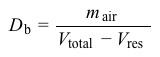 Db=mairVtotal-VresEquation 1Body density can be used to calculate an individual's body fat composition, the percentage of total body mass that is made up of fatty tissue. Human fatty tissue has an average density of 0.9 kg/L, and the density of water is 1 kg/L. The acceleration due to gravity is 10 m/s2.
Adapted from Siri, WE, Body composition from fluids spaces and density. Nutrition 1956 Springer Nature.
-A 0.3-kg object with half the density of human fatty tissue is placed in water. Ignoring the atmospheric pressure, what percentage of the mass will be submerged?
Db=mairVtotal-VresEquation 1Body density can be used to calculate an individual's body fat composition, the percentage of total body mass that is made up of fatty tissue. Human fatty tissue has an average density of 0.9 kg/L, and the density of water is 1 kg/L. The acceleration due to gravity is 10 m/s2.
Adapted from Siri, WE, Body composition from fluids spaces and density. Nutrition 1956 Springer Nature.
-A 0.3-kg object with half the density of human fatty tissue is placed in water. Ignoring the atmospheric pressure, what percentage of the mass will be submerged? (Multiple Choice)
4.7/5 (83)
(83) Blood flows from Point A to Point B at an initial velocity of 100 cm/s within an artery supplying the brain. Assume negligible blood pressure change as the blood ascends 1 cm in the head. 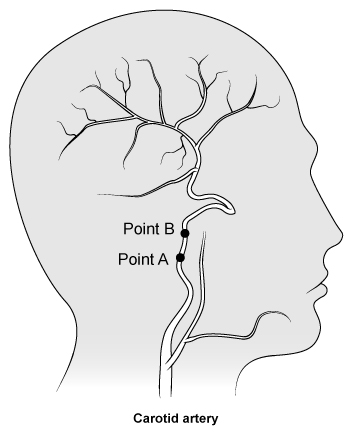 What is the velocity of blood flow when the blood reaches Point B? (Note: The density of blood is 1,060 kg/m3.)
 (Multiple Choice)
4.8/5 (84)
(84) Passage
Osteoporosis is a degenerative bone condition in which healthy bone degenerates into porous bone. Because bone provides the structural integrity that allows the musculoskeletal system to bear weight, osteoporosis is associated with a higher risk of bone fracture.Researchers conducted an experiment designed to assess the strength and elasticity of osteoporotic bone relative to normal bone. Osteoporotic and normal bone samples with identical physical dimensions were collected and placed within an pneumatic compression device, as shown in Figure 1.
Figure 1 Bone compression device loaded with a bone sampleThe force required to compress the bone samples longitudinally (lengthwise) by a given distance was measured, with the results shown in Figure 2.
Figure 2 Relationship between force and compression for normal and osteoporotic bonesResearchers observed that bone samples returned to their original dimensions for deformations not exceeding 1% of the original length L0. For each deformation, the associated strain ε is defined as the change in length of an object ΔL divided by the object's original length (Equation 1).
Equation 1Based on these observations, researchers concluded that both osteoporotic bone and normal bone behaved as an elastic material under a wide range of applied forces.
-Researchers devised a different experiment to measure the torque required to fracture a long bone fixed in place at one end. What information is required to calculate the torque?
Figure 1 Bone compression device loaded with a bone sampleThe force required to compress the bone samples longitudinally (lengthwise) by a given distance was measured, with the results shown in Figure 2.
Figure 2 Relationship between force and compression for normal and osteoporotic bonesResearchers observed that bone samples returned to their original dimensions for deformations not exceeding 1% of the original length L0. For each deformation, the associated strain ε is defined as the change in length of an object ΔL divided by the object's original length (Equation 1).
Equation 1Based on these observations, researchers concluded that both osteoporotic bone and normal bone behaved as an elastic material under a wide range of applied forces.
-Researchers devised a different experiment to measure the torque required to fracture a long bone fixed in place at one end. What information is required to calculate the torque? (Multiple Choice)
4.8/5 (84)
(84) Passage
The effects of gravity are effectively negated if an object is in free fall. For example, an object orbiting the Earth experiences an apparent weightlessness known as microgravity. Because the human body evolved under the influence of Earth's gravity, human physiology undergoes several changes in microgravity environments. Puffy face syndrome (PFS) occurs when an astronaut's extracellular fluid shifts toward upper body regions, resulting in facial bulging and leg shrinkage. Elongation of the spinal column also occurs as intervertebral discs (spinal cartilage) decompress, making astronauts up to 6 cm taller.Researchers simulated microgravity-induced spinal elongation on Earth by suspending 50 volunteers by the arms, holding each above the ground in an upright position. The thickness of each intervertebral disc was measured prior to and following 10 minutes of suspension. Researchers then compared the percentage change in intervertebral disc thickness to similar measurements recorded in microgravity, as shown in Figure 1.
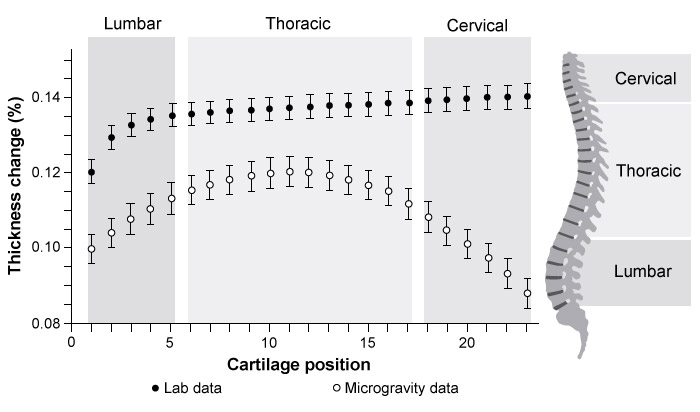 Figure 1 Percentage change in intervertebral disc thicknessIn theory, spinal elongation would also occur in reduced-gravity environments like the surface of the Moon, where the acceleration of gravity is one-sixth that observed on the Earth's surface.
-Provided that the initial velocity in both circumstances is identical, how much longer will an astronaut's vertical jumps last on the surface of the Moon compared to on the surface of the Earth?
Figure 1 Percentage change in intervertebral disc thicknessIn theory, spinal elongation would also occur in reduced-gravity environments like the surface of the Moon, where the acceleration of gravity is one-sixth that observed on the Earth's surface.
-Provided that the initial velocity in both circumstances is identical, how much longer will an astronaut's vertical jumps last on the surface of the Moon compared to on the surface of the Earth? (Multiple Choice)
4.9/5 (79)
(79) One horsepower (hp) is the amount of power required to lift a 75-kg mass a vertical distance of 1 m in 1 s. What is 2 hp equivalent to in watts (W)?
(Multiple Choice)
5.0/5 (85)
(85) Suppose that a simple circuit comprising one voltage source and one metallic resistor yields current I. If the resistor were replaced with another resistor that is identical except that it has 75% lower conductivity, then I would:
(Multiple Choice)
5.0/5 (78)
(78) Passage
Black holes have played an important part in astrophysics for the last half-century. A black hole is a region of space where the force of gravity is especially strong and gravitational potential energy U is very large. Analogous to the electrostatic potential energy associated with electrical charges, U is defined as the work required to move an object of mass m from an infinite distance to a point at radial distance r within the gravitational field of a second mass M as given by
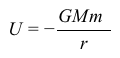 Equation 1where G is the gravitational constant. Near a black hole, the gravitational potential energy can become so negative that not even light has enough energy to escape the black hole's gravity.Escape velocity can be determined by launching an object of mass m with velocity v to an infinite radial distance from the surface of a central mass M (eg, a star or a planet) with radius R. For a black hole to exist, the escape velocity must be equal to the speed of light.Scientists have thoroughly studied the physics of black holes. Stars near the center of our galaxy have been observed to orbit an extremely massive, invisible object (millions of times more massive than our Sun) that is almost certainly a black hole. The orbital angular velocity ω of a star is defined as
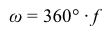 ω=360°⋅fEquation 2where f is the frequency of rotation in hertz (Hz). Likewise, black holes are not merely static masses but are often observed to rotate about their own axis. The interaction between the rotation of a black hole and matter falling into the hole is suspected to form powerful beams (jets) of ionized matter that project away from the black hole along its axis of rotation. Nevertheless, many aspects of how these jets are formed remains a mystery. Black holes will remain a fruitful area for research far into the future.
-A star orbiting a supermassive black hole makes two approximately circular revolutions around the black hole every 20 hours. What is the approximate angular velocity of the star?
Equation 1where G is the gravitational constant. Near a black hole, the gravitational potential energy can become so negative that not even light has enough energy to escape the black hole's gravity.Escape velocity can be determined by launching an object of mass m with velocity v to an infinite radial distance from the surface of a central mass M (eg, a star or a planet) with radius R. For a black hole to exist, the escape velocity must be equal to the speed of light.Scientists have thoroughly studied the physics of black holes. Stars near the center of our galaxy have been observed to orbit an extremely massive, invisible object (millions of times more massive than our Sun) that is almost certainly a black hole. The orbital angular velocity ω of a star is defined as
ω=360°⋅fEquation 2where f is the frequency of rotation in hertz (Hz). Likewise, black holes are not merely static masses but are often observed to rotate about their own axis. The interaction between the rotation of a black hole and matter falling into the hole is suspected to form powerful beams (jets) of ionized matter that project away from the black hole along its axis of rotation. Nevertheless, many aspects of how these jets are formed remains a mystery. Black holes will remain a fruitful area for research far into the future.
-A star orbiting a supermassive black hole makes two approximately circular revolutions around the black hole every 20 hours. What is the approximate angular velocity of the star? (Multiple Choice)
4.8/5 (81)
(81) A battery is connected to a circuit joining it to a lightbulb as shown. 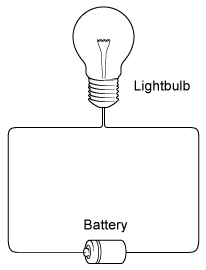 Increasing the internal resistance of the battery will:
 (Multiple Choice)
4.8/5 (86)
(86) Which of the following changes will increase the rate at which a mammalian organism loses body heat to the environment?
(Multiple Choice)
4.7/5 (75)
(75) Passage
In mass spectrometry, a sample's molecules are ionized in a vacuum and then exposed to a uniform electric field created by a high-voltage plate in the acceleration chamber. The electric field accelerates the ions until they arrive at the next section of the device, designated as the separation chamber. In this section, the drifting ions are sorted by their mass-to-charge ratio (m/q).The separation chamber in a time-of-flight mass spectrometer (TOF-MS) is linear and has no electric or magnetic fields. The ions travel at a constant velocity through the chamber until they reach the detector. The time it takes for an ion to reach the detector depends on its m/q ratio.
Figure 1 Time-of-flight mass spectrometerA magnetic sector mass spectrometer (MS-MS) has a curved separation chamber where a magnetic field is generated. The magnetic field exerts a centripetal force on drifting ions, bending their trajectories into curved paths. The radius of the curvature depends on the ion's m/q.
Figure 2 Magnetic sector mass spectrometerThe centripetal force (F) acting on a particle can be determined from its mass (m) and velocity (v) and the radius (r) of the curved path:F = mv2/rEquation 1
-When ions X and Y are analyzed in a TOF-MS, ion Y took more time to reach the detector. Which ion will be observed to have the smaller radius of curvature in MS-MS?
Figure 1 Time-of-flight mass spectrometerA magnetic sector mass spectrometer (MS-MS) has a curved separation chamber where a magnetic field is generated. The magnetic field exerts a centripetal force on drifting ions, bending their trajectories into curved paths. The radius of the curvature depends on the ion's m/q.
Figure 2 Magnetic sector mass spectrometerThe centripetal force (F) acting on a particle can be determined from its mass (m) and velocity (v) and the radius (r) of the curved path:F = mv2/rEquation 1
-When ions X and Y are analyzed in a TOF-MS, ion Y took more time to reach the detector. Which ion will be observed to have the smaller radius of curvature in MS-MS? (Multiple Choice)
5.0/5 (80)
(80) Thin-film interference is observed when polychromatic light is incident on an interface formed by two semitransparent media. Which of the following best explains why thin-film interference generates a multicolored array when two semitransparent fluids are used?
(Multiple Choice)
4.7/5 (69)
(69) Passage
A student performed an experiment to determine the energy content of a sample of potato chips. The chips were blended and then freeze-dried to remove moisture from the sample. Freeze-drying, or lyophilisation, is the preferred dehydration process for food calorimetry due to its minimal impact on nutritional content. Lyophilisation removes water from frozen food samples at low pressure through sublimation. The water is later collected in a cooled condensation chamber to prevent damage to any electric components.After freeze-drying, the sample was ground into a dry homogenous powder. A 1-g sample of the powder was placed in a bomb cell, an enclosed steel-walled container, and pressurized to 25 atm with pure oxygen to ensure complete combustion. The bomb cell was submerged in 500 g of water at room temperature (25°C) in an enclosed and thermally insulated calorimetry device. The sample was combusted using an electric fuse. The temperature of the surrounding water was measured with a glass thermometer every 30 s for several minutes (Figure 1).
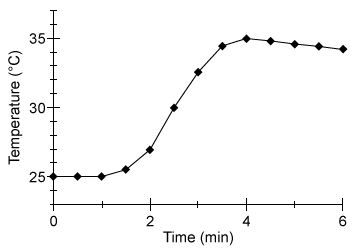 Figure 1 Temperature of the water in the bomb calorimeterThe energy content of food is given in units of dietary calories (Cal), which is equal to 4.185 kJ, or 1,000 gram calories (cal). A gram calorie is the amount of energy required to increase 1 g of water by 1°C.
Adapted from Jumpertz R, Venti CA, Le DS, et al., Food label accuracy of common snack foods. Obesity 2013 Wiley-Blackwell.
-After the experiment had progressed for 2 min, the liquid in the thermometer rose 2 mm. How high will the liquid rise from the 25°C mark after the experiment had progressed for 4 min?
Figure 1 Temperature of the water in the bomb calorimeterThe energy content of food is given in units of dietary calories (Cal), which is equal to 4.185 kJ, or 1,000 gram calories (cal). A gram calorie is the amount of energy required to increase 1 g of water by 1°C.
Adapted from Jumpertz R, Venti CA, Le DS, et al., Food label accuracy of common snack foods. Obesity 2013 Wiley-Blackwell.
-After the experiment had progressed for 2 min, the liquid in the thermometer rose 2 mm. How high will the liquid rise from the 25°C mark after the experiment had progressed for 4 min? (Multiple Choice)
4.9/5 (87)
(87) 
Filters
- Essay(0)
- Multiple Choice(0)
- Short Answer(0)
- True False(0)
- Matching(0)