Multiple Choice
Passage
Nitrogen is extremely cold in its liquid phase. It is used in the cryopreservation of small tissue samples and in cryosurgery to freeze and destroy diseased tissues. Liquid nitrogen can be produced from nitrogen gas using the Hampson-Linde cycle (Figure 1) .
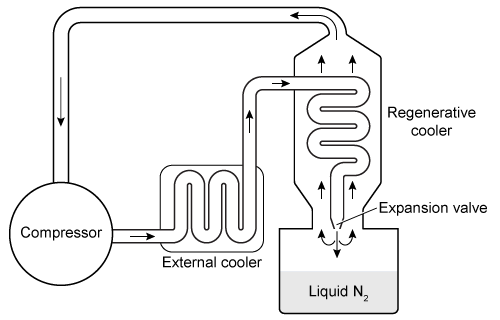 Figure 1 Hampson-Linde cycle apparatus used to liquefy nitrogenThe cycle begins by compressing nitrogen gas and forcing it through a coil in an external cooler that contains dry ice. The gas proceeds to a heat exchanger, where it cools further due to the countercurrent heat exchange with colder nitrogen gas returning from a later stage of the cycle; this process is known as regenerative cooling. The gas is subsequently forced through a narrow valve, where it expands and cools significantly upon exiting. As a result, a portion of the gas becomes liquefied.The temperature change of the gas exiting the valve is described by the Joule-Thomson effect, which occurs without heat transfer with the surroundings. Finally, the liquefied nitrogen is collected, and the remaining gas is sent through the regenerative cooler back to the compressor to reenter the cycle. The physical properties of nitrogen are given in Table 1.Table 1 Thermal Properties of Nitrogen
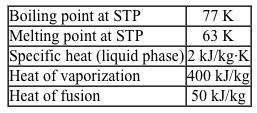
-Which of the following graphs best illustrates how the temperature of nitrogen gas changes as it is cooled past its condensation point?
A) 
B) 
C) 
D) 
Correct Answer:

Verified
Correct Answer:
Verified
Q83: Passage<br>In mass spectrometry, a sample's molecules are
Q84: A swimmer enters a straight river at
Q85: Passage<br>The humerus bone in the upper arm
Q86: Passage<br>In hemodynamics, blood flow through the cardiovascular
Q87: A concave mirror has a 4-m radius
Q89: Passage<br>Hydrostatic weighing is a technique used to
Q90: Blood flows from Point A to Point
Q91: Passage<br>Osteoporosis is a degenerative bone condition in
Q92: Passage<br>The effects of gravity are effectively negated
Q93: One horsepower (hp) is the amount of