Multiple Choice
Passage
In hemodynamics, blood flow through the cardiovascular system can be modeled as an electric circuit in which the blood serves as electricity, the blood vessels as resistive wires, and the heart as a battery (see Figure 1) .
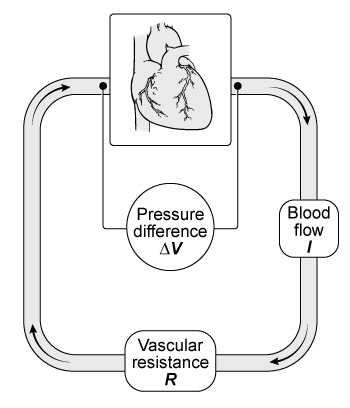 Figure 1 Cardiovascular circuit modelOhm's law states that the voltage drop ΔV across each element, the current I flowing through it, and its electrical resistance R are related by ΔV = IR. In a blood vessel, pressure difference between one vessel and the next ΔP replaces ΔV, volumetric blood flow Q replaces I, and vascular resistance R replaces electrical resistance. Therefore, Ohm's law for blood flow in a vessel isΔP = QREquation 1Vascular resistance is due to the blood's viscosity η and the dimensions of the vessel through which it flows. Assuming blood vessels are cylinders, R can be approximated as
 Equation 2where L is the length of the vessel, and r is its inner radius. If Equation 2 is combined with Equation 1, the resulting equation is Poiseuille law.In a study of the circulatory system in rats, researchers measured the intravascular blood pressure of the mesenteric blood vessels. The mesentery is the set of tissues that holds the intestines in place. Blood flows in the following order: aorta, superior mesenteric artery (SMA) , arterial arcade, venous arcade, superior mesenteric vein (SMV) .For the procedure, catheters with pressure transducers were inserted into each vessel via laparotomy. Laparotomy is an invasive procedure that involves a surgical incision into the abdominal cavity. Blood pressure measurements were taken simultaneously at the proximal end (beginning) of each blood vessel.
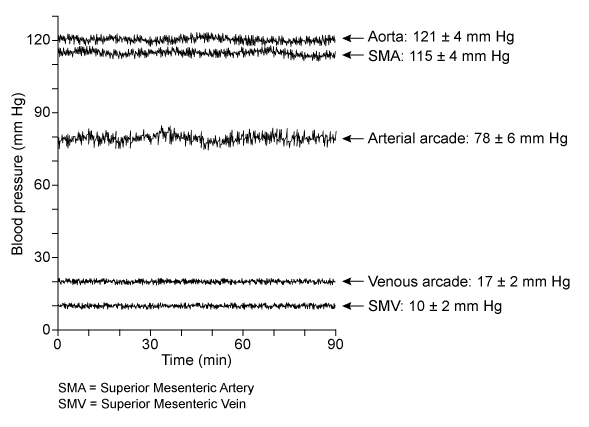 Figure 2 Mesenteric blood pressure profile of rats (Note: SMA = superior mesenteric artery; SMV = superior mesenteric vein.)
-In the image shown, a simplified cardiovascular system is modeled as an electrical circuit. Which of the following would occur if the blood flow to the brain is blocked? (Assume that the blood pressure supplied by the heart remains unchanged.) 
A) Total vascular flow resistance will increase
B) Pressure drop across the muscle will increase
C) Blood flow through the gut will always increase
D) Blood flow throughout the cardiovascular system will stop
Correct Answer:

Verified
Correct Answer:
Verified
Q81: Different substances have different thermal conductivities k,
Q82: Passage<br>Osteoporosis is a degenerative bone condition in
Q83: Passage<br>In mass spectrometry, a sample's molecules are
Q84: A swimmer enters a straight river at
Q85: Passage<br>The humerus bone in the upper arm
Q87: A concave mirror has a 4-m radius
Q88: Passage<br>Nitrogen is extremely cold in its liquid
Q89: Passage<br>Hydrostatic weighing is a technique used to
Q90: Blood flows from Point A to Point
Q91: Passage<br>Osteoporosis is a degenerative bone condition in