Multiple Choice
Passage
In mass spectrometry, a sample's molecules are ionized in a vacuum and then exposed to a uniform electric field created by a high-voltage plate in the acceleration chamber. The electric field accelerates the ions until they arrive at the next section of the device, designated as the separation chamber. In this section, the drifting ions are sorted by their mass-to-charge ratio (m/q) .The separation chamber in a time-of-flight mass spectrometer (TOF-MS) is linear and has no electric or magnetic fields. The ions travel at a constant velocity through the chamber until they reach the detector. The time it takes for an ion to reach the detector depends on its m/q ratio.
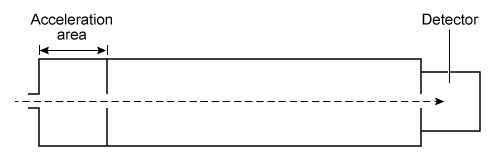 Figure 1 Time-of-flight mass spectrometerA magnetic sector mass spectrometer (MS-MS) has a curved separation chamber where a magnetic field is generated. The magnetic field exerts a centripetal force on drifting ions, bending their trajectories into curved paths. The radius of the curvature depends on the ion's m/q.
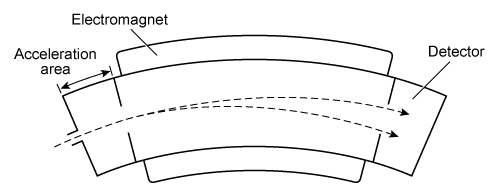 Figure 2 Magnetic sector mass spectrometerThe centripetal force (F) acting on a particle can be determined from its mass (m) and velocity (v) and the radius (r) of the curved path:F = mv2/rEquation 1
-What is the magnitude of the electric field generated in the acceleration chamber if the potential difference is 3,000 V over a distance of 50 cm?
A) 1.5 kN/C
B) 3.0 kN/C
C) 4.5 kN/C
D) 6.0 kN/C
Correct Answer:

Verified
Correct Answer:
Verified
Q78: An ideal fluid flows through a tube
Q79: Passage<br>Nitrogen is extremely cold in its liquid
Q80: Two convex lenses are placed in series
Q81: Different substances have different thermal conductivities k,
Q82: Passage<br>Osteoporosis is a degenerative bone condition in
Q84: A swimmer enters a straight river at
Q85: Passage<br>The humerus bone in the upper arm
Q86: Passage<br>In hemodynamics, blood flow through the cardiovascular
Q87: A concave mirror has a 4-m radius
Q88: Passage<br>Nitrogen is extremely cold in its liquid