Multiple Choice
Passage
Hydrostatic weighing is a technique used to determine an individual's overall body density. The weight of the individual is measured when their body is completely submerged in water. Because the volume of air in the respiratory system affects the measured underwater weight, the individual must exhale completely before entering the water. However, residual volume, the volume of air that always remains in the respiratory system, must also be accounted for.By comparing an individual's in-air weight to their underwater weight, their total body volume can be determined. The density of the body Db excluding any air in the respiratory system is calculated with the in-air mass of the individual mair, the individual's total body volume Vtotal, and an estimate of residual volume Vres by:
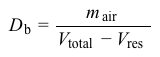 Db=mairVtotal-VresEquation 1Body density can be used to calculate an individual's body fat composition, the percentage of total body mass that is made up of fatty tissue. Human fatty tissue has an average density of 0.9 kg/L, and the density of water is 1 kg/L. The acceleration due to gravity is 10 m/s2.
Adapted from Siri, WE, Body composition from fluids spaces and density. Nutrition 1956 Springer Nature.
-A 0.3-kg object with half the density of human fatty tissue is placed in water. Ignoring the atmospheric pressure, what percentage of the mass will be submerged?
A) 30%
B) 45%
C) 90%
D) 100%
Correct Answer:

Verified
Correct Answer:
Verified
Q84: A swimmer enters a straight river at
Q85: Passage<br>The humerus bone in the upper arm
Q86: Passage<br>In hemodynamics, blood flow through the cardiovascular
Q87: A concave mirror has a 4-m radius
Q88: Passage<br>Nitrogen is extremely cold in its liquid
Q90: Blood flows from Point A to Point
Q91: Passage<br>Osteoporosis is a degenerative bone condition in
Q92: Passage<br>The effects of gravity are effectively negated
Q93: One horsepower (hp) is the amount of
Q94: Suppose that a simple circuit comprising one