



 Chat with AI
Exam 7: Physics

Exam 1: Behavioral Sciences343 Questions
Exam 2: Biochemistry307 Questions
Exam 3: Biology319 Questions
Exam 4: Critical Analysis & Reasoning Skills358 Questions
Exam 5: General Chemistry317 Questions
Exam 6: Organic Chemistry191 Questions
Exam 7: Physics200 Questions
Select questions type


Passage
The humerus bone in the upper arm and the radius bone in the lower arm can be modeled as a lever with the elbow joint as the pivot point. Movement about the elbow results from a combination of internal and external forces acting on these bones. The primary internal force is generated from contractions of skeletal muscles; a 1-cm2 cross-sectional area of skeletal muscle can generate a maximum of 7 × 10⁶ dynes of force (1 dyn = 1 g⋅cm/s2). Friction between the humerus and the radius at the elbow is another internal force that can affect arm movements. As people age, cartilage degeneration decreases the lubrication between bones, which increases the coefficients of static and kinetic friction.The contraction of the biceps, a skeletal muscle in the upper arm, exerts a pulling force on the radius in the lower arm. If the torque generated by this muscle exceeds that of any opposing internal and external forces, the arm curls about the elbow. This specific type of movement is known as a concentric muscle contraction.The following experiments were performed with a 30-year-old male subject. Electrodes were placed around the subject's biceps and attached to an electromyograph, a device that measures the electrical activity of skeletal muscle contractions. The estimated weight of the subject's lower arm is 45 N, and the subject's lower arm segments to the elbow are shown in Table 1.Table 1 Lower Arm Segment Lengths
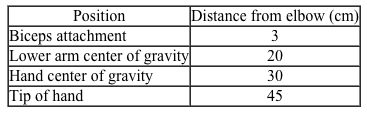 Experiment 1The subject kept his entire arm stationary and in a fixed position while holding balls of varying masses. The upper arm was perpendicular to the ground, and the lower arm was parallel to the ground (Figure 1).
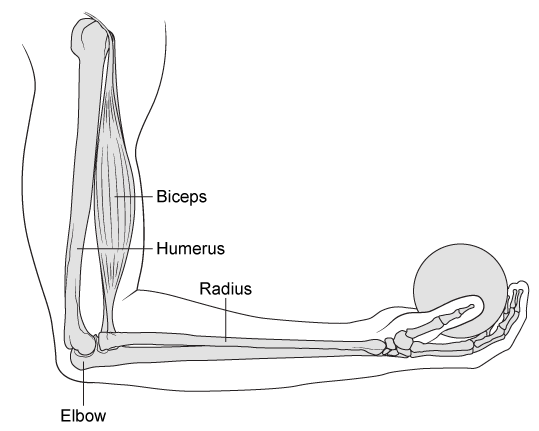 Figure 1 The fixed position of the arm during Experiment 1Experiment 2The subject kept his upper arm stationary and perpendicular to the ground while lifting and lowering balls of varying masses.
Adapted from N. Ozkaya, Fundamentals of Biomechanics. (C) 2016 Springer.
-Assuming the weight of the arm remains the same, how would the friction at the elbow change if the subject were to repeat the experiments 20 years later?
Experiment 1The subject kept his entire arm stationary and in a fixed position while holding balls of varying masses. The upper arm was perpendicular to the ground, and the lower arm was parallel to the ground (Figure 1).
Figure 1 The fixed position of the arm during Experiment 1Experiment 2The subject kept his upper arm stationary and perpendicular to the ground while lifting and lowering balls of varying masses.
Adapted from N. Ozkaya, Fundamentals of Biomechanics. (C) 2016 Springer.
-Assuming the weight of the arm remains the same, how would the friction at the elbow change if the subject were to repeat the experiments 20 years later? (Multiple Choice)
4.8/5  (85)
(85) 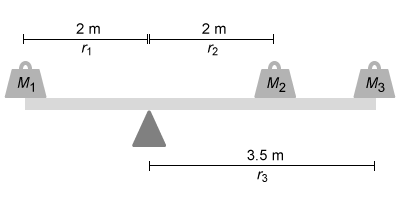 The figure above shows a board placed on top of a fulcrum that is balanced by three masses (M1, M2, and M3). If the mass of M1 and M2 are 60 kg and 30 kg, respectively, what is the mass of M3?
 (Multiple Choice)
4.9/5 (83)
(83) Ultrasonic shock wave devices may be used in medical settings to disrupt disease structures located deep in the body. Among other variables, the device user can control the frequency of emitted waveforms. The adjustment of waveform frequency:
(Multiple Choice)
4.9/5 (67)
(67) Which unit ratio CANNOT be used to express the quantity of current traveling through a circuit?
(Multiple Choice)
4.8/5 (84)
(84) An ideal fluid flows within a fixed tube with decreasing cross-sectional area. Assuming constant height and volumetric flow rate, which of the following graphs best illustrates the relationship between fluid pressure and the increase in fluid velocity?
(Multiple Choice)
4.8/5 (74)
(74) Passage
A traumatic brain injury (TBI) is a form of brain injury caused by an external physical force. In addition to direct injury at the site of an impact, the rapid acceleration-deceleration of the head may cause the brain to move within the skull and result in injury to the part of the brain opposite the impact site. This is known as a contrecoup injury.If an impact to the head also results in a skull fracture, the injury is classified as an open TBI. If there is no skull fracture, the injury is classified as a closed TBI. The type of TBI can be predicted from the collision duration and the average acceleration of the head. The thresholds for open and closed TBI are shown in Figure 1.
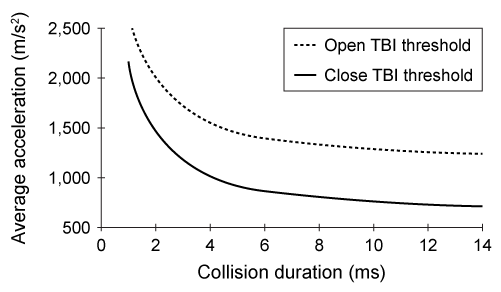 Figure 1 Thresholds for open and closed TBIIn an experiment to study head collisions with projectiles, researchers equipped the head of a crash test dummy with sensors that measured acceleration on multiple axes. The crash test dummy was stationary before its head was subjected to controlled collisions with incoming projectiles of varying mass and impact velocity. The linear acceleration of the crash test dummy's head was recorded during and after the impact. The results for a trial in which the impact lasted for 10 ms are shown in Figure 2.
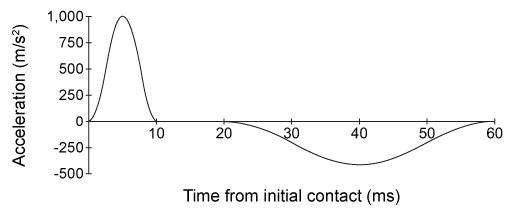 Figure 2 The acceleration of the head during and after a 10-ms collision
-In the range from 0 to 10 ms in Figure 2, which of the following represents the velocity of the head at 10 ms?
Figure 1 Thresholds for open and closed TBIIn an experiment to study head collisions with projectiles, researchers equipped the head of a crash test dummy with sensors that measured acceleration on multiple axes. The crash test dummy was stationary before its head was subjected to controlled collisions with incoming projectiles of varying mass and impact velocity. The linear acceleration of the crash test dummy's head was recorded during and after the impact. The results for a trial in which the impact lasted for 10 ms are shown in Figure 2.
Figure 2 The acceleration of the head during and after a 10-ms collision
-In the range from 0 to 10 ms in Figure 2, which of the following represents the velocity of the head at 10 ms? (Multiple Choice)
4.8/5 (73)
(73) A 1-m spring is compressed to half its original length. What is the potential energy stored within the spring? (Note: k = 40 N/m)
(Multiple Choice)
4.9/5 (82)
(82) Ideal fluids are used to model the behavior of fluids both in motion and at rest. Which one of the following assumptions does NOT apply to an ideal fluid?
(Multiple Choice)
4.9/5 (79)
(79) Passage
A student performed an experiment to determine the energy content of a sample of potato chips. The chips were blended and then freeze-dried to remove moisture from the sample. Freeze-drying, or lyophilisation, is the preferred dehydration process for food calorimetry due to its minimal impact on nutritional content. Lyophilisation removes water from frozen food samples at low pressure through sublimation. The water is later collected in a cooled condensation chamber to prevent damage to any electric components.After freeze-drying, the sample was ground into a dry homogenous powder. A 1-g sample of the powder was placed in a bomb cell, an enclosed steel-walled container, and pressurized to 25 atm with pure oxygen to ensure complete combustion. The bomb cell was submerged in 500 g of water at room temperature (25°C) in an enclosed and thermally insulated calorimetry device. The sample was combusted using an electric fuse. The temperature of the surrounding water was measured with a glass thermometer every 30 s for several minutes (Figure 1).
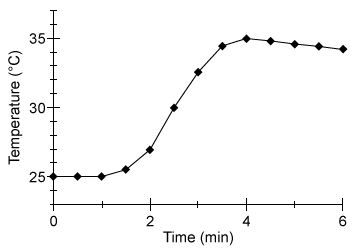 Figure 1 Temperature of the water in the bomb calorimeterThe energy content of food is given in units of dietary calories (Cal), which is equal to 4.185 kJ, or 1,000 gram calories (cal). A gram calorie is the amount of energy required to increase 1 g of water by 1°C.
Adapted from Jumpertz R, Venti CA, Le DS, et al., Food label accuracy of common snack foods. Obesity 2013 Wiley-Blackwell.
-Approximately how much heat in kJ was released from the combustion of the 1-g sample?
Figure 1 Temperature of the water in the bomb calorimeterThe energy content of food is given in units of dietary calories (Cal), which is equal to 4.185 kJ, or 1,000 gram calories (cal). A gram calorie is the amount of energy required to increase 1 g of water by 1°C.
Adapted from Jumpertz R, Venti CA, Le DS, et al., Food label accuracy of common snack foods. Obesity 2013 Wiley-Blackwell.
-Approximately how much heat in kJ was released from the combustion of the 1-g sample? (Multiple Choice)
4.9/5 (68)
(68) The misdirected transmission of a high-voltage electrical current is associated with a risk of accidental fire. To eliminate the risk of such accidents, the type of material that must be applied to the surface of bare wires is known as:
(Multiple Choice)
4.9/5 (76)
(76) Laser Doppler vibrometers detect the Doppler shift of a laser beam reflected off an individual's chest to measure respiratory rate. The calculated displacement of the chest during a breath using a 500-nm laser is shown below. 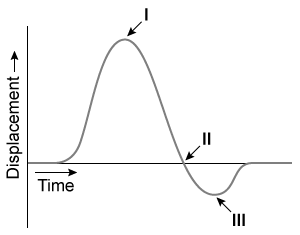 If the laser source is stationary, at which point(s) would the observed frequency of the reflected laser be 6 × 10¹⁴ Hz?
 (Multiple Choice)
4.9/5 (82)
(82) Passage
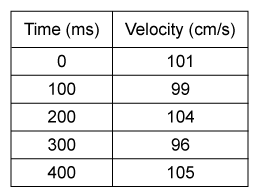
The flow of blood through the human body is typically laminar, but in certain conditions, as when blood flows through the aorta during a period of heightened physical activity, the flow can become turbulent. Blood flow can also become turbulent in abnormal cases in which the passage of blood is obstructed by constrictions within the blood vessel. The energy generated by blood turbulence creates sound vibrations that can be heard with a stethoscope.Using the technique of laser Doppler velocimetry, researchers recorded the blood velocity v at a point in the aorta of an experimental subject at different times during aerobic exercise. Table 1 shows the blood velocities observed over a 400 ms time interval.Table 1 Blood Velocity within the Aorta of an Experimental Subject (mean velocity v̅ = 101 cm/s)
 Turbulent kinetic energy (TKE) is the kinetic energy per unit mass associated with turbulence within flowing fluids and is defined as:
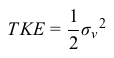 Equation 1where σv is the standard deviation of the fluctuating fluid velocities at a point within the turbulent flow.Reynolds number Re is the quantity that ultimately measures whether a flow is turbulent or laminar. Re is defined in terms of the fluid density ρ, mean velocity of the flow v̅, conduit diameter d, and dynamic viscosity η of the fluid, as given by:
 Equation 2In the context of blood flow, d is the diameter of the blood vessel, and blood has a fluid density of about 1,060 kg∙m−3 with a dynamic viscosity of about 0.003 kg∙m−1∙s−1.
-The blood leaving the aorta reaches the circle of Willis, a collection of arteries that supplies blood to the brain. Assume that it takes 600 ms for blood to reach the circle of Willis and that its average velocity is reduced to 61 cm/s. What is the average acceleration experienced by the blood?
Turbulent kinetic energy (TKE) is the kinetic energy per unit mass associated with turbulence within flowing fluids and is defined as:
Equation 1where σv is the standard deviation of the fluctuating fluid velocities at a point within the turbulent flow.Reynolds number Re is the quantity that ultimately measures whether a flow is turbulent or laminar. Re is defined in terms of the fluid density ρ, mean velocity of the flow v̅, conduit diameter d, and dynamic viscosity η of the fluid, as given by:
Equation 2In the context of blood flow, d is the diameter of the blood vessel, and blood has a fluid density of about 1,060 kg∙m−3 with a dynamic viscosity of about 0.003 kg∙m−1∙s−1.
-The blood leaving the aorta reaches the circle of Willis, a collection of arteries that supplies blood to the brain. Assume that it takes 600 ms for blood to reach the circle of Willis and that its average velocity is reduced to 61 cm/s. What is the average acceleration experienced by the blood? (Multiple Choice)
4.8/5 (81)
(81) Passage
Laparoscopy is a minimally invasive surgical procedure where small surgical instruments are inserted into the body through cannulas (hollow tubes 0.5 to 1.0 cm in diameter). A cannula is inserted into the skin while sleeved around a trocar (Figure 1). The skin incision can be made directly with a sharp-tipped trocar as it is being inserted with the cannula. If a blunt-tipped trocar is used, the incision is made beforehand with a surgical blade. After insertion, the trocar is removed, leaving the cannula as an access point for laparoscopic procedures.
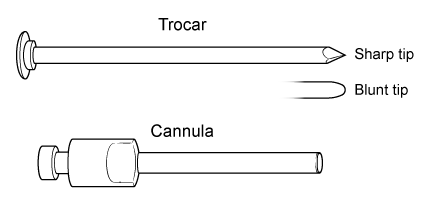 Figure 1 Cannula, trocar, and two types of tipsLow-friction trocars increase surgical precision and reduce postoperative scarring. Friction between the skin and trocar tip is tested with synthetic skin and a stationary ramp whose surface is made of the same material as the trocar. For testing, the synthetic skin is pressed against the ramp's surface by a load, weighted to allow the skin to slide down at a constant speed (Figure 2). In this setup, the weight of the synthetic skin layer is negligible.
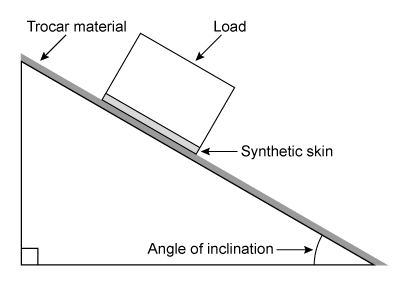 Figure 2 Experimental setup to test the friction between trocar and skin
Adapted from W. Firme-Gustavo et al., (C)2015 Society of Laparoendoscopic Surgeons.
-Which of the following expressions gives the magnitude of the work done by the frictional force F if the synthetic skin slides down the entire length L of the ramp and then is pushed back up to its original position?
Figure 1 Cannula, trocar, and two types of tipsLow-friction trocars increase surgical precision and reduce postoperative scarring. Friction between the skin and trocar tip is tested with synthetic skin and a stationary ramp whose surface is made of the same material as the trocar. For testing, the synthetic skin is pressed against the ramp's surface by a load, weighted to allow the skin to slide down at a constant speed (Figure 2). In this setup, the weight of the synthetic skin layer is negligible.
Figure 2 Experimental setup to test the friction between trocar and skin
Adapted from W. Firme-Gustavo et al., (C)2015 Society of Laparoendoscopic Surgeons.
-Which of the following expressions gives the magnitude of the work done by the frictional force F if the synthetic skin slides down the entire length L of the ramp and then is pushed back up to its original position? (Multiple Choice)
4.9/5 (82)
(82) Passage
The humerus bone in the upper arm and the radius bone in the lower arm can be modeled as a lever with the elbow joint as the pivot point. Movement about the elbow results from a combination of internal and external forces acting on these bones. The primary internal force is generated from contractions of skeletal muscles; a 1-cm2 cross-sectional area of skeletal muscle can generate a maximum of 7 × 10⁶ dynes of force (1 dyn = 1 g⋅cm/s2). Friction between the humerus and the radius at the elbow is another internal force that can affect arm movements. As people age, cartilage degeneration decreases the lubrication between bones, which increases the coefficients of static and kinetic friction.The contraction of the biceps, a skeletal muscle in the upper arm, exerts a pulling force on the radius in the lower arm. If the torque generated by this muscle exceeds that of any opposing internal and external forces, the arm curls about the elbow. This specific type of movement is known as a concentric muscle contraction.The following experiments were performed with a 30-year-old male subject. Electrodes were placed around the subject's biceps and attached to an electromyograph, a device that measures the electrical activity of skeletal muscle contractions. The estimated weight of the subject's lower arm is 45 N, and the subject's lower arm segments to the elbow are shown in Table 1.Table 1 Lower Arm Segment Lengths
Experiment 1The subject kept his entire arm stationary and in a fixed position while holding balls of varying masses. The upper arm was perpendicular to the ground, and the lower arm was parallel to the ground (Figure 1).
Figure 1 The fixed position of the arm during Experiment 1Experiment 2The subject kept his upper arm stationary and perpendicular to the ground while lifting and lowering balls of varying masses.
Adapted from N. Ozkaya, Fundamentals of Biomechanics. (C) 2016 Springer.
-What is the maximum pressure in N/m2 generated by skeletal muscles?
Experiment 1The subject kept his entire arm stationary and in a fixed position while holding balls of varying masses. The upper arm was perpendicular to the ground, and the lower arm was parallel to the ground (Figure 1).
Figure 1 The fixed position of the arm during Experiment 1Experiment 2The subject kept his upper arm stationary and perpendicular to the ground while lifting and lowering balls of varying masses.
Adapted from N. Ozkaya, Fundamentals of Biomechanics. (C) 2016 Springer.
-What is the maximum pressure in N/m2 generated by skeletal muscles? (Multiple Choice)
4.8/5 (86)
(86) Two identical balls of equal mass m1 and m2 are placed at rest at the top of separate hills. 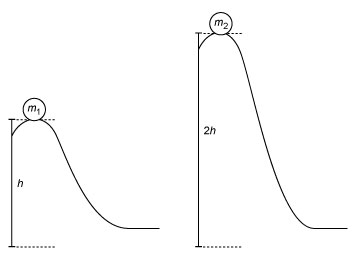 How do the velocities v1 and v2 of the balls compare, measured after each has rolled down to the bottom of its respective hill? (Note: Assume the absence of friction and negligible rotational kinetic energy.)
 (Multiple Choice)
4.7/5 (89)
(89) Passage
The humerus bone in the upper arm and the radius bone in the lower arm can be modeled as a lever with the elbow joint as the pivot point. Movement about the elbow results from a combination of internal and external forces acting on these bones. The primary internal force is generated from contractions of skeletal muscles; a 1-cm2 cross-sectional area of skeletal muscle can generate a maximum of 7 × 10⁶ dynes of force (1 dyn = 1 g⋅cm/s2). Friction between the humerus and the radius at the elbow is another internal force that can affect arm movements. As people age, cartilage degeneration decreases the lubrication between bones, which increases the coefficients of static and kinetic friction.The contraction of the biceps, a skeletal muscle in the upper arm, exerts a pulling force on the radius in the lower arm. If the torque generated by this muscle exceeds that of any opposing internal and external forces, the arm curls about the elbow. This specific type of movement is known as a concentric muscle contraction.The following experiments were performed with a 30-year-old male subject. Electrodes were placed around the subject's biceps and attached to an electromyograph, a device that measures the electrical activity of skeletal muscle contractions. The estimated weight of the subject's lower arm is 45 N, and the subject's lower arm segments to the elbow are shown in Table 1.Table 1 Lower Arm Segment Lengths
Experiment 1The subject kept his entire arm stationary and in a fixed position while holding balls of varying masses. The upper arm was perpendicular to the ground, and the lower arm was parallel to the ground (Figure 1).
Figure 1 The fixed position of the arm during Experiment 1Experiment 2The subject kept his upper arm stationary and perpendicular to the ground while lifting and lowering balls of varying masses.
Adapted from N. Ozkaya, Fundamentals of Biomechanics. (C) 2016 Springer.
-Which of the following graphs shows the relationship between the torque generated by the weight of the ball and the angle the biceps makes with the lower arm in Experiment 2?
Experiment 1The subject kept his entire arm stationary and in a fixed position while holding balls of varying masses. The upper arm was perpendicular to the ground, and the lower arm was parallel to the ground (Figure 1).
Figure 1 The fixed position of the arm during Experiment 1Experiment 2The subject kept his upper arm stationary and perpendicular to the ground while lifting and lowering balls of varying masses.
Adapted from N. Ozkaya, Fundamentals of Biomechanics. (C) 2016 Springer.
-Which of the following graphs shows the relationship between the torque generated by the weight of the ball and the angle the biceps makes with the lower arm in Experiment 2? (Multiple Choice)
4.8/5 (87)
(87) Passage
When present in the bloodstream above a threshold partial pressure, a general anesthetic blocks the sensation of pain, induces a state of unconsciousness, and causes muscle paralysis. Many anesthetic agents are administered in their gaseous phase and are absorbed into the bloodstream through the lungs. The rate of diffusion Vgas of an anesthetic across the alveolar membrane with a surface area A and a thickness T is described by the Fick law of diffusion:
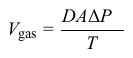 Vgas=DAΔPTEquation 1where D is the diffusion coefficient specific for the gas and ΔP is the partial pressure difference across the membrane.An inhaled anesthetic is described by its blood-gas partition coefficient, the ratio of the anesthetic's concentration in the blood to its concentration in the lungs when the partial pressures are equal. The concentration C of an anesthetic gas dissolved in blood is described by the Henry law of solubility:
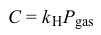 C=kHPgasEquation 2where kH is the solubility constant specific for the gas and Pgas is the partial pressure of the gas.Due to the paralytic effects of general anesthetics, mechanical ventilators are usually necessary to assist a patient's breathing during surgery. Positive-pressure ventilators are noninvasive and use external pumps to induce inspiration by forcing air into the lungs through a ventilation mask. Despite the paralytic effects of general anesthesia, patients are often capable of expiration without the active aid of a mechanical ventilator.
-Which of the following characteristics would describe an inhalational anesthetic that is present in a relatively low concentration in the blood when it takes effect?
Vgas=DAΔPTEquation 1where D is the diffusion coefficient specific for the gas and ΔP is the partial pressure difference across the membrane.An inhaled anesthetic is described by its blood-gas partition coefficient, the ratio of the anesthetic's concentration in the blood to its concentration in the lungs when the partial pressures are equal. The concentration C of an anesthetic gas dissolved in blood is described by the Henry law of solubility:
C=kHPgasEquation 2where kH is the solubility constant specific for the gas and Pgas is the partial pressure of the gas.Due to the paralytic effects of general anesthetics, mechanical ventilators are usually necessary to assist a patient's breathing during surgery. Positive-pressure ventilators are noninvasive and use external pumps to induce inspiration by forcing air into the lungs through a ventilation mask. Despite the paralytic effects of general anesthesia, patients are often capable of expiration without the active aid of a mechanical ventilator.
-Which of the following characteristics would describe an inhalational anesthetic that is present in a relatively low concentration in the blood when it takes effect? (Multiple Choice)
4.8/5 (72)
(72) Passage
Black holes have played an important part in astrophysics for the last half-century. A black hole is a region of space where the force of gravity is especially strong and gravitational potential energy U is very large. Analogous to the electrostatic potential energy associated with electrical charges, U is defined as the work required to move an object of mass m from an infinite distance to a point at radial distance r within the gravitational field of a second mass M as given by
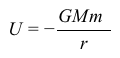 Equation 1where G is the gravitational constant. Near a black hole, the gravitational potential energy can become so negative that not even light has enough energy to escape the black hole's gravity.Escape velocity can be determined by launching an object of mass m with velocity v to an infinite radial distance from the surface of a central mass M (eg, a star or a planet) with radius R. For a black hole to exist, the escape velocity must be equal to the speed of light.Scientists have thoroughly studied the physics of black holes. Stars near the center of our galaxy have been observed to orbit an extremely massive, invisible object (millions of times more massive than our Sun) that is almost certainly a black hole. The orbital angular velocity ω of a star is defined as
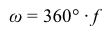 ω=360°⋅fEquation 2where f is the frequency of rotation in hertz (Hz). Likewise, black holes are not merely static masses but are often observed to rotate about their own axis. The interaction between the rotation of a black hole and matter falling into the hole is suspected to form powerful beams (jets) of ionized matter that project away from the black hole along its axis of rotation. Nevertheless, many aspects of how these jets are formed remains a mystery. Black holes will remain a fruitful area for research far into the future.
-A star orbiting a black hole in a clockwise direction at a radial distance of 1.0 × 10⁶ km is acted upon by a counterclockwise friction force of 250 N perpendicular to the orbit radius. What is the torque on the star?
Equation 1where G is the gravitational constant. Near a black hole, the gravitational potential energy can become so negative that not even light has enough energy to escape the black hole's gravity.Escape velocity can be determined by launching an object of mass m with velocity v to an infinite radial distance from the surface of a central mass M (eg, a star or a planet) with radius R. For a black hole to exist, the escape velocity must be equal to the speed of light.Scientists have thoroughly studied the physics of black holes. Stars near the center of our galaxy have been observed to orbit an extremely massive, invisible object (millions of times more massive than our Sun) that is almost certainly a black hole. The orbital angular velocity ω of a star is defined as
ω=360°⋅fEquation 2where f is the frequency of rotation in hertz (Hz). Likewise, black holes are not merely static masses but are often observed to rotate about their own axis. The interaction between the rotation of a black hole and matter falling into the hole is suspected to form powerful beams (jets) of ionized matter that project away from the black hole along its axis of rotation. Nevertheless, many aspects of how these jets are formed remains a mystery. Black holes will remain a fruitful area for research far into the future.
-A star orbiting a black hole in a clockwise direction at a radial distance of 1.0 × 10⁶ km is acted upon by a counterclockwise friction force of 250 N perpendicular to the orbit radius. What is the torque on the star? (Multiple Choice)
4.9/5 (86)
(86) Passage
When present in the bloodstream above a threshold partial pressure, a general anesthetic blocks the sensation of pain, induces a state of unconsciousness, and causes muscle paralysis. Many anesthetic agents are administered in their gaseous phase and are absorbed into the bloodstream through the lungs. The rate of diffusion Vgas of an anesthetic across the alveolar membrane with a surface area A and a thickness T is described by the Fick law of diffusion:
Vgas=DAΔPTEquation 1where D is the diffusion coefficient specific for the gas and ΔP is the partial pressure difference across the membrane.An inhaled anesthetic is described by its blood-gas partition coefficient, the ratio of the anesthetic's concentration in the blood to its concentration in the lungs when the partial pressures are equal. The concentration C of an anesthetic gas dissolved in blood is described by the Henry law of solubility:
C=kHPgasEquation 2where kH is the solubility constant specific for the gas and Pgas is the partial pressure of the gas.Due to the paralytic effects of general anesthetics, mechanical ventilators are usually necessary to assist a patient's breathing during surgery. Positive-pressure ventilators are noninvasive and use external pumps to induce inspiration by forcing air into the lungs through a ventilation mask. Despite the paralytic effects of general anesthesia, patients are often capable of expiration without the active aid of a mechanical ventilator.
-Unassisted expiration is possible under the effects of anesthesia due to:
Vgas=DAΔPTEquation 1where D is the diffusion coefficient specific for the gas and ΔP is the partial pressure difference across the membrane.An inhaled anesthetic is described by its blood-gas partition coefficient, the ratio of the anesthetic's concentration in the blood to its concentration in the lungs when the partial pressures are equal. The concentration C of an anesthetic gas dissolved in blood is described by the Henry law of solubility:
C=kHPgasEquation 2where kH is the solubility constant specific for the gas and Pgas is the partial pressure of the gas.Due to the paralytic effects of general anesthetics, mechanical ventilators are usually necessary to assist a patient's breathing during surgery. Positive-pressure ventilators are noninvasive and use external pumps to induce inspiration by forcing air into the lungs through a ventilation mask. Despite the paralytic effects of general anesthesia, patients are often capable of expiration without the active aid of a mechanical ventilator.
-Unassisted expiration is possible under the effects of anesthesia due to: (Multiple Choice)
4.9/5 (75)
(75) A sample of water vapor undergoes deposition and then melting. What happens to its entropy after each phase change?
(Multiple Choice)
4.9/5 (87)
(87) 
Filters
- Essay(0)
- Multiple Choice(0)
- Short Answer(0)
- True False(0)
- Matching(0)