



 Chat with AI
Exam 7: Physics

Exam 1: Behavioral Sciences343 Questions
Exam 2: Biochemistry307 Questions
Exam 3: Biology319 Questions
Exam 4: Critical Analysis & Reasoning Skills358 Questions
Exam 5: General Chemistry317 Questions
Exam 6: Organic Chemistry191 Questions
Exam 7: Physics200 Questions
Select questions type


That the spherical aberration of a converging lens is corrected by reducing the thickness of the lens periphery means that the light rays emerging from aberrant converging lenses:
(Multiple Choice)
4.9/5  (88)
(88) Passage
Osteoporosis is a degenerative bone condition in which healthy bone degenerates into porous bone. Because bone provides the structural integrity that allows the musculoskeletal system to bear weight, osteoporosis is associated with a higher risk of bone fracture.Researchers conducted an experiment designed to assess the strength and elasticity of osteoporotic bone relative to normal bone. Osteoporotic and normal bone samples with identical physical dimensions were collected and placed within an pneumatic compression device, as shown in Figure 1.
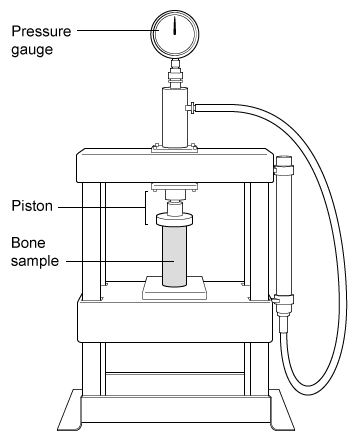 Figure 1 Bone compression device loaded with a bone sampleThe force required to compress the bone samples longitudinally (lengthwise) by a given distance was measured, with the results shown in Figure 2.
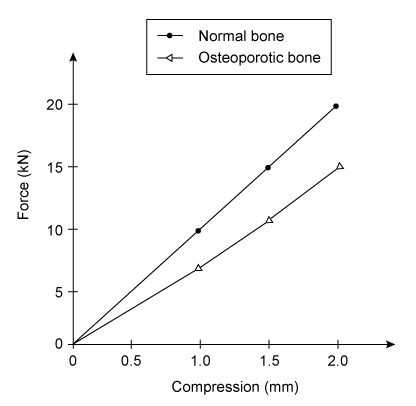 Figure 2 Relationship between force and compression for normal and osteoporotic bonesResearchers observed that bone samples returned to their original dimensions for deformations not exceeding 1% of the original length L0. For each deformation, the associated strain ε is defined as the change in length of an object ΔL divided by the object's original length (Equation 1).
 Equation 1Based on these observations, researchers concluded that both osteoporotic bone and normal bone behaved as an elastic material under a wide range of applied forces.
-Which of the following expressions is equal to Uel, the elastic potential energy stored within a compressed bone?
Figure 1 Bone compression device loaded with a bone sampleThe force required to compress the bone samples longitudinally (lengthwise) by a given distance was measured, with the results shown in Figure 2.
Figure 2 Relationship between force and compression for normal and osteoporotic bonesResearchers observed that bone samples returned to their original dimensions for deformations not exceeding 1% of the original length L0. For each deformation, the associated strain ε is defined as the change in length of an object ΔL divided by the object's original length (Equation 1).
Equation 1Based on these observations, researchers concluded that both osteoporotic bone and normal bone behaved as an elastic material under a wide range of applied forces.
-Which of the following expressions is equal to Uel, the elastic potential energy stored within a compressed bone? (Multiple Choice)
4.9/5 (94)
(94) 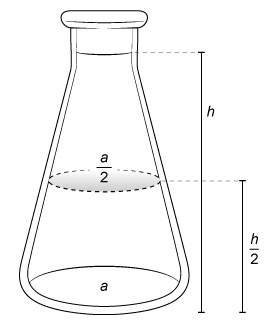 A flask with height h and base area A is filled with water. If the hydrostatic pressure is 2 atm halfway between the base and the top, what is the hydrostatic pressure at the base of the flask?
 (Multiple Choice)
4.9/5 (95)
(95) Passage
The effects of gravity are effectively negated if an object is in free fall. For example, an object orbiting the Earth experiences an apparent weightlessness known as microgravity. Because the human body evolved under the influence of Earth's gravity, human physiology undergoes several changes in microgravity environments. Puffy face syndrome (PFS) occurs when an astronaut's extracellular fluid shifts toward upper body regions, resulting in facial bulging and leg shrinkage. Elongation of the spinal column also occurs as intervertebral discs (spinal cartilage) decompress, making astronauts up to 6 cm taller.Researchers simulated microgravity-induced spinal elongation on Earth by suspending 50 volunteers by the arms, holding each above the ground in an upright position. The thickness of each intervertebral disc was measured prior to and following 10 minutes of suspension. Researchers then compared the percentage change in intervertebral disc thickness to similar measurements recorded in microgravity, as shown in Figure 1.
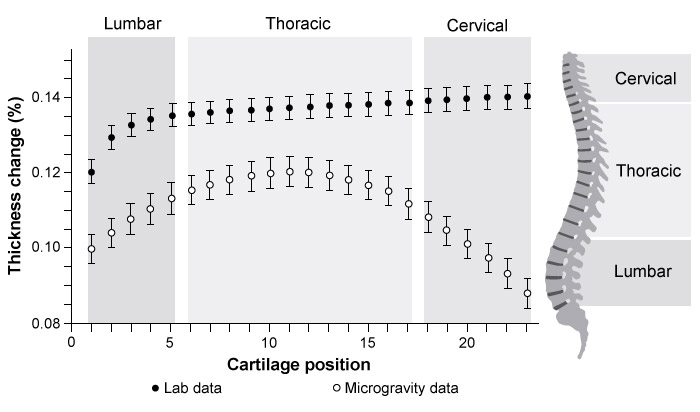 Figure 1 Percentage change in intervertebral disc thicknessIn theory, spinal elongation would also occur in reduced-gravity environments like the surface of the Moon, where the acceleration of gravity is one-sixth that observed on the Earth's surface.
-Which of the following statements explains the discrepancy between the microgravity data and the laboratory data for the experiment described in the passage?
Figure 1 Percentage change in intervertebral disc thicknessIn theory, spinal elongation would also occur in reduced-gravity environments like the surface of the Moon, where the acceleration of gravity is one-sixth that observed on the Earth's surface.
-Which of the following statements explains the discrepancy between the microgravity data and the laboratory data for the experiment described in the passage? (Multiple Choice)
4.8/5 (74)
(74) A car moves in a straight line along a paved road. The velocity of the car versus time is shown: 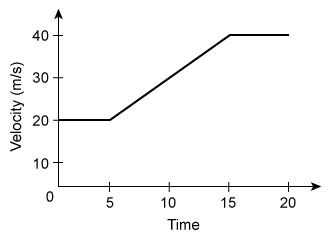 What is the distance travelled by the car from 0 s to 15 s?
 (Multiple Choice)
4.8/5 (81)
(81) Passage
Sound waves propagate through many conducting structures in the ear before they are transduced into neuronal signals. When sound waves reach the fluid-filled cochlea, they are detected by hair cells lining the basilar membrane. The cochlear spiral can be modeled as a resonator system because each section of the basilar membrane is sensitive to a specific frequency (Figure 1).
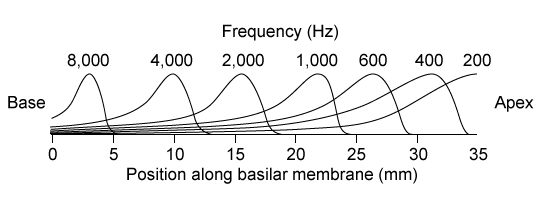 Figure 1 Amplitude pattern of the basilar membrane for different frequenciesPresbycusis (age-related hearing loss) results from a combination of factors that lessens an individual's mechanical and/or neurological sensitivity to sound. Pure tone audiometry (PTA) is used to determine an individual's ability to detect different sound frequencies and can be used to evaluate presbycusis. A "pure" tone is characterized by a single sinusoidal waveform. An audiogram plots the relative intensity required of a given frequency to be detected by the individual (Figure 2).
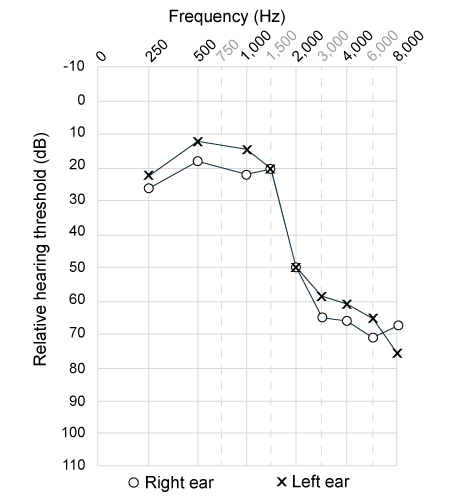 Figure 2 Audiogram of an elderly patient exhibiting presbycusis
-Hearing loss due to loud environments can be mitigated with noise-canceling earphones, which generate a waveform that reduces the intensity of ambient noise through wave interference.
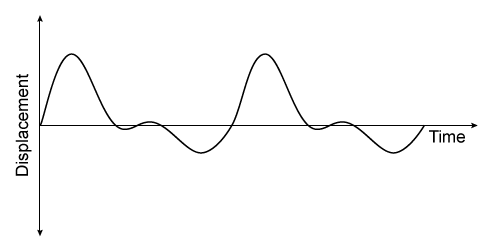 For the above sound wave, the waveform generated for complete noise cancellation will be:
Figure 1 Amplitude pattern of the basilar membrane for different frequenciesPresbycusis (age-related hearing loss) results from a combination of factors that lessens an individual's mechanical and/or neurological sensitivity to sound. Pure tone audiometry (PTA) is used to determine an individual's ability to detect different sound frequencies and can be used to evaluate presbycusis. A "pure" tone is characterized by a single sinusoidal waveform. An audiogram plots the relative intensity required of a given frequency to be detected by the individual (Figure 2).
Figure 2 Audiogram of an elderly patient exhibiting presbycusis
-Hearing loss due to loud environments can be mitigated with noise-canceling earphones, which generate a waveform that reduces the intensity of ambient noise through wave interference. For the above sound wave, the waveform generated for complete noise cancellation will be: (Multiple Choice)
4.8/5 (85)
(85) Passage
Laparoscopy is a minimally invasive surgical procedure where small surgical instruments are inserted into the body through cannulas (hollow tubes 0.5 to 1.0 cm in diameter). A cannula is inserted into the skin while sleeved around a trocar (Figure 1). The skin incision can be made directly with a sharp-tipped trocar as it is being inserted with the cannula. If a blunt-tipped trocar is used, the incision is made beforehand with a surgical blade. After insertion, the trocar is removed, leaving the cannula as an access point for laparoscopic procedures.
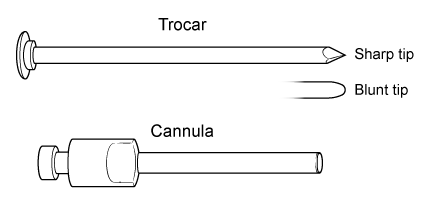 Figure 1 Cannula, trocar, and two types of tipsLow-friction trocars increase surgical precision and reduce postoperative scarring. Friction between the skin and trocar tip is tested with synthetic skin and a stationary ramp whose surface is made of the same material as the trocar. For testing, the synthetic skin is pressed against the ramp's surface by a load, weighted to allow the skin to slide down at a constant speed (Figure 2). In this setup, the weight of the synthetic skin layer is negligible.
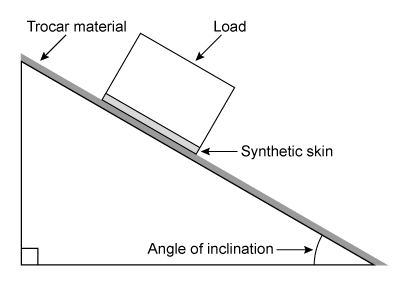 Figure 2 Experimental setup to test the friction between trocar and skin
Adapted from W. Firme-Gustavo et al., (C)2015 Society of Laparoendoscopic Surgeons.
-To remove the cannula at the end of a laparoscopy, the surgeon pulls on the cannula with increasing force. How does the frictional force vary with the applied pulling force before and after the cannula begins to slide?
Figure 1 Cannula, trocar, and two types of tipsLow-friction trocars increase surgical precision and reduce postoperative scarring. Friction between the skin and trocar tip is tested with synthetic skin and a stationary ramp whose surface is made of the same material as the trocar. For testing, the synthetic skin is pressed against the ramp's surface by a load, weighted to allow the skin to slide down at a constant speed (Figure 2). In this setup, the weight of the synthetic skin layer is negligible.
Figure 2 Experimental setup to test the friction between trocar and skin
Adapted from W. Firme-Gustavo et al., (C)2015 Society of Laparoendoscopic Surgeons.
-To remove the cannula at the end of a laparoscopy, the surgeon pulls on the cannula with increasing force. How does the frictional force vary with the applied pulling force before and after the cannula begins to slide? (Multiple Choice)
4.8/5 (94)
(94) Which of the following spherical mirrors produces a virtual image from the given light rays and has the larger radius of curvature?
(Multiple Choice)
5.0/5 (78)
(78) Passage
The effects of gravity are effectively negated if an object is in free fall. For example, an object orbiting the Earth experiences an apparent weightlessness known as microgravity. Because the human body evolved under the influence of Earth's gravity, human physiology undergoes several changes in microgravity environments. Puffy face syndrome (PFS) occurs when an astronaut's extracellular fluid shifts toward upper body regions, resulting in facial bulging and leg shrinkage. Elongation of the spinal column also occurs as intervertebral discs (spinal cartilage) decompress, making astronauts up to 6 cm taller.Researchers simulated microgravity-induced spinal elongation on Earth by suspending 50 volunteers by the arms, holding each above the ground in an upright position. The thickness of each intervertebral disc was measured prior to and following 10 minutes of suspension. Researchers then compared the percentage change in intervertebral disc thickness to similar measurements recorded in microgravity, as shown in Figure 1.
Figure 1 Percentage change in intervertebral disc thicknessIn theory, spinal elongation would also occur in reduced-gravity environments like the surface of the Moon, where the acceleration of gravity is one-sixth that observed on the Earth's surface.
-A volunteer with a mass of 80 kg is suspended by his arms on Earth. What is the approximate tension on lumbar disc 1? (Note: The acceleration of gravity is g = 10 m/s2)
Figure 1 Percentage change in intervertebral disc thicknessIn theory, spinal elongation would also occur in reduced-gravity environments like the surface of the Moon, where the acceleration of gravity is one-sixth that observed on the Earth's surface.
-A volunteer with a mass of 80 kg is suspended by his arms on Earth. What is the approximate tension on lumbar disc 1? (Note: The acceleration of gravity is g = 10 m/s2) (Multiple Choice)
4.9/5 (76)
(76) Passage
For a person with perfect vision, light from an object is properly refracted by the eye lens to converge on a single point at the retina, forming a clear image of the object. Vision defects result from eye shape abnormalities or errors in the refractive power of the eye lens. Myopia (nearsightedness) occurs when light from a distant object is incorrectly focused in front of the retina. Hyperopia (farsightedness) occurs when light rays from a nearby object are focused beyond the retina.Many optical techniques are available to measure the refractive error of an individual to determine the necessary correction. Photorefraction is a photographic technique often used with young children because it does not require the individual to be still for a lengthy duration. When the patient is looking at the camera, a flash photograph is taken of the eye to determine the amount of light that is reflected off the retina and captured by the camera lens.In healthy eyes, all the light from the flash that enters the eye is reflected off the retina and returns back to the camera's light source. Because the camera lens does not receive this light, the pupil is completely dark in the resulting image. A myopic eye cannot properly focus the light at the retina. Due to the geometry of the eye and its lens, some of the light is reflected to the top portion of the camera lens. The camera captures an image of a pupil with a crescent of light at the top. In a hyperopic eye, the crescent appears at the bottom of the pupil. Ray diagrams for photorefraction are shown in Figure 1.
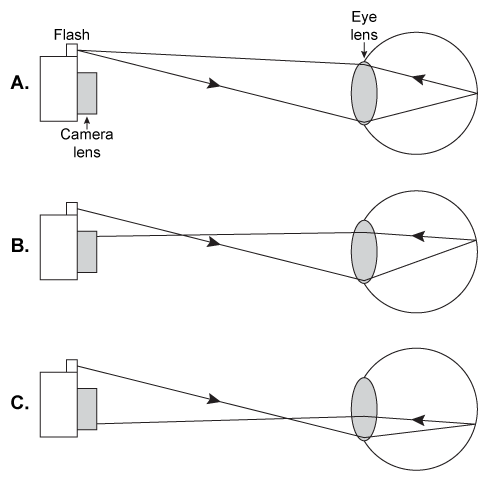 Figure 1 Paths of light in photorefraction for different eyes: (A) Healthy, (B) Myopic, and (C) Hyperopic.
HC. Howland, "Optics of photorefraction: orthogonal and isotropic methods." ©1983 Optical Society of America.
-Myopia can be corrected with a:
Figure 1 Paths of light in photorefraction for different eyes: (A) Healthy, (B) Myopic, and (C) Hyperopic.
HC. Howland, "Optics of photorefraction: orthogonal and isotropic methods." ©1983 Optical Society of America.
-Myopia can be corrected with a: (Multiple Choice)
4.9/5 (77)
(77) Passage
Ultrasound is a technique that uses the propagation properties of high-frequency sound waves to construct images of internal organs or to measure blood flow velocity. The shape and position of internal organs are resolved by measuring the return time of reflected ultrasound waves. Similarly, blood flow velocity is resolved by measuring the Doppler shift of reflected ultrasound waves. An ultrasound device consists of an array of piezoelectric crystals and an acoustic lens. The piezoelectric crystals generate sound when an alternating voltage is applied, and the acoustic lens increases the transmission efficiency from the device to the body by reducing sound reflection at the skin.Ultrasound is performed using frequencies in the range of 2-15 MHz. The lower ultrasound frequencies are used for deep abdomen and obstetric/gynecological imaging due to their greater penetrating ability. The higher ultrasound frequencies have less penetrating ability but provide higher resolution, and therefore are used for blood flow measurements and the imaging of more superficial structures. Detailed ultrasound penetration data is shown in Figure 1.
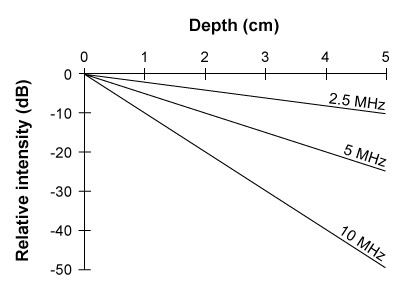 Figure 1 Penetration in soft tissue for three different ultrasound frequenciesSound waves propagate through soft tissue at an average speed of 1,500 m/s and through blood at 1,570 m/s.
-What is the period of an ultrasound signal that is attenuated by 20 dB after it travels 4 cm into soft tissue?
Figure 1 Penetration in soft tissue for three different ultrasound frequenciesSound waves propagate through soft tissue at an average speed of 1,500 m/s and through blood at 1,570 m/s.
-What is the period of an ultrasound signal that is attenuated by 20 dB after it travels 4 cm into soft tissue? (Multiple Choice)
4.9/5 (81)
(81) Passage
A traumatic brain injury (TBI) is a form of brain injury caused by an external physical force. In addition to direct injury at the site of an impact, the rapid acceleration-deceleration of the head may cause the brain to move within the skull and result in injury to the part of the brain opposite the impact site. This is known as a contrecoup injury.If an impact to the head also results in a skull fracture, the injury is classified as an open TBI. If there is no skull fracture, the injury is classified as a closed TBI. The type of TBI can be predicted from the collision duration and the average acceleration of the head. The thresholds for open and closed TBI are shown in Figure 1.
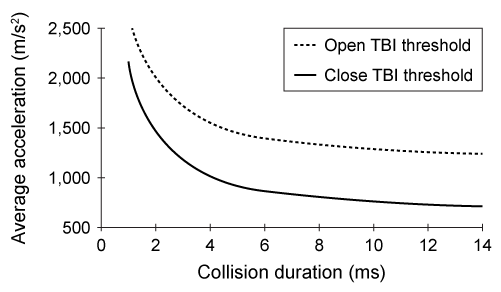 Figure 1 Thresholds for open and closed TBIIn an experiment to study head collisions with projectiles, researchers equipped the head of a crash test dummy with sensors that measured acceleration on multiple axes. The crash test dummy was stationary before its head was subjected to controlled collisions with incoming projectiles of varying mass and impact velocity. The linear acceleration of the crash test dummy's head was recorded during and after the impact. The results for a trial in which the impact lasted for 10 ms are shown in Figure 2.
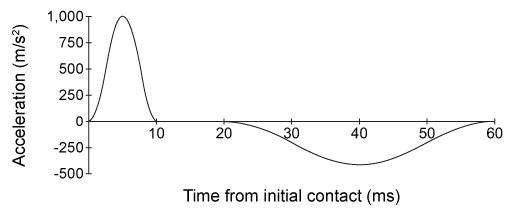 Figure 2 The acceleration of the head during and after a 10-ms collision
-Suppose the physical characteristics of the crash test dummy accurately represent those of a human. What is the expected injury of the impact shown in Figure 2 if the head accelerated to 10 m/s at the end of the impact?
Figure 1 Thresholds for open and closed TBIIn an experiment to study head collisions with projectiles, researchers equipped the head of a crash test dummy with sensors that measured acceleration on multiple axes. The crash test dummy was stationary before its head was subjected to controlled collisions with incoming projectiles of varying mass and impact velocity. The linear acceleration of the crash test dummy's head was recorded during and after the impact. The results for a trial in which the impact lasted for 10 ms are shown in Figure 2.
Figure 2 The acceleration of the head during and after a 10-ms collision
-Suppose the physical characteristics of the crash test dummy accurately represent those of a human. What is the expected injury of the impact shown in Figure 2 if the head accelerated to 10 m/s at the end of the impact? (Multiple Choice)
4.8/5 (72)
(72) Passage
In mass spectrometry, a sample's molecules are ionized in a vacuum and then exposed to a uniform electric field created by a high-voltage plate in the acceleration chamber. The electric field accelerates the ions until they arrive at the next section of the device, designated as the separation chamber. In this section, the drifting ions are sorted by their mass-to-charge ratio (m/q).The separation chamber in a time-of-flight mass spectrometer (TOF-MS) is linear and has no electric or magnetic fields. The ions travel at a constant velocity through the chamber until they reach the detector. The time it takes for an ion to reach the detector depends on its m/q ratio.
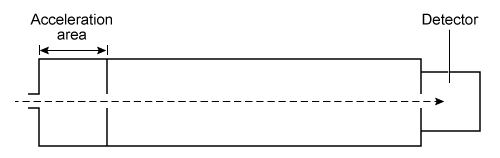 Figure 1 Time-of-flight mass spectrometerA magnetic sector mass spectrometer (MS-MS) has a curved separation chamber where a magnetic field is generated. The magnetic field exerts a centripetal force on drifting ions, bending their trajectories into curved paths. The radius of the curvature depends on the ion's m/q.
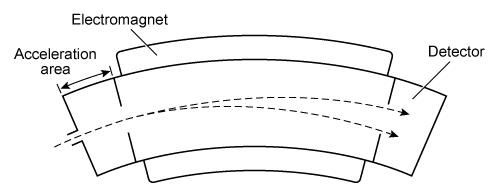 Figure 2 Magnetic sector mass spectrometerThe centripetal force (F) acting on a particle can be determined from its mass (m) and velocity (v) and the radius (r) of the curved path:F = mv2/rEquation 1
-What is the force felt by a doubly ionized particle in a 2,000-N/C electric field? (Note: The charge of an electron is e = 1.6 × 10⁻¹⁹ C.)
Figure 1 Time-of-flight mass spectrometerA magnetic sector mass spectrometer (MS-MS) has a curved separation chamber where a magnetic field is generated. The magnetic field exerts a centripetal force on drifting ions, bending their trajectories into curved paths. The radius of the curvature depends on the ion's m/q.
Figure 2 Magnetic sector mass spectrometerThe centripetal force (F) acting on a particle can be determined from its mass (m) and velocity (v) and the radius (r) of the curved path:F = mv2/rEquation 1
-What is the force felt by a doubly ionized particle in a 2,000-N/C electric field? (Note: The charge of an electron is e = 1.6 × 10⁻¹⁹ C.) (Multiple Choice)
4.9/5 (69)
(69) Passage
The effects of gravity are effectively negated if an object is in free fall. For example, an object orbiting the Earth experiences an apparent weightlessness known as microgravity. Because the human body evolved under the influence of Earth's gravity, human physiology undergoes several changes in microgravity environments. Puffy face syndrome (PFS) occurs when an astronaut's extracellular fluid shifts toward upper body regions, resulting in facial bulging and leg shrinkage. Elongation of the spinal column also occurs as intervertebral discs (spinal cartilage) decompress, making astronauts up to 6 cm taller.Researchers simulated microgravity-induced spinal elongation on Earth by suspending 50 volunteers by the arms, holding each above the ground in an upright position. The thickness of each intervertebral disc was measured prior to and following 10 minutes of suspension. Researchers then compared the percentage change in intervertebral disc thickness to similar measurements recorded in microgravity, as shown in Figure 1.
Figure 1 Percentage change in intervertebral disc thicknessIn theory, spinal elongation would also occur in reduced-gravity environments like the surface of the Moon, where the acceleration of gravity is one-sixth that observed on the Earth's surface.
-According to the passage, which of the following changes as an astronaut leaves Earth's surface and enters orbit?
Figure 1 Percentage change in intervertebral disc thicknessIn theory, spinal elongation would also occur in reduced-gravity environments like the surface of the Moon, where the acceleration of gravity is one-sixth that observed on the Earth's surface.
-According to the passage, which of the following changes as an astronaut leaves Earth's surface and enters orbit? (Multiple Choice)
4.9/5 (77)
(77) A large number of monoatomic ideal gas molecules are stored within a closed container at a temperature of 200 K. What is the average translational kinetic energy of the individual gas molecules? (Note: Use Boltzmann's constant k = 1.381 × 10⁻²³ J/K.)
(Multiple Choice)
4.8/5 (77)
(77) Passage
Cable theory is a mathematical model used to calculate currents and voltages along and across axon membranes. The model treats small sections of the membrane as the resistor-capacitor circuit shown in Figure 1. An electric neuronal signal enters the circuit through the input node. A portion of the signal remains inside the axon and continues to the next section of membrane via Output 1, and the rest of the signal exits to the extracellular fluid via Output 2.
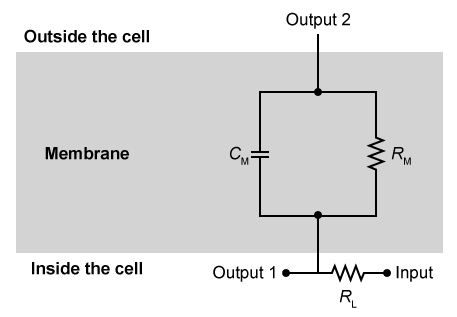 Figure 1 Circuit unit used to model axon membranesResearchers studied cable theory by recreating the circuit in Figure 1 using a 2 μF capacitor for CM, a 200 Ω resistor for RM, and a 1,000 Ω resistor for RL. The researchers sent an electrical signal through the input and discovered that the capacitor acted as a resistor whose resistance varied with the signal's frequency, as shown in Figure 2.
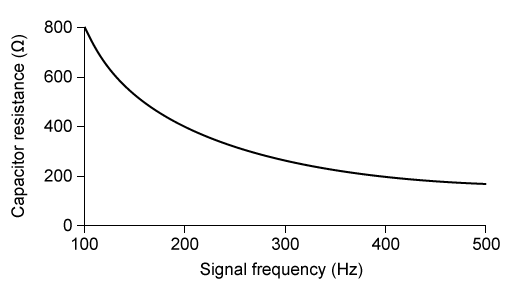 Figure 2 Capacitor equivalent resistance vs. signal frequency for CM
Adapted from Tuckwell H, Introduction to Theoretical Neurobiology 2006 SIAM.
-Adding two 1,000 Ω resistors in series with RL would be equivalent to:
Figure 1 Circuit unit used to model axon membranesResearchers studied cable theory by recreating the circuit in Figure 1 using a 2 μF capacitor for CM, a 200 Ω resistor for RM, and a 1,000 Ω resistor for RL. The researchers sent an electrical signal through the input and discovered that the capacitor acted as a resistor whose resistance varied with the signal's frequency, as shown in Figure 2.
Figure 2 Capacitor equivalent resistance vs. signal frequency for CM
Adapted from Tuckwell H, Introduction to Theoretical Neurobiology 2006 SIAM.
-Adding two 1,000 Ω resistors in series with RL would be equivalent to: (Multiple Choice)
4.7/5 (84)
(84) Passage
The electric capacitance of biological tissues serves as the basis for numerous medical technologies. For example, dielectric spectroscopy glucose reading (DSGR) is a noninvasive diagnostic technique that uses the electric capacitance of blood to estimate blood glucose levels.A DSGR device records the electric current that results from applying a voltage source to the skin and underlying blood vessels. DSGR can be modeled by the circuit shown in Figure 1, in which V represents the applied potential, CB represents the capacitance of the blood, and RE, RD, and RB represent the electrical resistances of the epidermis, the dermis, and the blood, respectively.
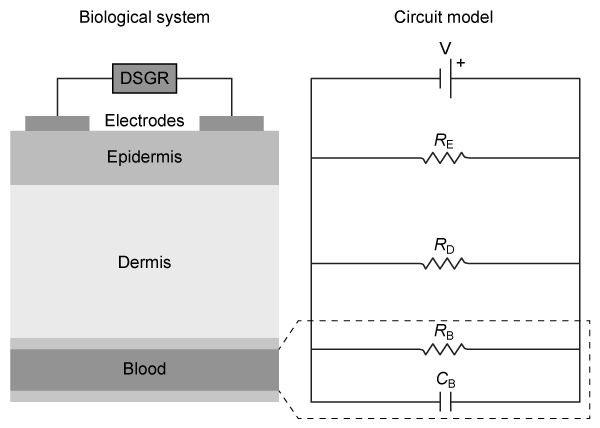 Figure 1 DSGR circuit model including skin and superficial blood vesselThe capacitance of charged blood may be explained by red blood cell membranes acting as physical barriers that separate electrons introduced into the blood from positively charged ions in the red blood cell cytoplasm. The dielectric constant k of red blood cell membranes varies with glucose concentration (Figure 2) because glucose uptake by red blood cells alters the activity of membrane-bound proteins that regulate the flow of ions into and out of the cell.
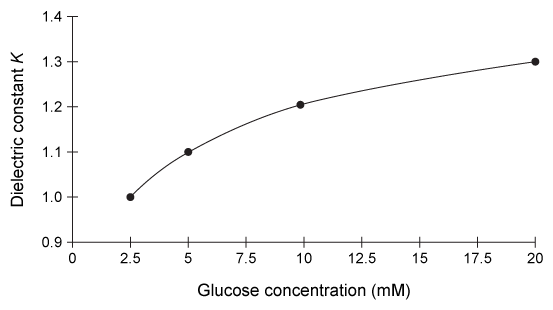 Figure 2 Blood dielectric constant vs blood glucose concentrationDSGR readings vary with blood glucose concentration because the time needed to fully charge the blood is related to total blood capacitance. However, interpreting DSGR readings may be complicated by changes in biological variables other than blood capacitance. For example, the resistivity of blood varies in accordance with osmolarity such that changes in diet or hydration status influence the current measured by DSGR devices.
Livshits, L. et al. Dielectric response of biconcave erythrocyte membranes to D- and L-glucose. J. Phys. D: Appl. Phys. 40 (2007), 15-19.
-Which of the following statements best describes the behavior of the circuit in Figure 1 when the fully charged capacitor (comprising red blood cells) is discharged?
Figure 1 DSGR circuit model including skin and superficial blood vesselThe capacitance of charged blood may be explained by red blood cell membranes acting as physical barriers that separate electrons introduced into the blood from positively charged ions in the red blood cell cytoplasm. The dielectric constant k of red blood cell membranes varies with glucose concentration (Figure 2) because glucose uptake by red blood cells alters the activity of membrane-bound proteins that regulate the flow of ions into and out of the cell.
Figure 2 Blood dielectric constant vs blood glucose concentrationDSGR readings vary with blood glucose concentration because the time needed to fully charge the blood is related to total blood capacitance. However, interpreting DSGR readings may be complicated by changes in biological variables other than blood capacitance. For example, the resistivity of blood varies in accordance with osmolarity such that changes in diet or hydration status influence the current measured by DSGR devices.
Livshits, L. et al. Dielectric response of biconcave erythrocyte membranes to D- and L-glucose. J. Phys. D: Appl. Phys. 40 (2007), 15-19.
-Which of the following statements best describes the behavior of the circuit in Figure 1 when the fully charged capacitor (comprising red blood cells) is discharged? (Multiple Choice)
4.8/5 (68)
(68) Which of the following expressions correctly compares the energies of visible light (Evisible), microwaves (Emicrowave), and radio waves (Eradio)?
(Multiple Choice)
4.8/5 (79)
(79) Passage
In hemodynamics, blood flow through the cardiovascular system can be modeled as an electric circuit in which the blood serves as electricity, the blood vessels as resistive wires, and the heart as a battery (see Figure 1).
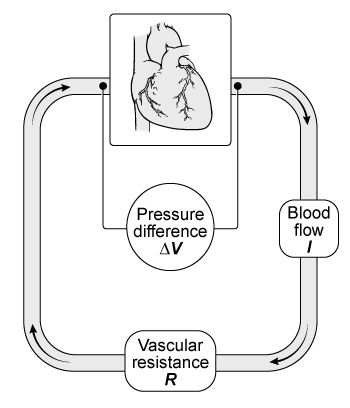 Figure 1 Cardiovascular circuit modelOhm's law states that the voltage drop ΔV across each element, the current I flowing through it, and its electrical resistance R are related by ΔV = IR. In a blood vessel, pressure difference between one vessel and the next ΔP replaces ΔV, volumetric blood flow Q replaces I, and vascular resistance R replaces electrical resistance. Therefore, Ohm's law for blood flow in a vessel isΔP = QREquation 1Vascular resistance is due to the blood's viscosity η and the dimensions of the vessel through which it flows. Assuming blood vessels are cylinders, R can be approximated as
 Equation 2where L is the length of the vessel, and r is its inner radius. If Equation 2 is combined with Equation 1, the resulting equation is Poiseuille law.In a study of the circulatory system in rats, researchers measured the intravascular blood pressure of the mesenteric blood vessels. The mesentery is the set of tissues that holds the intestines in place. Blood flows in the following order: aorta, superior mesenteric artery (SMA), arterial arcade, venous arcade, superior mesenteric vein (SMV).For the procedure, catheters with pressure transducers were inserted into each vessel via laparotomy. Laparotomy is an invasive procedure that involves a surgical incision into the abdominal cavity. Blood pressure measurements were taken simultaneously at the proximal end (beginning) of each blood vessel.
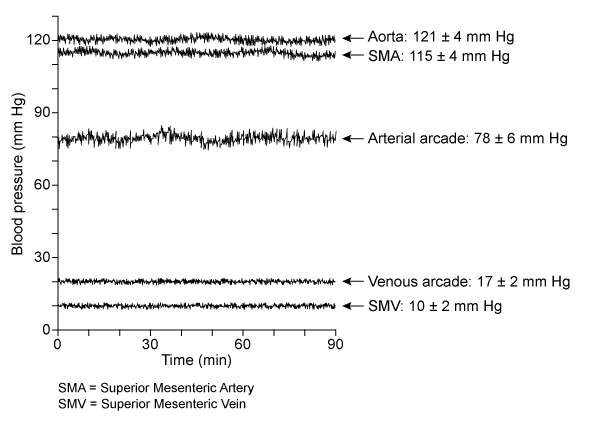 Figure 2 Mesenteric blood pressure profile of rats (Note: SMA = superior mesenteric artery; SMV = superior mesenteric vein.)
-Which change would result in the greatest decrease in the volumetric blood flow rate within a mesenteric vessel?
Figure 1 Cardiovascular circuit modelOhm's law states that the voltage drop ΔV across each element, the current I flowing through it, and its electrical resistance R are related by ΔV = IR. In a blood vessel, pressure difference between one vessel and the next ΔP replaces ΔV, volumetric blood flow Q replaces I, and vascular resistance R replaces electrical resistance. Therefore, Ohm's law for blood flow in a vessel isΔP = QREquation 1Vascular resistance is due to the blood's viscosity η and the dimensions of the vessel through which it flows. Assuming blood vessels are cylinders, R can be approximated as
Equation 2where L is the length of the vessel, and r is its inner radius. If Equation 2 is combined with Equation 1, the resulting equation is Poiseuille law.In a study of the circulatory system in rats, researchers measured the intravascular blood pressure of the mesenteric blood vessels. The mesentery is the set of tissues that holds the intestines in place. Blood flows in the following order: aorta, superior mesenteric artery (SMA), arterial arcade, venous arcade, superior mesenteric vein (SMV).For the procedure, catheters with pressure transducers were inserted into each vessel via laparotomy. Laparotomy is an invasive procedure that involves a surgical incision into the abdominal cavity. Blood pressure measurements were taken simultaneously at the proximal end (beginning) of each blood vessel.
Figure 2 Mesenteric blood pressure profile of rats (Note: SMA = superior mesenteric artery; SMV = superior mesenteric vein.)
-Which change would result in the greatest decrease in the volumetric blood flow rate within a mesenteric vessel? (Multiple Choice)
4.8/5 (76)
(76) Passage
Osteoporosis is a degenerative bone condition in which healthy bone degenerates into porous bone. Because bone provides the structural integrity that allows the musculoskeletal system to bear weight, osteoporosis is associated with a higher risk of bone fracture.Researchers conducted an experiment designed to assess the strength and elasticity of osteoporotic bone relative to normal bone. Osteoporotic and normal bone samples with identical physical dimensions were collected and placed within an pneumatic compression device, as shown in Figure 1.
Figure 1 Bone compression device loaded with a bone sampleThe force required to compress the bone samples longitudinally (lengthwise) by a given distance was measured, with the results shown in Figure 2.
Figure 2 Relationship between force and compression for normal and osteoporotic bonesResearchers observed that bone samples returned to their original dimensions for deformations not exceeding 1% of the original length L0. For each deformation, the associated strain ε is defined as the change in length of an object ΔL divided by the object's original length (Equation 1).
Equation 1Based on these observations, researchers concluded that both osteoporotic bone and normal bone behaved as an elastic material under a wide range of applied forces.
-What is the pressure required to compress a normal bone sample by 1.5 mm? (Note: The cross-sectional area of bone samples used in the experiment is 10 mm2.)
Figure 1 Bone compression device loaded with a bone sampleThe force required to compress the bone samples longitudinally (lengthwise) by a given distance was measured, with the results shown in Figure 2.
Figure 2 Relationship between force and compression for normal and osteoporotic bonesResearchers observed that bone samples returned to their original dimensions for deformations not exceeding 1% of the original length L0. For each deformation, the associated strain ε is defined as the change in length of an object ΔL divided by the object's original length (Equation 1).
Equation 1Based on these observations, researchers concluded that both osteoporotic bone and normal bone behaved as an elastic material under a wide range of applied forces.
-What is the pressure required to compress a normal bone sample by 1.5 mm? (Note: The cross-sectional area of bone samples used in the experiment is 10 mm2.) (Multiple Choice)
4.8/5 (80)
(80) 
Filters
- Essay(0)
- Multiple Choice(0)
- Short Answer(0)
- True False(0)
- Matching(0)