Multiple Choice
Passage
Osteoporosis is a degenerative bone condition in which healthy bone degenerates into porous bone. Because bone provides the structural integrity that allows the musculoskeletal system to bear weight, osteoporosis is associated with a higher risk of bone fracture.Researchers conducted an experiment designed to assess the strength and elasticity of osteoporotic bone relative to normal bone. Osteoporotic and normal bone samples with identical physical dimensions were collected and placed within an pneumatic compression device, as shown in Figure 1.
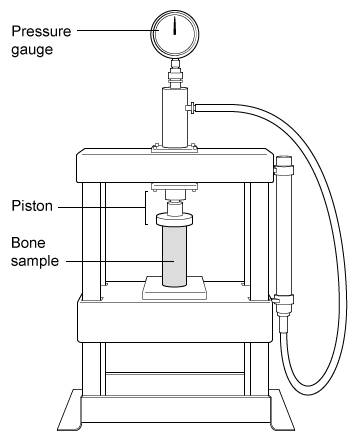 Figure 1 Bone compression device loaded with a bone sampleThe force required to compress the bone samples longitudinally (lengthwise) by a given distance was measured, with the results shown in Figure 2.
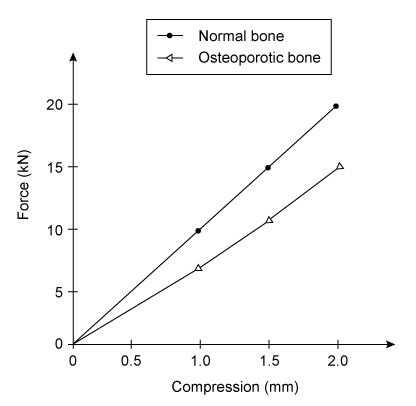 Figure 2 Relationship between force and compression for normal and osteoporotic bonesResearchers observed that bone samples returned to their original dimensions for deformations not exceeding 1% of the original length L0. For each deformation, the associated strain ε is defined as the change in length of an object ΔL divided by the object's original length (Equation 1) .
 Equation 1Based on these observations, researchers concluded that both osteoporotic bone and normal bone behaved as an elastic material under a wide range of applied forces.
-What is the pressure required to compress a normal bone sample by 1.5 mm? (Note: The cross-sectional area of bone samples used in the experiment is 10 mm2.)
A) 1.10 kN/mm2
B) 1.50 kN/mm2
C) 110 kN/mm2
D) 150 kN/mm2
Correct Answer:

Verified
Correct Answer:
Verified
Q135: A large number of monoatomic ideal gas
Q136: Passage<br>Cable theory is a mathematical model used
Q137: Passage<br>The electric capacitance of biological tissues serves
Q138: Which of the following expressions correctly compares
Q139: Passage<br>In hemodynamics, blood flow through the cardiovascular
Q141: Passage<br>Sound waves propagate through many conducting structures
Q142: Passage<br>Ultrasound is a technique that uses the
Q143: Passage<br>Black holes have played an important part
Q144: Light from an incandescent lightbulb passes through
Q145: Compared to other diffraction techniques, the advantage