Multiple Choice
Passage
Sound waves propagate through many conducting structures in the ear before they are transduced into neuronal signals. When sound waves reach the fluid-filled cochlea, they are detected by hair cells lining the basilar membrane. The cochlear spiral can be modeled as a resonator system because each section of the basilar membrane is sensitive to a specific frequency (Figure 1) .
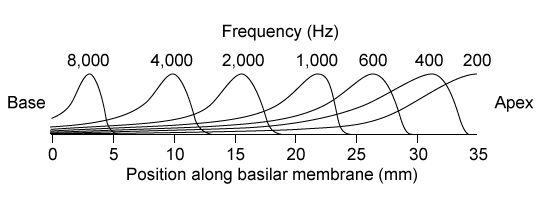 Figure 1 Amplitude pattern of the basilar membrane for different frequenciesPresbycusis (age-related hearing loss) results from a combination of factors that lessens an individual's mechanical and/or neurological sensitivity to sound. Pure tone audiometry (PTA) is used to determine an individual's ability to detect different sound frequencies and can be used to evaluate presbycusis. A "pure" tone is characterized by a single sinusoidal waveform. An audiogram plots the relative intensity required of a given frequency to be detected by the individual (Figure 2) .
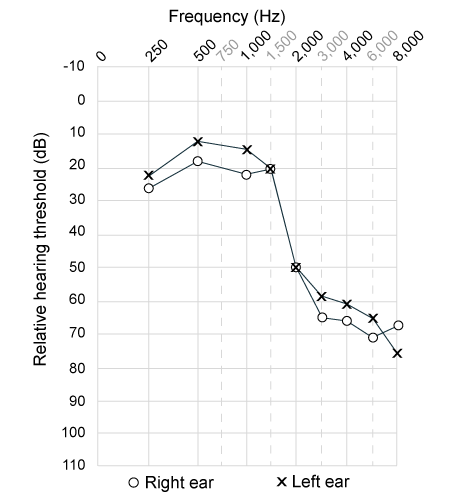 Figure 2 Audiogram of an elderly patient exhibiting presbycusis
-Audiometry can also be used to evaluate a subject's ability to localize a moving sound source. When the sound source is moving toward the subject, which of the following increases?
A) The observed wave velocity
B) The observed period
C) The observed frequency
D) The observed wavelength
Correct Answer:

Verified
Correct Answer:
Verified
Q136: Passage<br>Cable theory is a mathematical model used
Q137: Passage<br>The electric capacitance of biological tissues serves
Q138: Which of the following expressions correctly compares
Q139: Passage<br>In hemodynamics, blood flow through the cardiovascular
Q140: Passage<br>Osteoporosis is a degenerative bone condition in
Q142: Passage<br>Ultrasound is a technique that uses the
Q143: Passage<br>Black holes have played an important part
Q144: Light from an incandescent lightbulb passes through
Q145: Compared to other diffraction techniques, the advantage
Q146: Passage<br>Black holes have played an important part