Multiple Choice
Passage
Ultrasound is a technique that uses the propagation properties of high-frequency sound waves to construct images of internal organs or to measure blood flow velocity. The shape and position of internal organs are resolved by measuring the return time of reflected ultrasound waves. Similarly, blood flow velocity is resolved by measuring the Doppler shift of reflected ultrasound waves. An ultrasound device consists of an array of piezoelectric crystals and an acoustic lens. The piezoelectric crystals generate sound when an alternating voltage is applied, and the acoustic lens increases the transmission efficiency from the device to the body by reducing sound reflection at the skin.Ultrasound is performed using frequencies in the range of 2-15 MHz. The lower ultrasound frequencies are used for deep abdomen and obstetric/gynecological imaging due to their greater penetrating ability. The higher ultrasound frequencies have less penetrating ability but provide higher resolution, and therefore are used for blood flow measurements and the imaging of more superficial structures. Detailed ultrasound penetration data is shown in Figure 1.
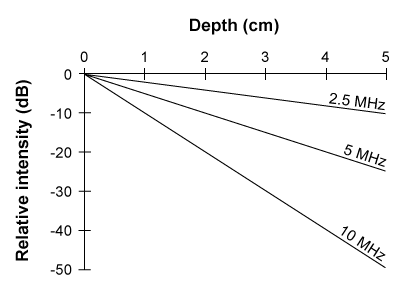 Figure 1 Penetration in soft tissue for three different ultrasound frequenciesSound waves propagate through soft tissue at an average speed of 1,500 m/s and through blood at 1,570 m/s.
-How much farther will a 5 MHz signal penetrate compared to a 10 MHz signal when the initial intensity of each signal decreases by a factor of 100?
A) 1 cm
B) 2 cm
C) 4 cm
D) 10 cm
Correct Answer:

Verified
Correct Answer:
Verified
Q137: Passage<br>The electric capacitance of biological tissues serves
Q138: Which of the following expressions correctly compares
Q139: Passage<br>In hemodynamics, blood flow through the cardiovascular
Q140: Passage<br>Osteoporosis is a degenerative bone condition in
Q141: Passage<br>Sound waves propagate through many conducting structures
Q143: Passage<br>Black holes have played an important part
Q144: Light from an incandescent lightbulb passes through
Q145: Compared to other diffraction techniques, the advantage
Q146: Passage<br>Black holes have played an important part
Q147: Passage<br>In hemodynamics, blood flow through the cardiovascular