



 Chat with AI
Exam 21: International Trade and Finance

Exam 1: Introducing the Economic Way of Thinking254 Questions
Exam 2: Production Possibilities, Opportunity Cost, and Economic Growth209 Questions
Exam 3: Market Demand and Supply361 Questions
Exam 4: Markets in Action259 Questions
Exam 5: Price Elasticity of Demand181 Questions
Exam 6: Production Costs254 Questions
Exam 7: Perfect Competition226 Questions
Exam 8: Monopoly175 Questions
Exam 9: Monopolistic Competition and Oligopoly166 Questions
Exam 10: Labor Markets and Income Distribution185 Questions
Exam 11: Gross Domestic Product207 Questions
Exam 12: Business Cycles and Unemployment199 Questions
Exam 13: Inflation131 Questions
Exam 14: Aggregate Demand and Supply83 Questions
Exam 15: Fiscal Policy205 Questions
Exam 16: The Public Sector131 Questions
Exam 17: Federal Deficits, Surpluses, and the National Debt102 Questions
Exam 18: Money and the Federal Reserve System159 Questions
Exam 19: Money Creation250 Questions
Exam 20: Policy Disputes Using the Self-Correcting Aggregate Demand and Supply Model246 Questions
Exam 21: International Trade and Finance251 Questions
Exam 22: Economies in Transition108 Questions
Exam 23: Growth and the Less-Developed Countries121 Questions
Select questions type


If a hotel room priced at 120,000 Venezuela bolivar per night can be purchased for 80 U.S. dollars, the exchange rate is:
(Multiple Choice)
4.9/5  (87)
(87) If a country has a comparative advantage in the production of all goods, it should:
(Multiple Choice)
4.7/5 (79)
(79) An increase in the price level in Japan relative to the price level in the United States will shift the demand curve for dollars leftward and the dollar depreciates or becomes weaker.
(True/False)
4.7/5 (79)
(79) A major difference between a tariff and a quota is that a tariff:
(Multiple Choice)
4.7/5 (74)
(74) Which of the following transactions would be excluded in the capital account?
(Multiple Choice)
4.9/5 (97)
(97) It is possible for the balance of trade to be negative, and the current account to be positive.
(True/False)
4.9/5 (87)
(87) If the exchange rate between the yen and the dollar changes from 110 yen = $1 to 100 yen = $1, then:
(Multiple Choice)
4.8/5 (74)
(74) If goods imports are greater than goods exports, the nation is experiencing a:
(Multiple Choice)
4.9/5 (85)
(85) Comparative advantage explains why a nation will benefit from trade when:
(Multiple Choice)
4.9/5 (85)
(85) Exhibit 21-1 Production possibilities curves 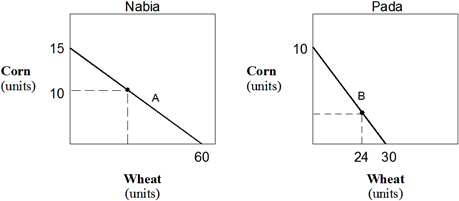 In Exhibit 21-1, the production possibilities curves of wheat and corn for Nabia and Pada are presented. Suppose Pada produces at point B on its PPC. How much corn is the country able to produce?
 (Multiple Choice)
4.7/5 (82)
(82) Tariffs help consumers by lowering the price of imported goods.
(True/False)
4.9/5 (87)
(87) If Japan gives up ten bushels of rice to produce one bicycle, while the United States gives up five bushels of rice to produce one bicycle, then:
(Multiple Choice)
4.9/5 (88)
(88) Which of the following would cause the supply of dollars curve in the United States to shift to the right?
(Multiple Choice)
4.8/5 (90)
(90) Exhibit 21-4 Coffee and tea output (pounds per hour) 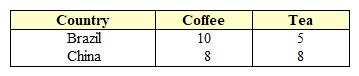 As shown in Exhibit 21-4, the opportunity cost to Brazil of producing one pound of coffee is:
 (Multiple Choice)
4.9/5 (67)
(67) If India has an absolute advantage in rug production when compared to England, then:
(Multiple Choice)
4.8/5 (76)
(76) Suppose Japan has a comparative advantage over Canada in the production of VCRs. This means that Japan:
(Multiple Choice)
4.9/5 (71)
(71) 
Filters
- Essay(0)
- Multiple Choice(0)
- Short Answer(0)
- True False(0)
- Matching(0)